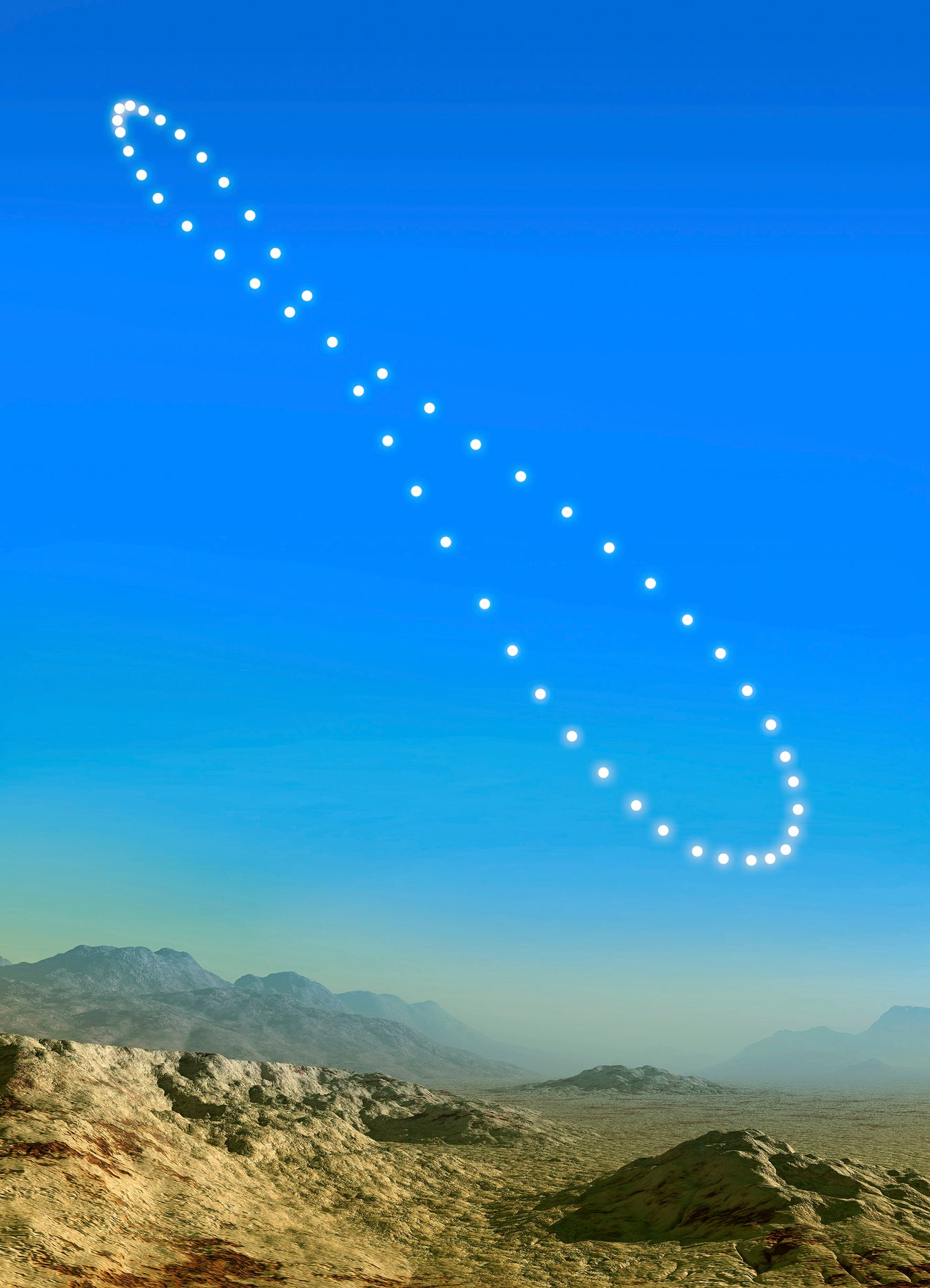
The Sun does not appear at exactly the same point in the sky at the same clock time every day. Record its position repeatedly over a full year and the dots trace a stretched figure-8 called an analemma.
A 2026 NASA Astronomy Picture of the Day placed this yearly solar pattern above the Callanish Stones in Scotland, combining a modern astronomical demonstration with a Bronze Age landscape.
What an analemma is
An analemma is the apparent yearly path of the Sun when photographed from the same location at the same clock time on many different days.
Why the shape is a figure-8
Two effects combine: Earth’s axis is tilted relative to its orbital plane, and Earth’s orbit around the Sun is slightly elliptical.

What solstices and equinoxes do to the pattern
The Sun appears near the upper or lower extremes of the analemma around the solstices. Equinox positions fall near the middle portions of the curve.
Why the Sun shifts even at the same clock time
Earth’s orbital speed changes slightly through the year and the tilted axis changes how solar motion projects onto our sky. Together these effects create the equation of time.

What the Callanish Stones add to the image
The stone circle was built around 2700 BC. NASA notes that it is not known whether its placement had astronomical significance, so the image should not be taken as proof that the stones were designed as an observatory.
FAQ
Does the Sun really move in a figure-8 through space?
No. The figure-8 is the Sun’s apparent position in our sky when measured at the same clock time throughout the year.
How long does it take to photograph an analemma?
A complete one requires observations spread across roughly a full year.
What causes the shape?
Earth’s axial tilt and the ellipticity of its orbit.
Were the Callanish Stones definitely built for astronomy?
NASA’s APOD notes that the astronomical significance of their placement is not known.