
The Cocoon Nebula looks like a bright island embedded in a river of dark dust. Its glow comes from a young stellar environment where radiation, gas and dust are interacting.
The wide view is especially useful because it shows that the bright nebula is only one part of a much larger cloud complex. Long dark filaments extend away from the colorful center and hide stars that are still forming.
What makes the Cocoon Nebula glow
Young energetic stars illuminate and ionize surrounding material. Some light is emitted by gas, while some is reflected by dust.
Why the wide-field view matters
A close-up can hide the connection between the bright nebula and the surrounding dark molecular cloud. Wide-field imaging reveals the larger structure.
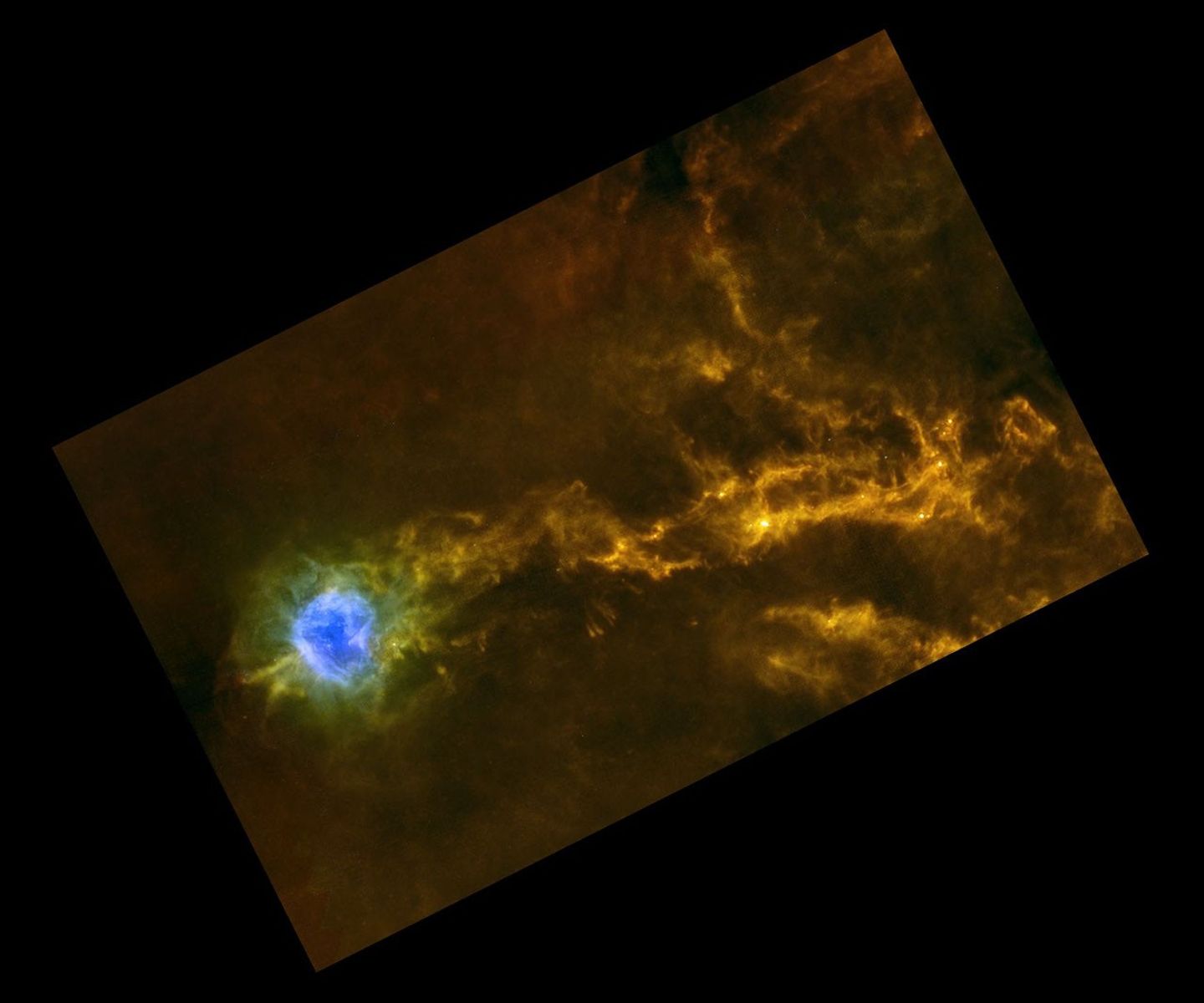
The dark tail is full of material
The long dark lane blocks visible background starlight because it contains dense interstellar dust. Inside those dusty regions, new stars can be hidden from ordinary visible-light observations.
How infrared astronomy changes the view
Infrared telescopes can see through more dust than visible-light cameras. Observations by missions such as Herschel have shown networks of filaments associated with star formation in the IC 5146 cloud.

What the central star is doing
A bright star near the nebula’s center provides energy to surrounding gas and helps clear a cavity in the cloud, changing the local environment as the young cluster evolves.
FAQ
What is the Cocoon Nebula’s catalog number?
IC 5146.
How far away is it?
NASA’s 2026 APOD description places the Cocoon Nebula and associated cloud at about 2,500 light-years away.
Why are parts of the image dark?
Dense dust blocks visible light from stars behind the cloud.
Are stars still forming there?
Yes. The dusty filaments contain regions where stars are forming.