
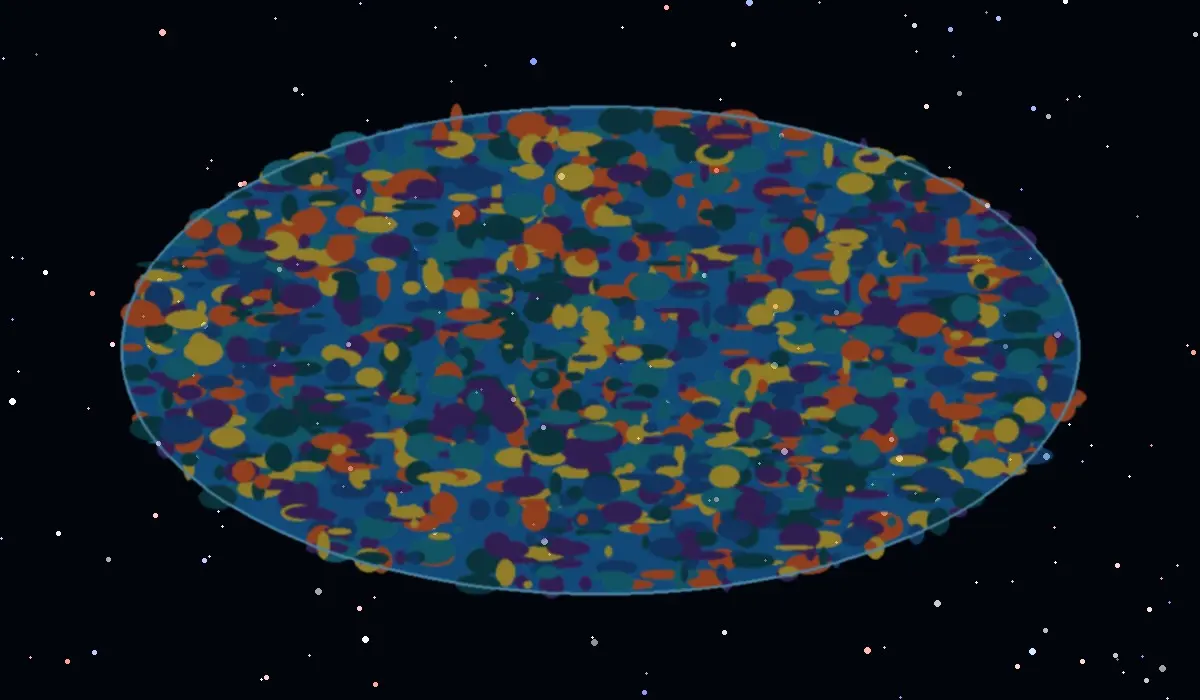
The CMB is faint microwave radiation released when the early universe became transparent. Tiny variations in it preserve information about the seeds from which later cosmic structure grew.
What do astronomers mean by the universe’s oldest light?
The cosmic microwave background, usually shortened to CMB, is faint microwave radiation arriving from every direction in the sky. It is a relic of a much earlier stage of the universe.
The light did not travel freely immediately after the Big Bang. Early on, the universe was extremely hot and filled with charged particles that scattered photons repeatedly. As expansion continued, the universe cooled enough for electrons and nuclei to combine into neutral atoms, allowing light to travel much more freely.
Why is this ancient light now in microwaves?
That early radiation has been traveling through an expanding universe for billions of years. Expansion stretches the wavelength of light, a process known as cosmological redshift.
Radiation that was once much hotter is therefore observed today as a very cold microwave background with a temperature only a few degrees above absolute zero.
Why do CMB maps look blotchy?
The CMB is remarkably uniform, but it is not perfectly smooth. Sensitive instruments reveal tiny temperature differences across the sky. These fluctuations trace small differences in density in the early universe.
Gravity later amplified those differences. Over enormous spans of time, slightly denser regions helped seed the large-scale structure that eventually developed into galaxies, clusters and the cosmic web.
How spacecraft measured it
NASA's Cosmic Background Explorer established key properties of the CMB, and the Wilkinson Microwave Anisotropy Probe — WMAP — later mapped temperature variations across the full sky with much greater precision.
The European Space Agency's Planck mission improved those measurements further. Together, CMB observations became a foundation of modern precision cosmology.
What can the CMB tell us?
The detailed statistical pattern of CMB fluctuations allows cosmologists to test models for the age, geometry and composition of the universe. It also provides evidence about the conditions that existed before stars and galaxies formed.
Scientists compare CMB observations with other measurements, such as galaxy surveys and supernova distances. No single map answers every cosmological question, but the CMB is one of the strongest records we have of the early universe.
What the CMB is not
The CMB is not a photograph of the Big Bang itself, and the colorful maps are not what human eyes would see. Colors are added to make extremely small microwave temperature variations easier to understand.
It is better to think of the CMB as a fossil light field: a physical signal from an early cosmic era that can still be measured today.
Simple takeaway
The CMB is faint microwave radiation released when the early universe became transparent. Tiny variations in it preserve information about the seeds from which later cosmic structure grew.
Trusted sources & further reading
Hero image: original Neela Asman illustration created for this article.