
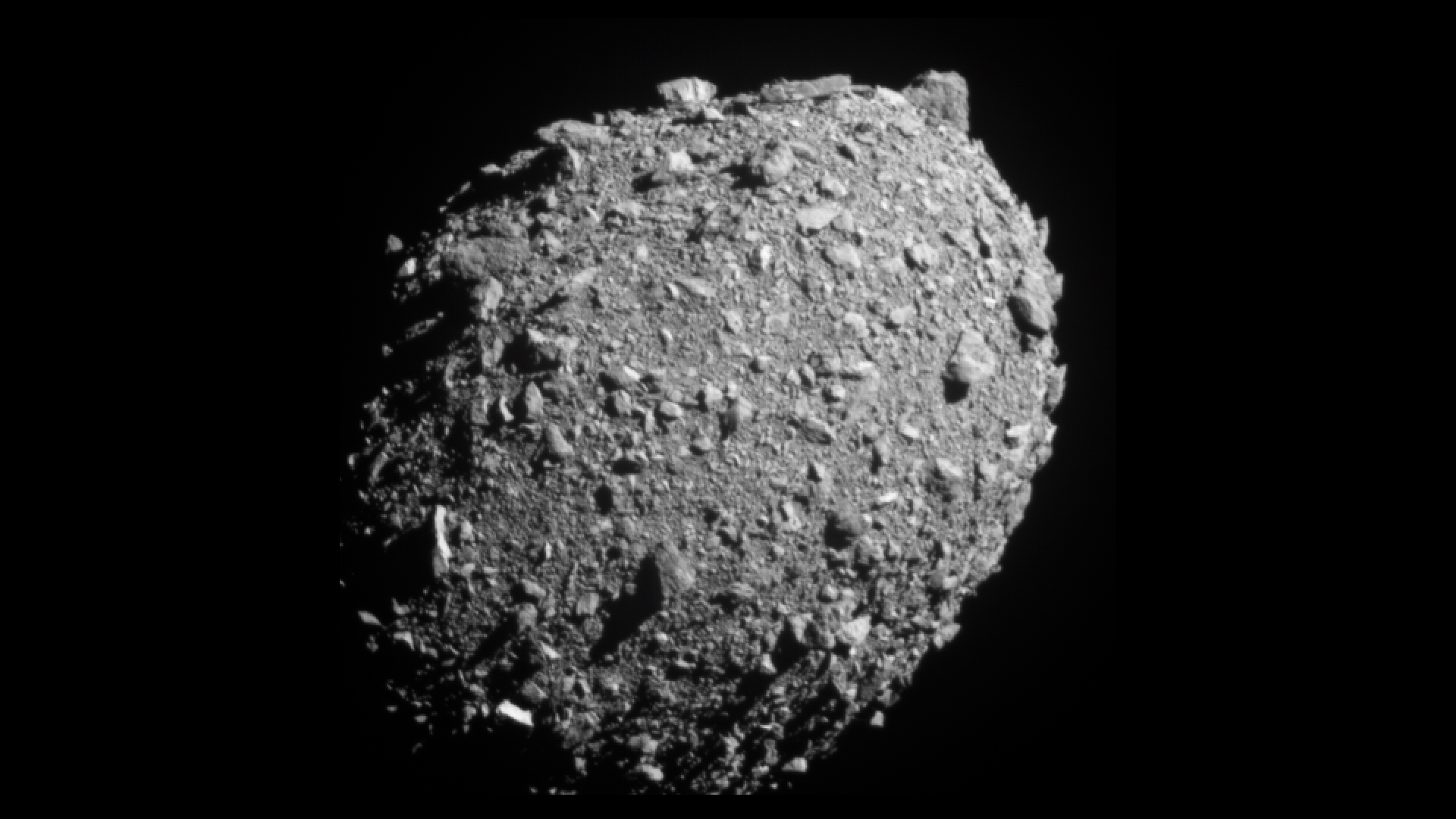
On September 26, 2022, NASA deliberately crashed the DART spacecraft into Dimorphos, the small moonlet orbiting the larger asteroid Didymos. The goal was to test whether a kinetic impactor could change an asteroid’s motion enough to become a useful planetary-defense technique.
What changed after DART hit Dimorphos?
Before impact, Dimorphos orbited Didymos in roughly 11 hours and 55 minutes. After the collision, the orbit became about 33 minutes shorter. That was the first major proof that a spacecraft impact could intentionally change the motion of a celestial object.
But Didymos and Dimorphos are gravitationally linked. They move around a shared center of mass while the pair itself travels around the Sun. When DART changed the momentum of Dimorphos, the effect was therefore transmitted to the motion of the whole binary system.
How much did DART change Didymos’ orbit around the Sun?
NASA’s 2026 result showed that the binary system’s orbital period around the Sun changed by roughly 0.15 seconds. That sounds tiny, especially compared with an orbit lasting about 770 days, but the measurement is scientifically important because it proves the system’s heliocentric motion was changed by a human-made impact.
Researchers also calculated that the binary’s orbital speed changed by about 11.7 microns per second, equivalent to roughly 1.7 inches per hour. Planetary defense does not require an asteroid to be dramatically shoved aside all at once. If an object is detected years in advance, a very small speed change can build into a much larger positional difference over time.
Why the debris made DART’s push stronger
The spacecraft itself carried momentum into the collision, but the impact blasted a large amount of material from Dimorphos. That debris escaped in the opposite direction and acted like a recoil thrust.
The 2026 research estimated a momentum-enhancement factor of about two. In simple terms, the escaping debris roughly doubled the effective push compared with the spacecraft impact alone.

How scientists measured such a tiny orbital shift
Detecting a fraction-of-a-second change in a 770-day orbit required extraordinary precision. Researchers combined years of existing observations with stellar occultations, events in which Didymos passes directly in front of a distant star and briefly blocks its light.
The exact time and location of an occultation reveals the asteroid’s position with high accuracy. NASA reported that volunteer observers around the world recorded 22 useful occultations between October 2022 and March 2025.
When those observations were combined with radar and other ground-based data, the team could refine the orbit enough to isolate DART’s effect on the system’s motion around the Sun.
The impact also changed Dimorphos itself
DART did more than alter orbital periods. Later analysis showed that Dimorphos’ shape changed after impact, and evidence supports the idea that it is a loosely bound rubble-pile asteroid rather than a single solid rock.
This matters because asteroid structure affects how efficiently a kinetic impact transfers momentum. A solid body and a loosely packed rubble pile can respond very differently to the same collision.

Why this is important for planetary defense
The DART experiment was designed to answer a practical question: if astronomers discover a dangerous asteroid early enough, can a spacecraft change its path before it reaches Earth?
The answer from DART is encouraging. The mission demonstrated that a kinetic impactor can change an asteroid’s motion, while follow-up measurements show that the effect can extend to the larger orbit of an entire binary system.
The key requirement is warning time. A small velocity change applied years before a predicted encounter can eventually produce a large miss distance. That is why asteroid detection missions and long-term tracking are just as important as the deflection technology itself.
Didymos and Dimorphos are not threats to Earth
NASA stresses that neither Didymos nor Dimorphos was on a collision course with Earth before the test, and DART could not have placed them on one. The pair was selected because it allowed researchers to test asteroid deflection safely while measuring the results from Earth.
That makes the system an ideal natural laboratory for learning how a real planetary-defense mission might work if a hazardous asteroid were discovered in the future.
Frequently Asked Questions
Did DART really change an asteroid’s orbit around the Sun?
Yes. NASA reported in 2026 that the impact measurably changed the Didymos-Dimorphos binary system’s roughly 770-day orbit around the Sun by about 0.15 seconds.
How much did Dimorphos’ orbit around Didymos change?
The orbital period became roughly 33 minutes shorter after DART’s impact.
Why was the impact more effective than the spacecraft momentum alone?
Rock and dust blasted away from Dimorphos produced recoil. The new research estimated a momentum-enhancement factor of about two.
How was the solar-orbit change measured?
Researchers used radar, long-term observations and 22 stellar occultations recorded between October 2022 and March 2025.
Is Didymos dangerous to Earth?
No. NASA states that Didymos and Dimorphos are not threats to Earth.