
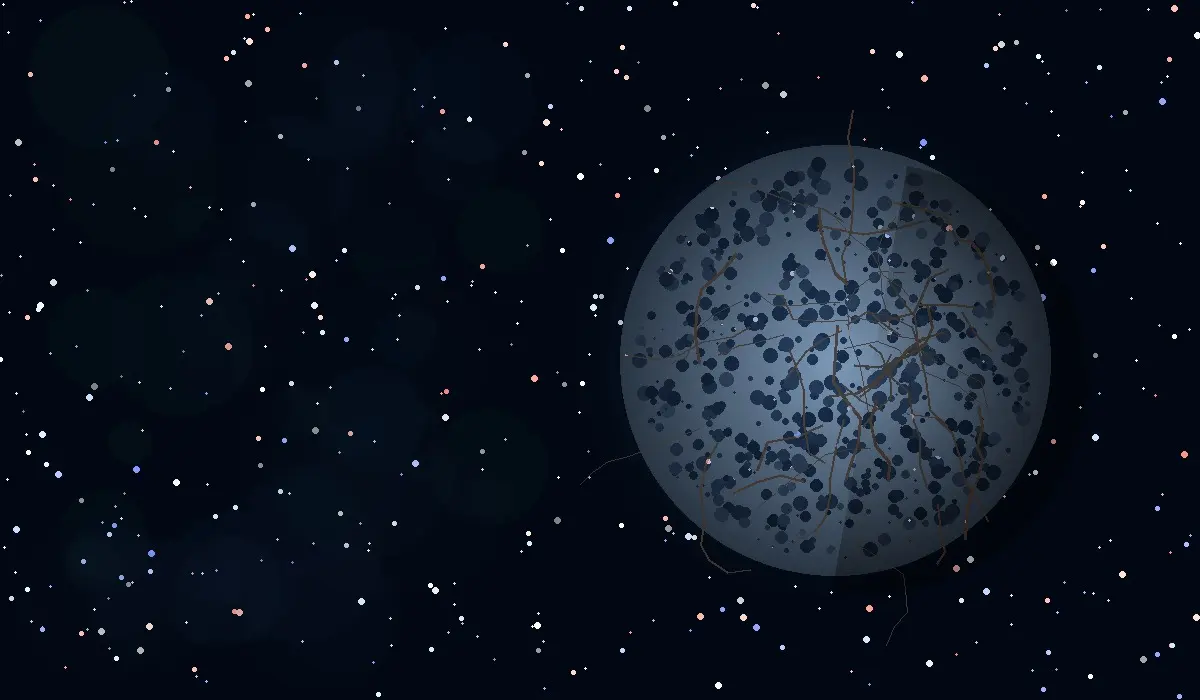
Rogue planets are planetary-mass worlds that are not bound to a star. Astronomers can detect them through effects such as gravitational microlensing, and future surveys should reveal how common they really are.
What is a rogue planet?
Most planets we know follow a familiar rule: they orbit a star. Rogue planets are different. They move through interstellar space without being gravitationally bound to a host star, making them some of the loneliest worlds in the galaxy.
A rogue planet can still have gravity, moons, an atmosphere and internal heat. What it lacks is the steady daylight and energy that an ordinary planet receives from a nearby star. That makes its environment extremely different from Earth, Mars or the known exoplanets that circle other suns.
How can a planet become a rogue world?
One possibility is that the planet formed inside a normal planetary system and was later thrown out. Young systems can be chaotic. Large planets can tug on smaller worlds, close encounters can reshape orbits, and a planet can gain enough speed to escape its star completely.
Another possibility is that some planetary-mass objects form more directly from collapsing clouds of gas and dust. The boundary between a very small brown dwarf and a free-floating planet can therefore depend on how the object formed as well as how massive it is.
How do astronomers find something so dark?
Rogue planets are difficult to see because they do not reflect much starlight. One powerful method is gravitational microlensing. When a foreground object passes almost exactly in front of a more distant star, its gravity bends and magnifies the background starlight for a short time.
A very short microlensing event can reveal an object with planetary mass even when the object itself gives off little or no visible light. Infrared observations can also help with young rogue planets because newly formed worlds may still glow from leftover internal heat.
Could the galaxy contain huge numbers of them?
Researchers are still working out how common rogue planets are. Microlensing surveys suggest that free-floating worlds could be numerous, especially at lower masses that are difficult to count with other techniques.
NASA's Nancy Grace Roman Space Telescope is designed to perform wide, sensitive surveys that should greatly improve this census. A larger sample will help astronomers test how planetary systems form and how often planets are ejected.
Could life exist on a rogue planet?
Without a star, the surface of an Earth-like rogue planet would probably be extremely cold. That does not automatically mean every part of the world must be frozen solid forever. Radioactive decay and leftover heat inside a planet can provide energy, and a thick atmosphere or deep layer of ice could slow heat loss.
Scientists sometimes discuss whether subsurface liquid water could persist under special conditions. That remains a theoretical possibility rather than evidence for life. Rogue planets are interesting precisely because they push scientists to ask how far habitability can extend beyond the familiar idea of a warm planet orbiting a star.
Why rogue planets matter
Rogue planets are not just astronomical curiosities. Their numbers can reveal how violent young planetary systems are, how efficiently nature makes low-mass objects, and how much unseen planetary material may be drifting between the stars.
Every new rogue-world detection adds another piece to the story of how planetary systems evolve — including systems that may once have looked much like our own.
Simple takeaway
Rogue planets are planetary-mass worlds that are not bound to a star. Astronomers can detect them through effects such as gravitational microlensing, and future surveys should reveal how common they really are.
Trusted sources & further reading
- NASA Goddard Scientific Visualization Studio — Icy Earth-mass Rogue Planet
- NASA — Nancy Grace Roman Space Telescope
Hero image: original Neela Asman illustration created for this article.