
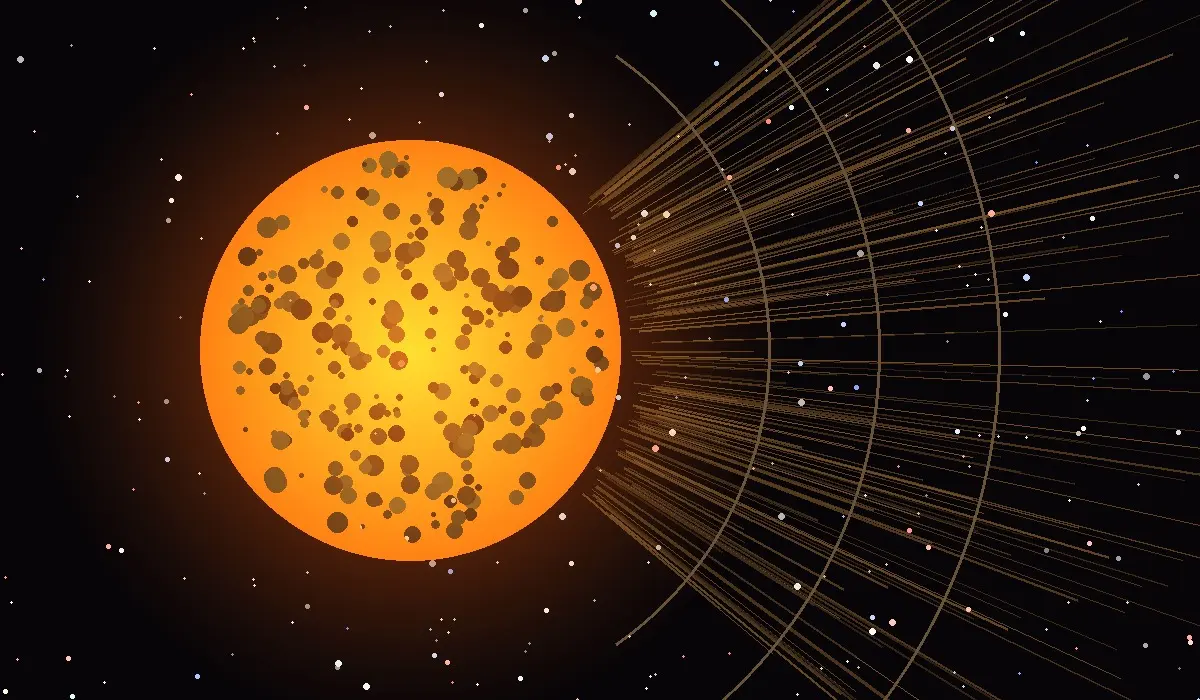
The solar wind is a continuous stream of charged particles from the Sun. Over enormous distances it creates the heliosphere, a changing bubble that shapes the space environment around the planets.
What is the solar wind?
The Sun's outer atmosphere is so hot that some electrically charged particles can escape the Sun's gravity. This continuous outflow of plasma — mainly protons and electrons — is called the solar wind.
It is not a wind like moving air on Earth. It is a stream of charged particles carrying the Sun's magnetic field outward through interplanetary space. Its speed, density and magnetic structure change as solar activity changes.
What does the solar wind do near Earth?
Earth's magnetic field deflects much of the solar wind and creates a protective magnetosphere. When disturbances from the Sun reach Earth, they can transfer energy into this magnetic environment.
Those interactions help produce auroras and can also contribute to space-weather effects that matter for satellites, radio systems, navigation and power infrastructure. The severity depends on the type and orientation of the solar disturbance, not simply on the presence of ordinary solar wind.
The heliosphere: our home inside the Sun’s influence
As the solar wind expands far beyond the planets, it creates a vast region dominated by the Sun called the heliosphere. This bubble separates much of the solar environment from the surrounding interstellar medium.
The boundary is not a hard shell. Instead, there are transition regions where the solar wind slows, heats and mixes with material from interstellar space. Scientists study these regions to understand how stars interact with their galactic neighborhoods.
How do we study the distant edge?
Voyager 1 and Voyager 2 provided the first direct measurements from beyond the heliopause, the boundary commonly used to mark entry into interstellar space. Other missions study the heliosphere remotely.
NASA's Interstellar Mapping and Acceleration Probe, or IMAP, is designed to map energetic neutral atoms that can travel from the heliosphere's boundary back toward the inner Solar System. These particles provide clues about regions too distant to image like ordinary planets.
The heliosphere changes with the Sun
The Sun follows an activity cycle that changes sunspots, eruptions, magnetic structure and the solar wind. Stronger or weaker solar-wind pressure can alter the size and shape of parts of the heliosphere.
That means our Solar System's space environment is dynamic on scales much larger than Earth's orbit. Understanding that variability also helps scientists study how galactic cosmic rays enter the heliosphere.
Why this matters for future exploration
Human missions beyond low Earth orbit spend more time outside the strongest protection of Earth's magnetic field. Better knowledge of solar particles and space radiation is therefore important for mission planning and spacecraft design.
Heliophysics connects the Sun, planets, interplanetary space and the galaxy. The solar wind is one of the main threads tying all of those environments together.
Simple takeaway
The solar wind is a continuous stream of charged particles from the Sun. Over enormous distances it creates the heliosphere, a changing bubble that shapes the space environment around the planets.
Trusted sources & further reading
Hero image: original Neela Asman illustration created for this article.