
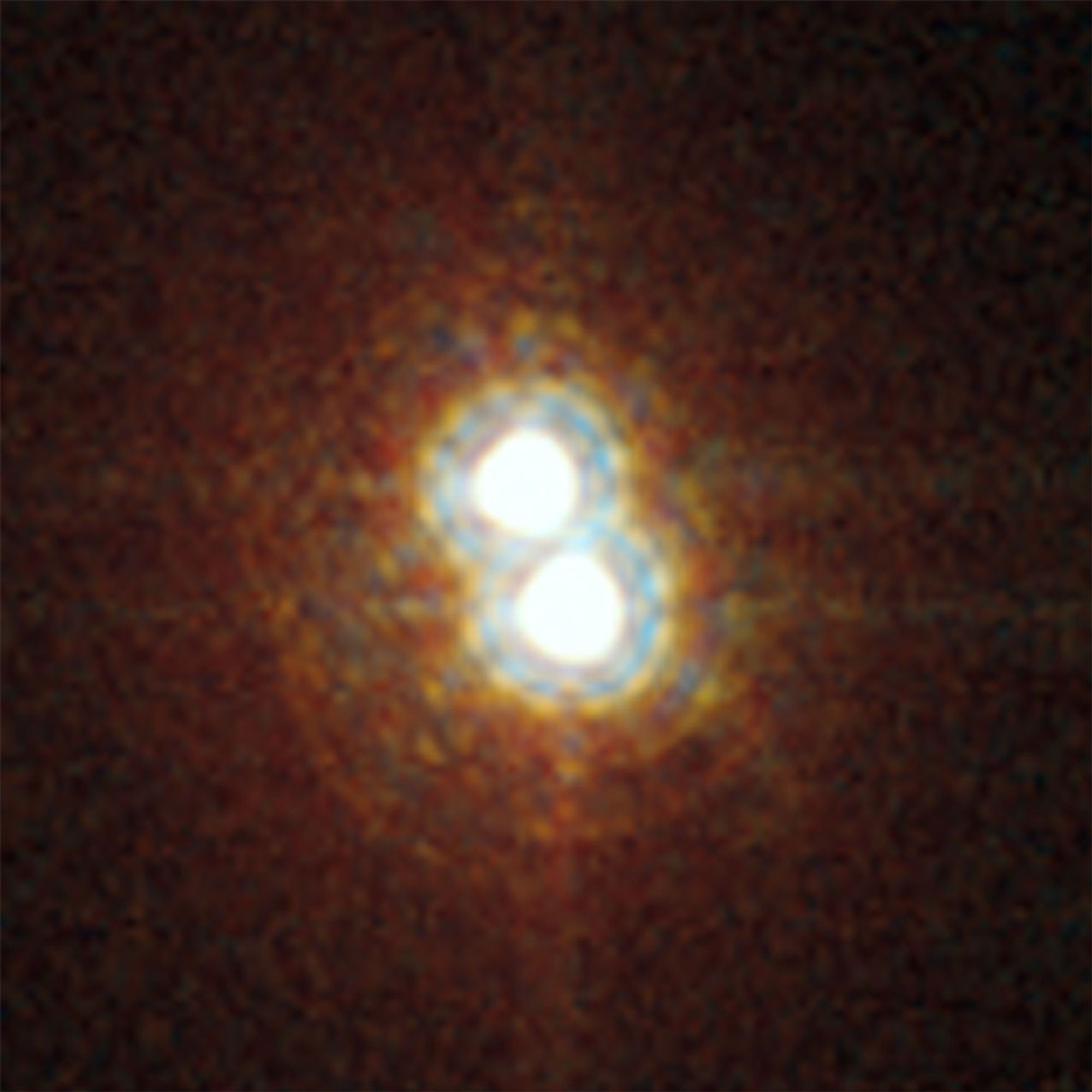
A double star is a pair of stars that appear very close together in the sky. Some are true binary systems, where both stars orbit a common center of mass. Others only look close from our viewpoint even though they are separated by large distances in space.
For beginner observers, both kinds are rewarding because a telescope can split what looks like a single point of light into two stars. Many bright double stars are visible even from cities and do not require dark rural skies.
What is a double star?
When two stars appear close together through a telescope, astronomers call the pair a double star. If the two stars are physically bound by gravity and orbit one another, they form a binary system.
Some visual pairs are only apparent neighbors. Their alignment is a line-of-sight effect, so they may lie at very different distances from Earth.
Why double stars are ideal beginner targets
Many double stars are bright enough to observe from suburban or urban skies. Unlike faint nebulae or galaxies, they often remain impressive even when skyglow is strong.
They also teach useful observing skills. A beginner can practice accurate focusing, compare different magnifications, and notice how atmospheric turbulence affects sharpness.

Why some pairs show beautiful color contrast
Stars have different surface temperatures, so their colors can differ. Some pairs appear white and orange, yellow and blue, or gold and blue through a telescope.
Albireo in Cygnus is one of the best-known examples. Its components are famous among amateur observers for their contrasting warm and cool appearance. Human vision can exaggerate subtle differences, but the effect is part of what makes double-star observing so enjoyable.
How angular separation changes difficulty
Astronomers describe the apparent spacing between stars using angular separation, usually measured in arcseconds. Wide pairs can be split at low magnification, while close pairs require steadier air, sharper optics, careful focusing, and often more magnification.
Trying progressively closer pairs is a practical way to learn the limits of your telescope and local seeing conditions.
How to start observing double stars
Start with a bright, widely separated pair listed in a beginner star chart or astronomy app. Use low magnification to locate it, then increase magnification slowly until the two stars are comfortably separated.
Keep notes about the pair’s color, brightness difference, separation, and how steady the image appears. Revisiting the same targets on different nights will show how much atmospheric conditions affect what your telescope can resolve.
FAQ
Do I need a large telescope to see double stars?
No. Many famous pairs are visible in small beginner telescopes, especially when the components are bright and widely separated.
Why do some double stars look different colors?
Different stellar temperatures can produce different colors, and visual contrast between nearby stars can make those differences appear stronger.
Are all double stars true binary systems?
No. Some are optical doubles that only appear close together from Earth. True binaries are gravitationally bound and orbit a common center of mass.