
A supernova is one of the most energetic events a star can produce. Some happen when the core of a massive star collapses under its own gravity; others happen when a white dwarf in a binary system undergoes a runaway thermonuclear explosion. The details differ, but both routes can briefly produce enormous amounts of light and spread stellar material into surrounding space.
What is a supernova?
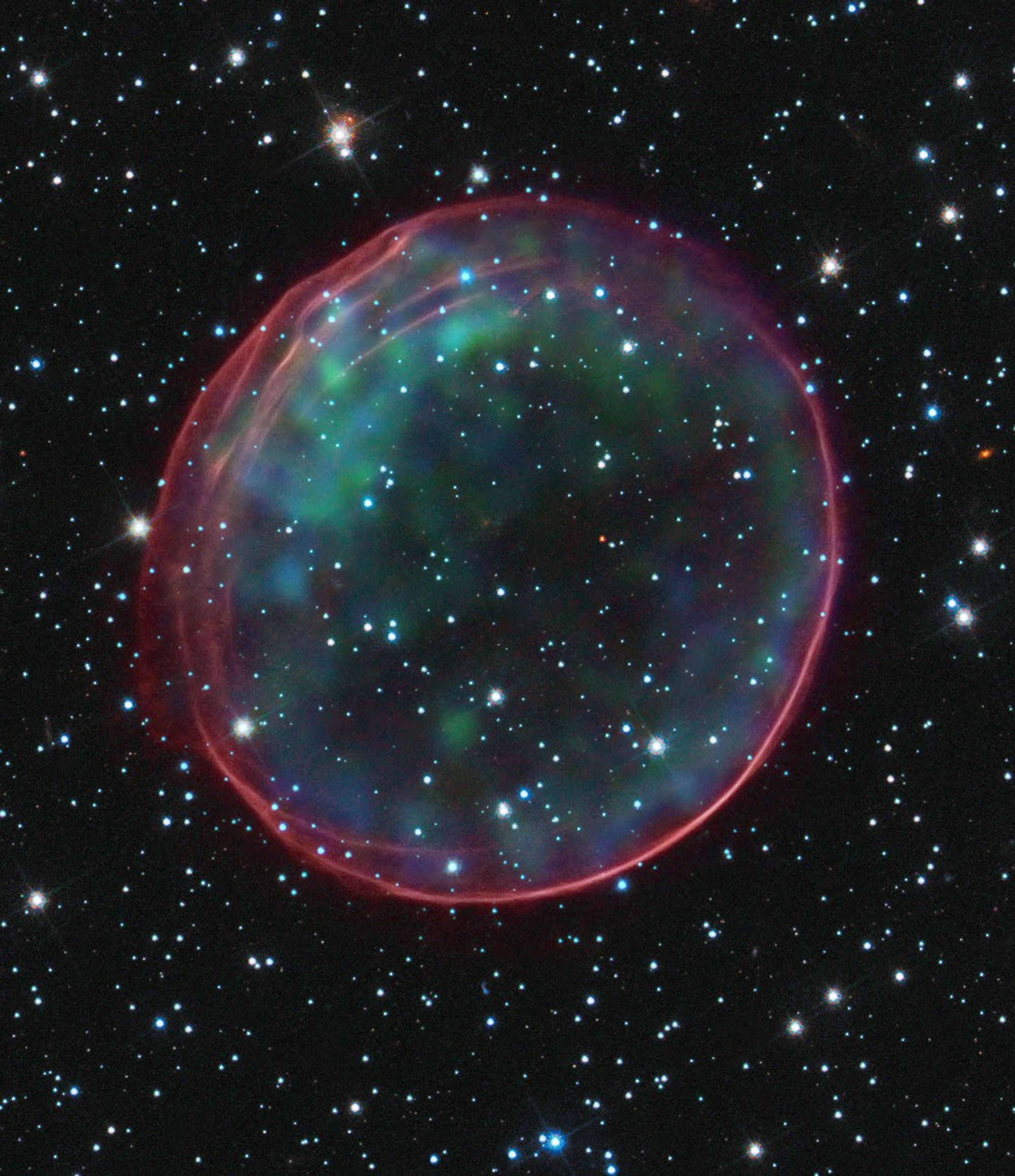
A supernova is a stellar explosion. For a short period, the event can become extraordinarily bright while ejecting material at very high speed. The expanding debris interacts with surrounding gas and can remain visible for hundreds or thousands of years as a supernova remnant.
Astronomers use these explosions and remnants to learn about stellar evolution, nuclear reactions, compact objects, magnetic fields and the structure of the interstellar medium.
How massive stars explode
Massive stars spend most of their lives producing energy through nuclear fusion. Over time, increasingly heavy elements can build up in the core. Eventually the core reaches a stage where fusion can no longer provide enough outward pressure to balance gravity.
The core collapses rapidly. In many cases, the outer layers are driven outward in a violent explosion while the collapsed center becomes a neutron star or black hole. The exact physics is complex, but the result is a powerful release of energy and a rapidly expanding shell of stellar debris.

The white-dwarf route
Not every supernova comes from the collapse of a massive star. Type Ia supernovae involve white dwarfs in binary systems. A white dwarf can gain material from a companion or merge with another compact object, eventually triggering a runaway thermonuclear explosion.
Because these explosions have useful brightness properties, Type Ia supernovae are important tools for measuring cosmic distances and studying the expansion history of the universe.
What supernova remnants reveal
The explosion is only the beginning of the story. Afterward, a supernova remnant expands through surrounding gas. Shock waves heat material to extremely high temperatures, producing X-rays, while radio and optical observations trace other parts of the shell and magnetic environment.
Recent Chandra observations have shown that some objects identified with supernova remnants can vary unexpectedly in X-ray brightness. These changes help astronomers investigate surviving stellar companions, neutron stars, black holes and interactions between explosion debris and surrounding matter.
Why supernovae matter to the universe
Stars manufacture elements through fusion, and stellar explosions help return enriched material to interstellar space. Elements such as oxygen, silicon and iron become part of gas and dust that can later participate in new generations of stars and planetary systems.
Supernova shock waves can also compress nearby clouds, stir galactic gas and accelerate high-energy particles. In that sense, the death of one star can influence the environment from which other stars eventually form.
FAQ
Do all stars become supernovae?
No. Lower-mass stars such as the Sun end much more gently and eventually become white dwarfs. Supernova explosions require particular stellar masses or binary-star conditions.
What can remain after a supernova?
A core-collapse supernova can leave a neutron star or black hole, while the expelled material expands as a remnant. A thermonuclear Type Ia event can disrupt the white dwarf much more completely.
Are supernovae dangerous to Earth?
A sufficiently nearby supernova could affect Earth, but known stars expected to explode are generally far enough away that they are not considered an immediate danger.