
Some stars seem to blink, but the effect can come from orbital geometry rather than a star switching on and off. XZ Andromedae is a pair of stars orbiting in a plane that is almost edge-on from Earth.
As the cooler member crosses in front of the hotter and brighter star, the combined light from the system falls. Astronomers record that change as a light curve and use it to study the stars and their orbit.
Why XZ Andromedae appears to wink
The system contains two stars whose orbit is aligned so that one periodically passes in front of the other from our viewpoint. During the eclipse, the total amount of light reaching Earth decreases.
What an Algol-type eclipsing binary is
Algol-type systems contain stars that remain roughly spherical while producing distinct eclipses. Their light curves usually show a deeper primary eclipse and a shallower secondary eclipse.
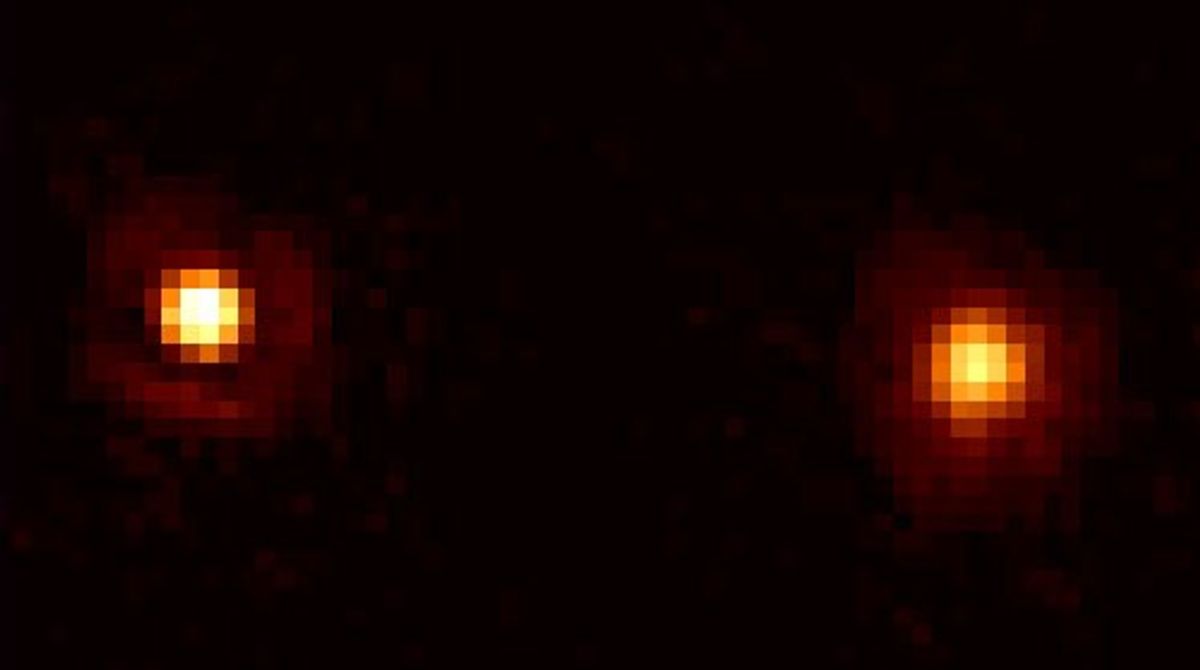
How astronomers build a light curve
Differential photometry compares the brightness of the target star with nearby comparison stars. This reduces many changes caused by Earth’s atmosphere or the observing instrument.
Why extra companion stars are suspected
Analyses of multiple XZ Andromedae light curves suggest that the timing of the eclipses may be influenced by additional bodies, with NASA’s APOD noting that two more stars may orbit the system.

Why variable-star observations still matter
Repeated brightness measurements can reveal orbital changes, hidden companions and stellar evolution. Even modest telescopes can contribute useful data when observations are carefully calibrated.
FAQ
Is XZ Andromedae one star?
No. The central system is an eclipsing binary containing two stars.
Why does it get dimmer?
The cooler star periodically passes in front of the hotter, brighter star from Earth’s perspective.
Could there be more than two stars?
NASA’s APOD notes that analyses of several light curves indicate two additional stars may orbit the system.
Can amateur astronomers study eclipsing binaries?
Yes. Differential photometry can be performed with suitable imaging equipment and careful calibration.