
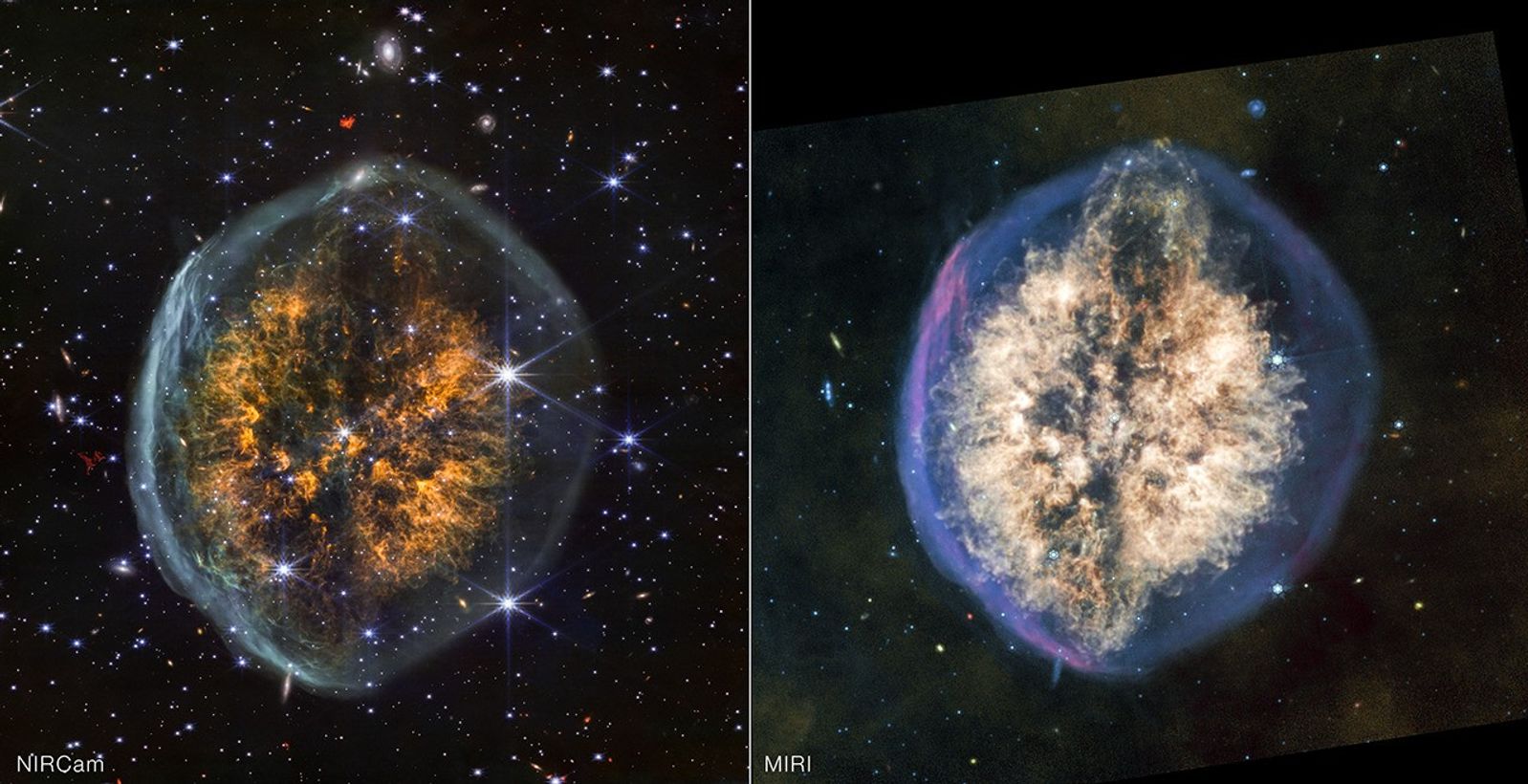
Planetary nebulae are the glowing remains of stars that have shed their outer layers near the end of their lives. The Exposed Cranium Nebula is a vivid example. Webb can observe it at multiple infrared wavelengths, separating warm dust, molecules and ionized gas that overlap in ordinary images.
Quick facts
- Planetary nebulae are unrelated to planets; the name is historical.
- They form when aging low- to intermediate-mass stars expel their outer envelopes.
- Ultraviolet light from the hot remnant core makes surrounding gas glow.
- Infrared data are sensitive to dust and molecular material as well as ionized gas.
Why this matters
The gas leaving an aging star carries elements produced or processed during stellar evolution. That material mixes into interstellar space and can later become part of new stars, planets and organic chemistry. Mapping a planetary nebula therefore links the death of one generation of stars with the raw material for the next.
How to read this result
For this astronomy story, the strongest interpretation comes from connecting the image with quantitative measurements and physical models. Planetary nebulae are unrelated to planets; the name is historical. They form when aging low- to intermediate-mass stars expel their outer envelopes. Together, those measurements give the visual feature a testable physical meaning and help researchers compare it with earlier observations and models.
What comes next
Detailed spectra can identify atoms, ions and molecules in different shells. Comparing their velocities and temperatures helps reconstruct how the star’s mass loss changed over time.