
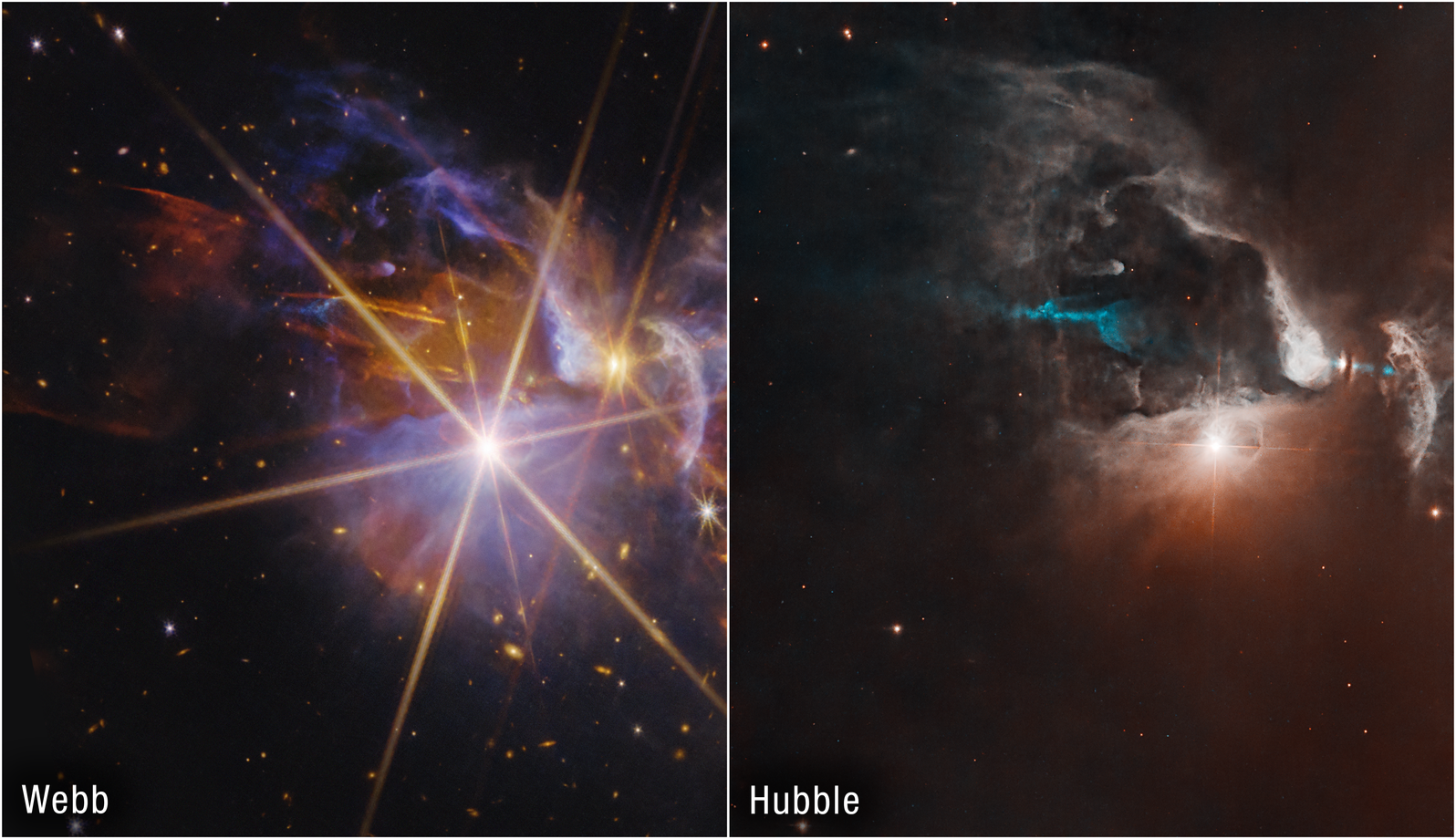
FS Tau is a very young stellar system roughly 450 light-years away. Its stars are still interacting with the material from which they formed, producing disks, outflows and narrow jets. Webb’s infrared imaging makes the surrounding dusty environment easier to trace and reveals how energetic newborn stars can be.
Quick facts
- Young stars commonly form with rotating disks of gas and dust.
- Magnetic fields can help launch narrow jets along a star’s rotation axis.
- Jets produce shocks when they hit surrounding interstellar material.
- Binary companions can complicate disks, accretion and outflow geometry.
Why this matters
A star grows by accreting material, yet some of that material is simultaneously expelled in jets. Those outflows help remove angular momentum, allowing additional gas to spiral inward. FS Tau offers a visual example of this balance between growth and mass loss during an early phase of stellar evolution.
How to read this result
For this astronomy story, the strongest interpretation comes from connecting the image with quantitative measurements and physical models. Young stars commonly form with rotating disks of gas and dust. Magnetic fields can help launch narrow jets along a star’s rotation axis. Together, those measurements give the visual feature a testable physical meaning and help researchers compare it with earlier observations and models.
What comes next
Tracking knots in the jets over time can measure their speed, while spectroscopy can reveal temperatures and chemical composition. Observers can also compare the jet directions with the orientation of circumstellar disks.