Pulsars are rapidly spinning neutron stars whose beams sweep across space with extraordinary regularity. Learn how they form, why they pulse, and what astronomers can measure with them.
From a massive star to a neutron star
A pulsar begins with a massive star that has exhausted the nuclear fuel in its core. When the core can no longer support itself, it collapses while the outer layers may be expelled in a supernova. The compact remnant can become a neutron star: an object with roughly stellar mass compressed into a region only tens of kilometres across. Matter is packed to densities that cannot be reproduced on Earth, making neutron stars natural laboratories for nuclear physics and gravity.
Collapse also changes the star's rotation and magnetic field. Just as a spinning skater can rotate faster by pulling in their arms, a shrinking stellar core can spin much more rapidly as its size decreases. Magnetic fields can become extremely intense. When rotation and magnetism combine, charged particles are accelerated around the neutron star and can produce beams of radiation.
Why a pulsar looks like a lighthouse
The word pulsar comes from the regular pulses that first made these objects famous. A pulsar is not normally switching itself completely on and off. Instead, radiation is concentrated into beams connected to the magnetic regions of the rotating neutron star. If one of those beams crosses Earth during each rotation, our telescopes receive a pulse. The geometry is often compared with a lighthouse: the lamp stays active, but a distant observer sees a flash whenever the beam sweeps past.
Different pulsars emit strongly at different wavelengths. Many were discovered with radio telescopes, while space observatories reveal X-rays and gamma rays from energetic particles near some neutron stars. Combining wavelengths helps astronomers separate the compact star, its surrounding particle wind, and structures produced where that wind interacts with nearby gas.

Pulsar timing and extraordinary regularity
A pulsar's repeating signal can be timed with remarkable precision. Astronomers record when pulses arrive and compare those arrival times over months or years. Tiny changes can reveal how the star is slowing as it loses rotational energy, whether it has an unseen companion, and how it moves through the Galaxy. Millisecond pulsars, which can rotate hundreds of times each second, are especially valuable for long-baseline precision measurements.
The pulses do not make neutron stars perfect clocks in every circumstance. Some pulsars show timing noise, and young pulsars can undergo sudden changes in spin called glitches. Those irregularities are scientifically useful because they offer clues about the neutron star's crust, interior superfluid and the way angular momentum moves through matter under extreme conditions.
Magnetic fields, particle winds and glowing nebulae
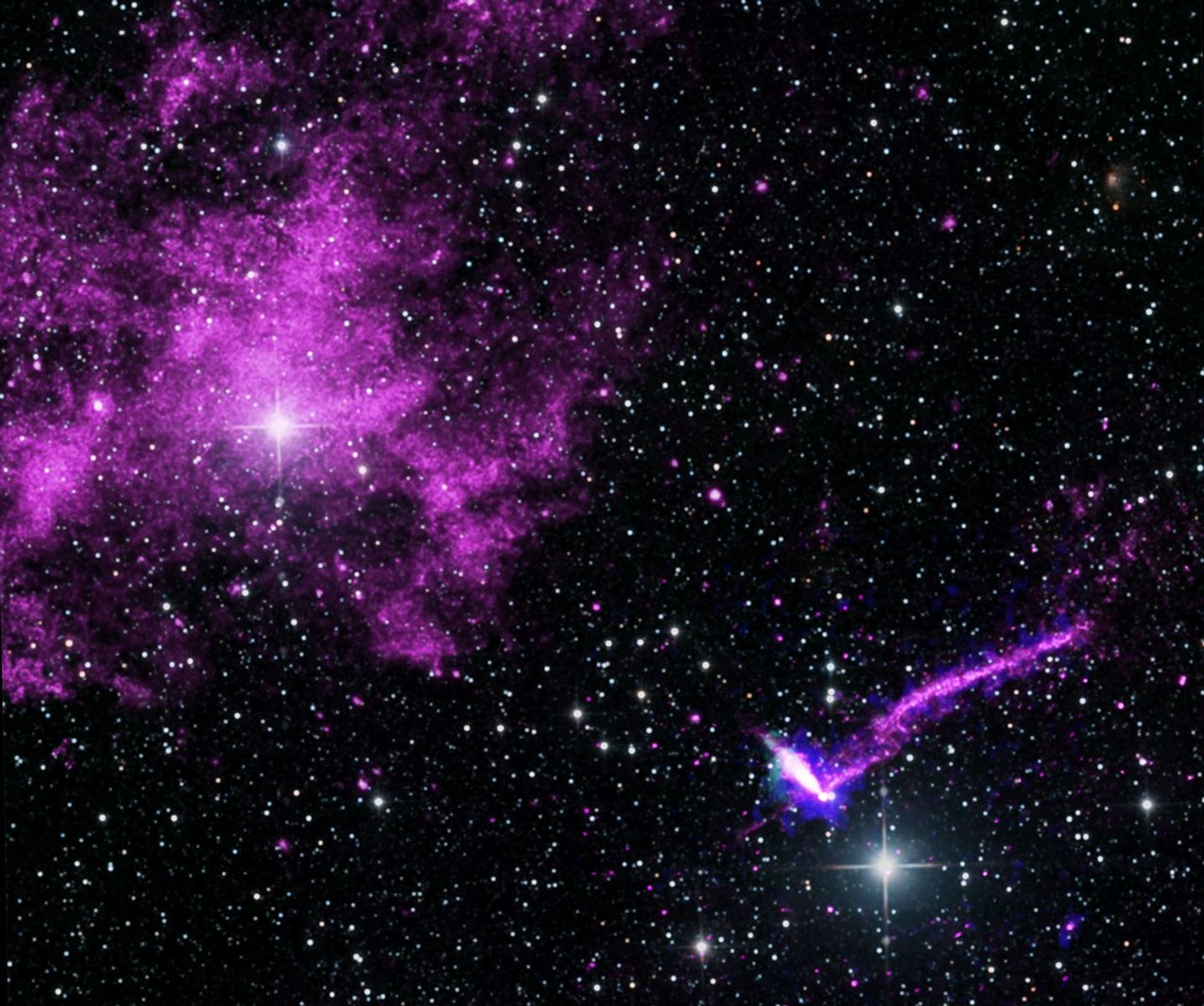
A pulsar can pour rotational energy into its surroundings. Fast particles stream away from the neutron star and interact with magnetic fields and ambient material, creating a pulsar wind nebula. X-ray images of systems such as Vela show arcs, jets and complex structures close to the star. These are not ordinary visible clouds: their high-energy radiation traces particles accelerated to enormous energies.
The exact shape of a pulsar wind nebula depends on the neutron star's motion, magnetic geometry, surrounding gas and viewing angle. Repeated images can reveal changes in jets and shocks. That makes pulsar nebulae dynamic laboratories rather than static photographs of stellar remains.
Pulsars in binary systems
Some neutron stars orbit ordinary stars or other compact objects. In certain binaries, gas from a companion can be captured by the neutron star. This accreting material becomes very hot and can shine strongly in X-rays. Over long periods, transferred material can also change the neutron star's rotation; astronomers think this recycling process helps produce many millisecond pulsars.
Binary pulsars are particularly important because orbital motion imprints a precise pattern on pulse arrival times. Those systems have enabled demanding tests of gravity and measurements of compact-object masses. They also show that the life of a pulsar is strongly influenced by its environment rather than being determined only at birth.

What astronomers still want to know
Major questions remain about the composition of neutron-star interiors, how pulsar magnetospheres accelerate particles, why some neutron stars produce strong radio pulses while others do not, and how magnetic fields evolve. New X-ray observatories, radio arrays and gamma-ray instruments attack different parts of the problem.
Recent observations continue to add detail. In 2026, for example, NASA reported XRISM observations of the high-mass binary BP Crucis that tracked material from a giant companion star as it interacted with a pulsar. Work like this connects pulse timing, spectroscopy and gas dynamics, giving researchers a more complete picture of how extreme compact stars behave.
FAQ
Is every neutron star a pulsar?
No. A neutron star is called a pulsar when its beamed emission is observed as regular pulses. Geometry, emission strength and evolutionary state affect whether we detect pulses.
Can a pulsar be dangerous to Earth?
Known pulsars are extremely distant. Their radiation is scientifically valuable to observe but does not pose a practical danger to people on Earth.
Why do pulsars slow down?
They lose rotational energy through electromagnetic radiation and particle winds, so their spin usually decreases gradually over time.