
A quasar can look like a single brilliant point of light, yet the source is not a star. It is the intensely active center of a galaxy, where gas and dust are falling toward a supermassive black hole. The black hole itself does not shine, but the material around it can release extraordinary amounts of energy before crossing the event horizon.
Because quasars are bright enough to be seen across billions of light-years, they act like cosmic beacons. Astronomers use them to trace the growth of early black holes, study the galaxies that host them and probe otherwise invisible gas between galaxies. The same brightness that makes quasars useful also makes them challenging: the central glare can overwhelm the much fainter host galaxy.
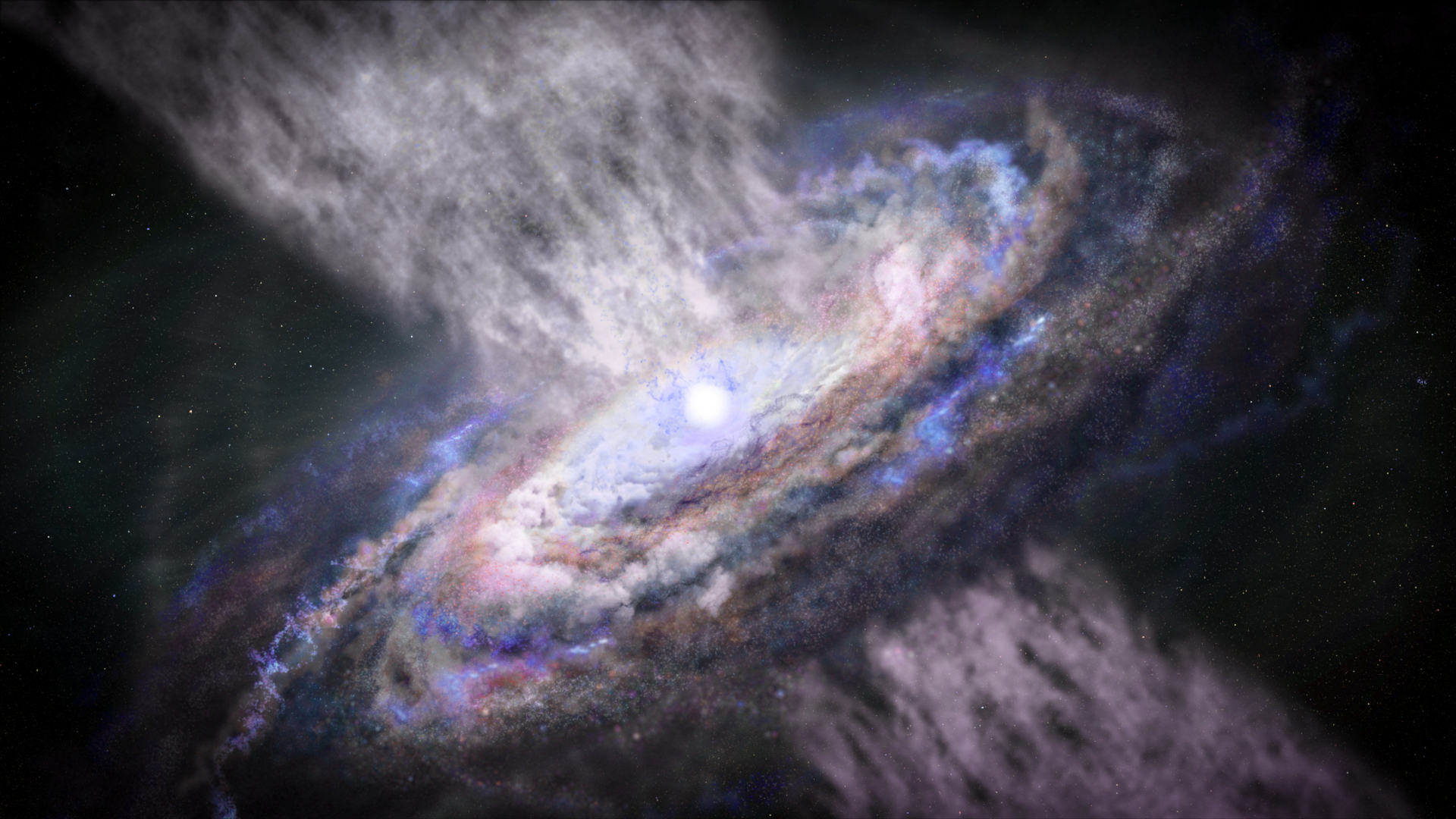
The hidden engine inside a quasar
When gas falls toward a supermassive black hole, it usually carries angular momentum, so it does not plunge straight in. Instead it forms a rotating accretion disk. Friction, magnetic turbulence and gravitational energy heat the material to enormous temperatures, causing the disk to radiate from optical light through ultraviolet and X-rays.
The brightest region is tiny compared with an entire galaxy. That compactness explains how an object associated with one galactic nucleus can compete with or exceed the light from hundreds of billions of stars. Variability provides another clue: changes in brightness over relatively short timescales imply that much of the emission originates from a small region.
Why some quasars launch enormous jets
Magnetic fields threading the inner accretion flow can help channel plasma into narrow jets that race away from the black hole. These jets can extend far outside the host galaxy and emit strongly at radio wavelengths, though not every active galactic nucleus produces the same kind of jet.
The jet of 3C 273 is visible in Hubble observations. Such structures allow astronomers to study how a small central engine transfers energy into its surroundings. That feedback can heat gas, reshape the galactic environment and influence how easily new stars form.
Quasars, AGN and the angle we view them from
“Active galactic nucleus,” or AGN, is the broad term for a galaxy center powered by rapid accretion onto a supermassive black hole. Quasars are among the most luminous AGN. Astronomers also use names such as Seyfert galaxy, radio galaxy and blazar for different observational classes.
Part of that variety can be explained by geometry. A dusty structure around the center can hide some regions from certain viewing angles, while a jet aimed nearly toward Earth can make an object appear especially variable and bright. Physical differences such as accretion rate, black-hole mass and magnetic fields also matter.
How 3C 273 changed astronomy
In the early 1960s, several powerful radio sources looked almost star-like through optical telescopes. The breakthrough came when astronomers measured the spectrum of 3C 273 and realized its lines were shifted to much longer wavelengths. The source was not a nearby unusual star; it was an extraordinarily distant and energetic object.
3C 273 became the first object widely identified as a quasar in 1963. NASA notes that it lies about 2.5 billion light-years away. Modern Hubble observations use techniques such as coronagraphy to suppress the bright nucleus and reveal filaments, lobes and other structures close to the central region.
Why quasars are especially important in the early universe
Quasars were more common when the universe was younger, so their light provides a record of an era when galaxies and supermassive black holes were growing rapidly. Finding very distant quasars tells astronomers that some black holes became massive surprisingly early in cosmic history.
That creates a major formation question. Did the first black-hole “seeds” start relatively small and grow extremely quickly, or did some begin from much more massive seeds? Measuring quasar masses, accretion rates and host galaxies helps distinguish between competing pathways.
Using quasars as backlights for invisible matter
Quasar light travels through huge stretches of intergalactic space before reaching us. Along the way, gas clouds absorb very specific wavelengths. When astronomers spread the light into a spectrum, those absorption lines reveal hydrogen and heavier elements that may otherwise be too faint to see directly.
This turns a quasar into a background flashlight for the cosmic web. Researchers can map the distribution, temperature and chemical enrichment of gas across different epochs, connecting galaxy growth to the material flowing into and out of galaxies.

What new telescopes are trying to learn
Hubble remains valuable for high-resolution imaging, while Webb can study quasar host galaxies and the earlier universe at infrared wavelengths. X-ray observatories probe the hottest regions closest to the black hole, and radio arrays trace jets and cold gas.
The goal is not simply to catalogue bright objects. Astronomers want a connected story of how black holes and galaxies grow together, how feedback changes their surroundings and how the earliest massive black holes appeared so quickly after the first stars and galaxies formed.
FAQ
Is a quasar a black hole?
Not exactly. A quasar is the extremely luminous active region around a feeding supermassive black hole. The black hole itself emits no light from inside its event horizon.
Can a quasar be brighter than its galaxy?
Yes. The compact accretion-powered nucleus can outshine the combined starlight of the host galaxy, which is why observing the host can be difficult.
Is the Milky Way a quasar today?
No. The Milky Way’s central black hole, Sagittarius A*, is currently far less active than a quasar engine.