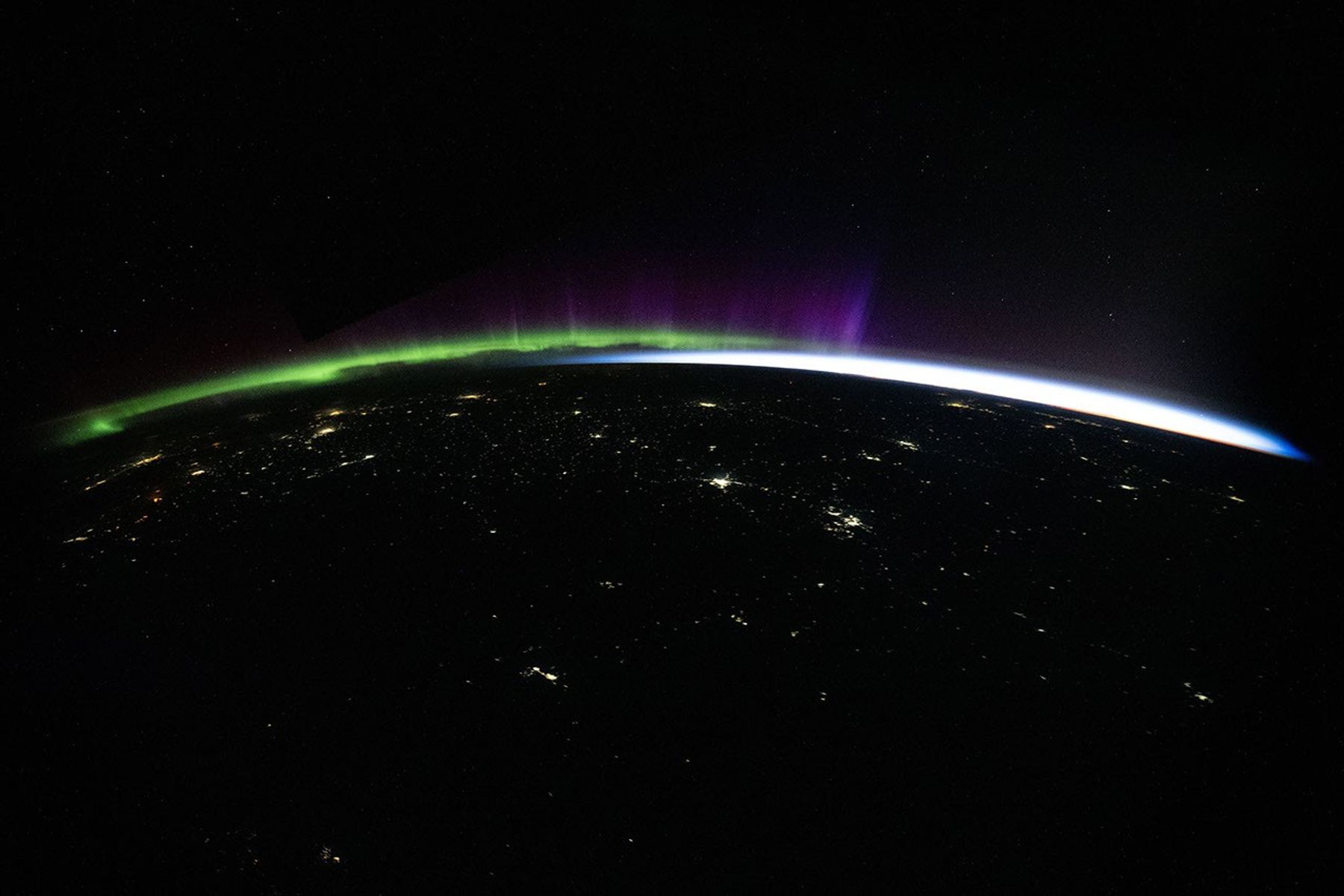
An astronaut photographed a vivid green-and-purple aurora from the ISS on September 7, 2026. Here is what creates the colors and why equinox season matters.
What the September 2026 astronaut photo captured
The featured image was taken from the International Space Station on September 7, 2026 while the station was roughly 255 miles above Earth and passing over the region of Kyrgyzstan. A green arc hugs the horizon while a purple-red glow rises higher into the dark sky, with city lights scattered below.
NASA Earth Observatory identifies the frame as astronaut photograph ISS075-E-88592, taken with a Nikon Z9. The image was cropped and contrast-enhanced for clarity, but the atmospheric colors record real light emitted high above Earth.

Why auroras can be green, red, pink or purple
The aurora begins when energetic charged particles enter Earth’s magnetic environment and are guided toward the upper atmosphere. Collisions transfer energy to oxygen and nitrogen. When those atoms and molecules return to lower-energy states, they emit photons at characteristic wavelengths.
Green is commonly produced by oxygen at roughly 100 to 200 kilometers altitude. Red oxygen emission becomes important higher up, generally above about 200 kilometers. Nitrogen can contribute blue and pink light. Where emissions overlap along a line of sight, human eyes and cameras can register purple, magenta or nearly white mixtures.
The Sun supplies the energy
Solar wind continuously flows outward from the Sun, but auroral displays can intensify when solar flares or coronal mass ejections disturb the near-Earth environment. A CME can drive a geomagnetic storm if its magnetic field couples effectively with Earth’s field.
During the early September 2026 interval described by NASA, geomagnetic activity reached G1, or minor-storm, levels. Even a modest storm can produce strong orbital views because astronauts look through long paths of glowing atmosphere against the blackness of space.
How Earth’s magnetic field shapes the light
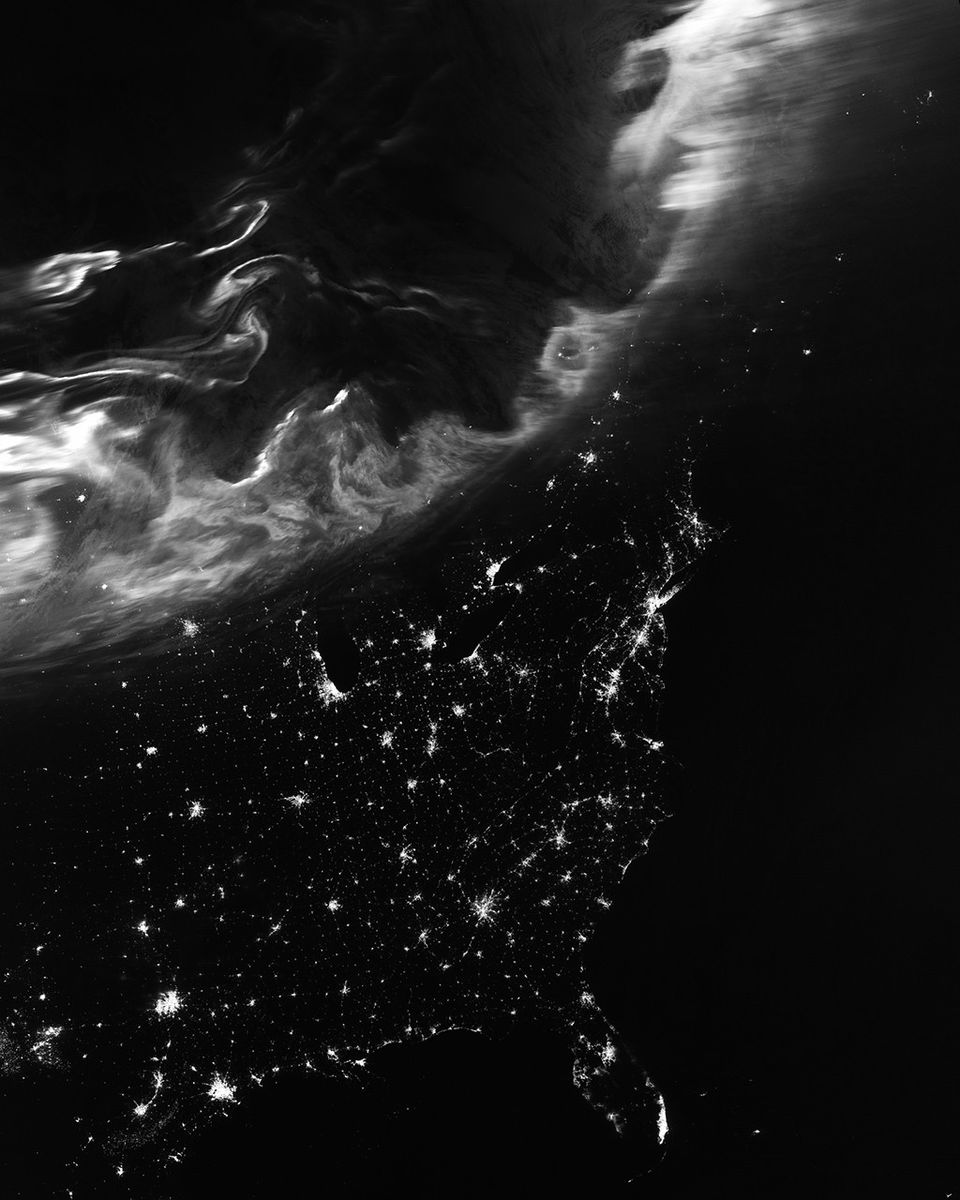
Earth’s magnetosphere acts as both a shield and a guide. Most charged particles are diverted, but the magnetic field channels some particles toward high-latitude regions where they interact with the atmosphere. That is why auroral ovals normally encircle the magnetic poles.
When geomagnetic activity increases, the auroral ovals can expand toward lower latitudes. The exact brightness and location change minute by minute as solar-wind conditions and magnetic-field orientation evolve.
Why auroras often become more favorable near equinoxes
Auroras can occur throughout the year, yet statistical activity often rises around the March and September equinoxes. One explanation is the Russell–McPherron effect: the geometry between Earth’s tilted magnetic field and the interplanetary magnetic field becomes especially favorable for magnetic coupling during parts of the equinox seasons.
This is not a guarantee of a storm on every equinox. The Sun still needs to provide suitable solar-wind conditions. The geometry simply makes energy transfer into the magnetosphere more efficient at certain times.
Aurora is not the same thing as airglow
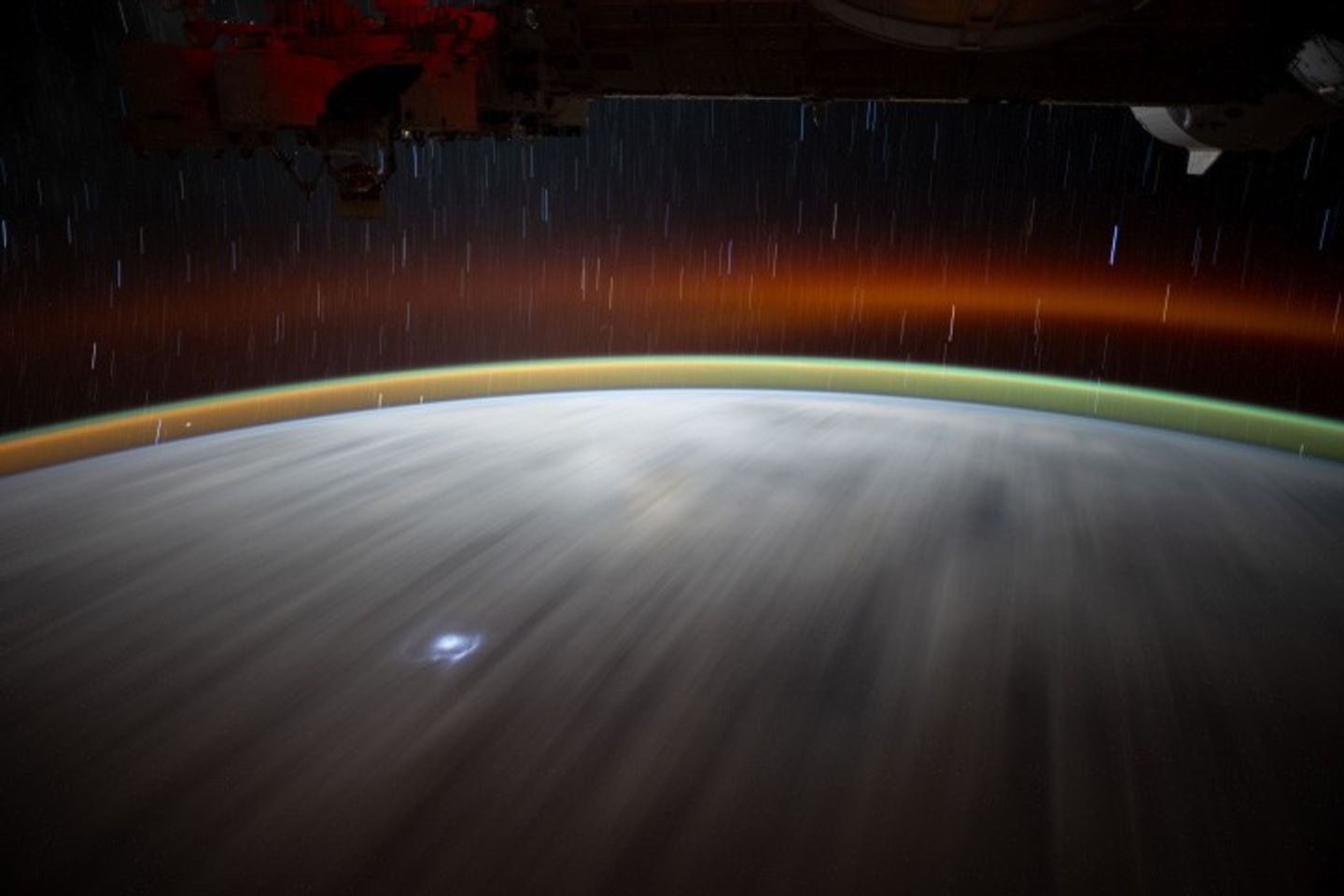
Orbit photographs can show more than one luminous atmospheric phenomenon. Airglow is a faint, persistent emission produced by chemical and photochemical processes in the upper atmosphere. Aurora is driven by incoming energetic particles and can vary dramatically with space weather.
Both can create green and red layers, so context matters. The comparison image of airglow from the ISS is useful because it shows how Earth’s atmosphere naturally forms glowing bands even when the mechanism differs from an auroral storm.
Why astronaut photographs are scientifically useful
Astronaut images provide oblique perspectives that complement satellites looking straight down and ground observers looking up. A single frame can show the curvature of Earth, the relative altitude of emissions, stars and city lights at the same time.
They are also valuable for public communication. Seeing an aurora as a thin luminous layer above a planet-sized horizon makes it clear just how shallow Earth’s habitable atmosphere is compared with the scale of the planet and surrounding space.
Auroras are beautiful signs of space weather
For most people, aurora is the most visible effect of the Sun-Earth connection. The same geomagnetic disturbances that brighten the sky can also affect radio communications, navigation accuracy, satellite operations and electrical systems during stronger events.
That is why heliophysics missions continuously monitor the Sun and near-Earth space. Forecasting space weather is not about predicting a pretty sky alone; it supports technology that modern society depends on.
FAQ
Can aurora really look purple from space?
Yes. Purple can result when emissions from nitrogen and oxygen overlap, and cameras can record faint colors more clearly than dark-adapted human vision in some conditions.
Was this photograph taken above the aurora?
The ISS was about 411 km high. Different auroral emissions occur at different altitudes, so an astronaut can see glowing layers below, near, or along the station’s line of sight.
Does every solar flare cause an aurora?
No. The eruption’s direction and magnetic orientation matter. Strong aurora requires solar material and magnetic conditions that couple effectively with Earth’s magnetosphere.
Official sources & further reading
- NASA Earth Observatory — Purple Haze Aurora
- NASA Earth Observatory — Aurora Australis from the ISS
- NASA Science — Heliophysics
Image credits are shown with each image. External source links open official NASA, ESA/Hubble or Chandra pages.