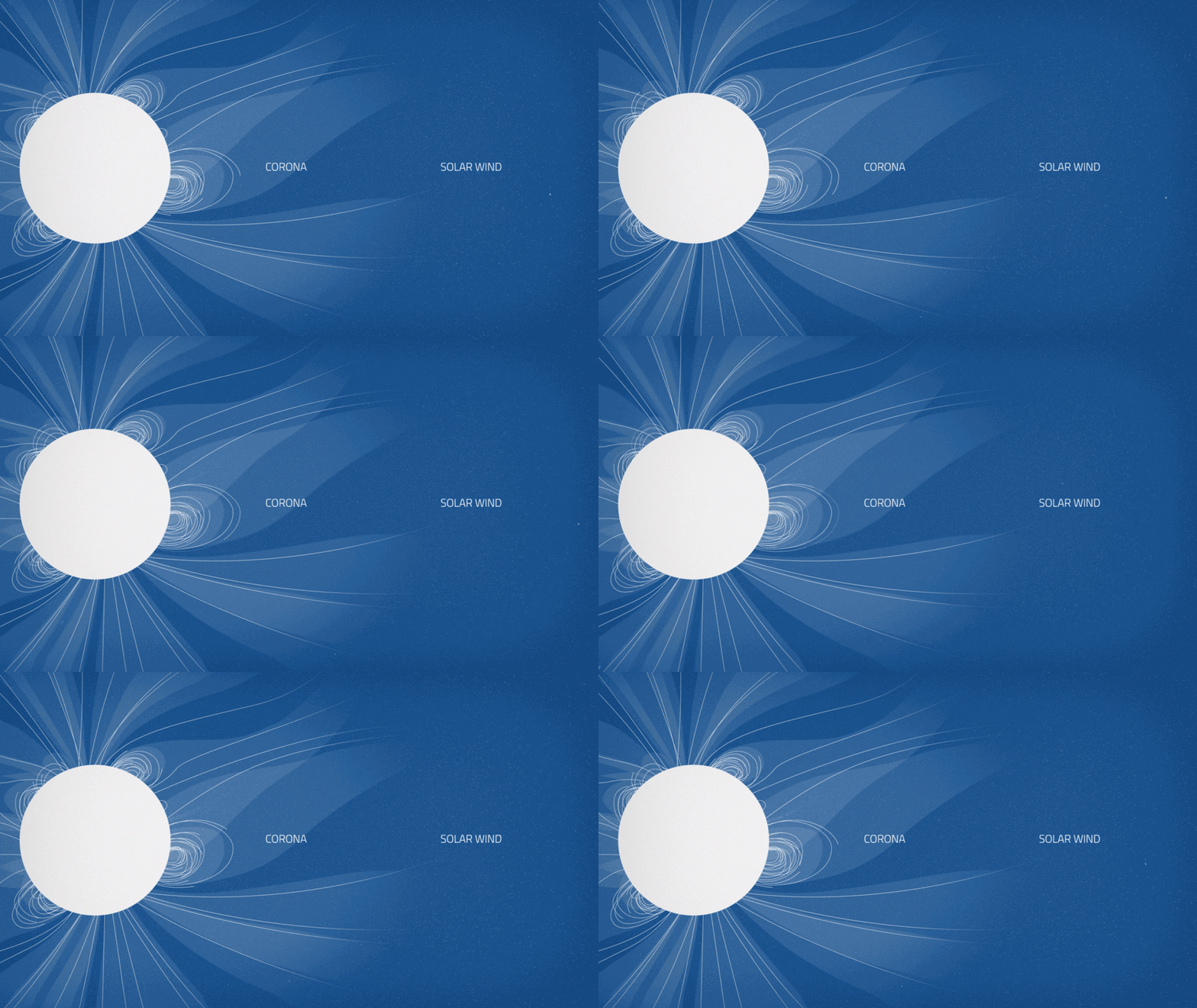
Space between the planets is not empty. The Sun continuously releases a thin stream of electrically charged particles, mainly protons and electrons, together with a magnetic field carried outward from the solar atmosphere. This expanding plasma is the solar wind.
The wind fills the planetary system and keeps traveling until its pressure is balanced by the surrounding interstellar medium. In doing so it creates the heliosphere: an enormous bubble of solar plasma and magnetic influence that extends far beyond Pluto. Understanding this flow connects phenomena as different as auroras near Earth, radiation hazards for astronauts and the boundary between our solar environment and interstellar space.

Where the solar wind comes from
The Sun’s visible surface is only one layer of a much larger atmosphere. Above it lies the corona, a tenuous region heated to temperatures of millions of degrees. At those temperatures, matter exists as plasma and particles can escape the Sun’s gravitational hold.
The detailed physics of how the corona becomes so hot and how the solar wind is accelerated has challenged scientists for decades. Magnetic fields, waves, turbulence and explosive events all play roles. Measuring the wind close to the Sun is therefore crucial, because by the time it reaches Earth it has already evolved through interactions over tens of millions of kilometers.
What Parker Solar Probe measures close to the Sun
NASA’s Parker Solar Probe launched in 2018 and became the first spacecraft to fly through the solar corona in 2021. Its increasingly close passes allow instruments to sample magnetic fields, plasma and energetic particles in the region where the solar wind is still being accelerated.
NASA says Parker travels about 430,000 mph (700,000 kph) near closest approach and uses a thick carbon-composite heat shield to protect its instruments. The mission aims to explain how energy moves through the corona, what accelerates the solar wind and how high-energy solar particles are produced.
How solar wind becomes space weather
The background solar wind changes in density, speed and magnetic orientation. Coronal mass ejections can add huge clouds of plasma and magnetic field, while high-speed streams can emerge from coronal holes. When those structures reach Earth, the interaction with our magnetosphere can trigger geomagnetic storms.
The visible result can be spectacular auroras, but there are practical effects too. Strong space weather can disturb radio communication and navigation, increase radiation exposure, affect satellite electronics and produce electrical currents in long conductors on the ground. Forecasting therefore depends on understanding both solar eruptions and the solar wind that carries their effects outward.
How the solar wind reshapes planetary environments
Every planet meets the solar wind differently. Earth’s global magnetic field deflects much of the flow and creates a magnetosphere with a compressed dayside and long nightside tail. Jupiter’s much stronger magnetic environment forms an even larger structure.
Worlds without a strong global magnetic field interact more directly. Mars and Venus have different atmospheric and induced-magnetic responses, and airless bodies such as the Moon are directly exposed at the surface. Over long timescales, solar-wind interactions can contribute to atmospheric loss and surface weathering.
How the heliosphere forms
As solar plasma streams away from the Sun, it carries the Sun’s magnetic field into interplanetary space. The combined flow and field create the heliosphere, which encloses all the planets. Far from the Sun, the solar wind slows as it encounters the pressure of the local interstellar medium.
The outer region includes the termination shock and heliosheath before reaching the heliopause. The exact shape is not a simple sphere; it responds to the direction and properties of the interstellar environment and to changing solar conditions. Modern models use data from Voyager, IBEX and other missions to refine that shape.

What Voyager discovered at the heliopause
Voyager 1 crossed the heliopause in 2012, and Voyager 2 crossed in 2018. Voyager 2’s working plasma instrument directly measured a sharp change as the spacecraft left the solar-wind-dominated environment, providing a powerful confirmation that it had entered interstellar space.
The heliopause is where the outward influence of the solar wind meets the interstellar medium. Crossing it does not mean leaving the Solar System in every possible definition—the distant Oort Cloud extends much farther—but it does mark a fundamental plasma boundary between the Sun’s wind and interstellar space.
Does the heliosphere protect us?
The heliosphere helps modulate many high-energy galactic cosmic rays coming from outside the Solar System. Solar magnetic fields and solar-wind turbulence deflect or slow some incoming particles, so the cosmic-ray environment changes with solar activity.
That shielding is not absolute, and the heliosphere itself also contains energetic particles produced by the Sun. Understanding how particles are accelerated and transported is important for both astrophysics and human exploration beyond Earth’s magnetic protection.
FAQ
Is the solar wind the same as sunlight?
No. Sunlight is electromagnetic radiation made of photons. The solar wind is a flow of charged particles and magnetic fields moving outward from the Sun.
Where does the solar wind end?
Its dominance ends near the heliopause, the outer boundary of the heliosphere where the solar wind meets the interstellar medium.
Have any spacecraft crossed the heliopause?
Yes. Voyager 1 crossed in 2012 and Voyager 2 crossed in 2018, returning direct measurements from beyond the heliosphere.