
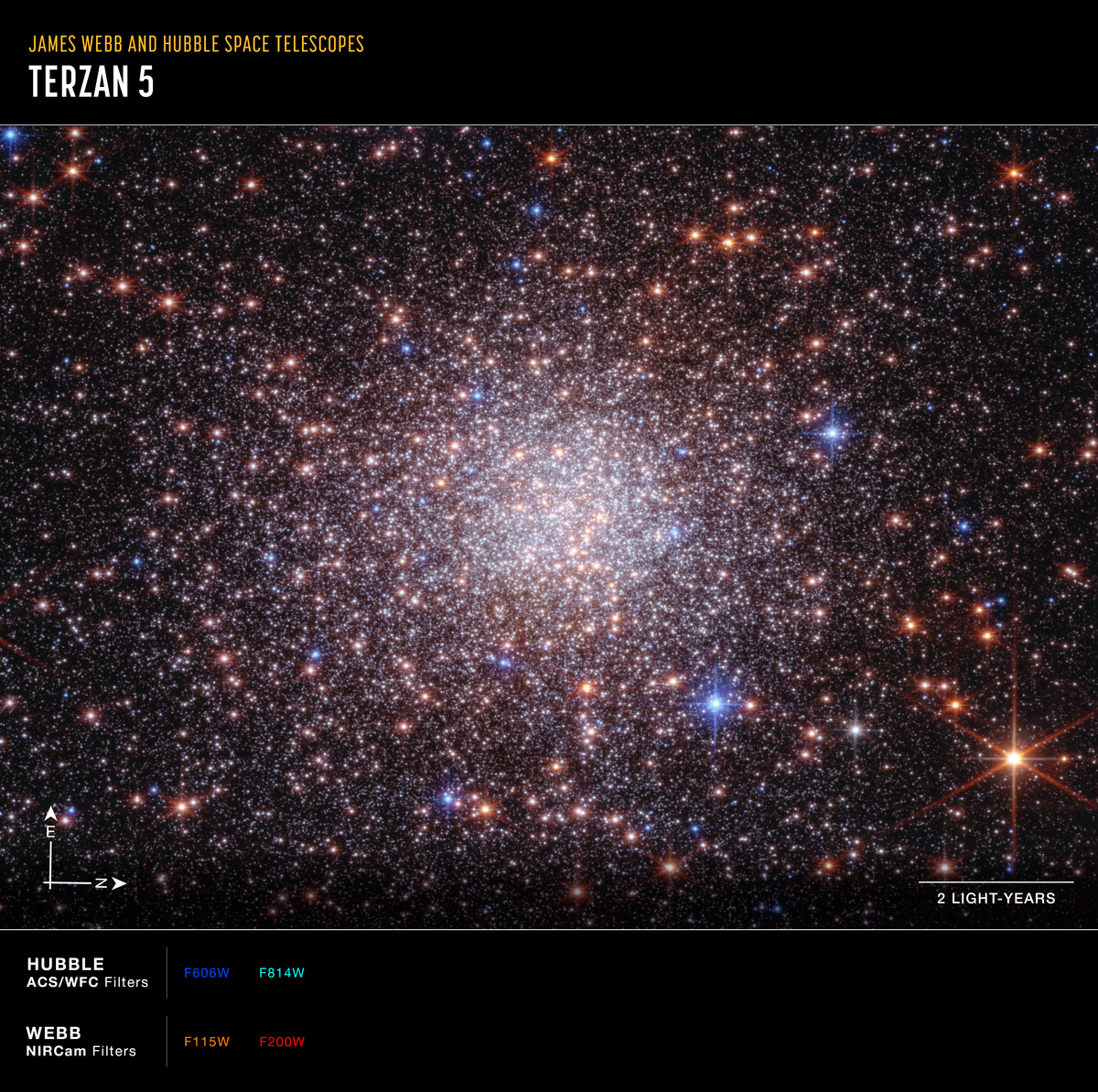
Terzan 5 sits toward the crowded, dusty inner Milky Way, where visible-light observations are difficult. It resembles a globular cluster but contains multiple stellar populations with different chemical histories, making it an important clue to how the central regions of our galaxy assembled.
Quick facts
- Terzan 5 lies about 22,000 light-years from Earth.
- Infrared observations are valuable because interstellar dust dims visible light strongly toward the Galactic center.
- Dense clusters allow astronomers to study large numbers of stars with similar distances.
- Differences in stellar chemistry can reveal more than one episode of star formation.
Why this matters
If all stars in a simple cluster formed at once from the same gas, they should share a closely related chemical history. Terzan 5 is more complicated. Its mixed populations suggest repeated enrichment and formation episodes, making it more like a surviving fragment of a larger early Galactic component than a textbook single-generation cluster.
How to read this result
For this astronomy story, the strongest interpretation comes from connecting the image with quantitative measurements and physical models. Terzan 5 lies about 22,000 light-years from Earth. Infrared observations are valuable because interstellar dust dims visible light strongly toward the Galactic center. Together, those measurements give the visual feature a testable physical meaning and help researchers compare it with earlier observations and models.
What comes next
Precise infrared photometry and spectroscopy can improve stellar ages and chemical abundances. Those measurements can be compared with models of the Milky Way bulge to test whether Terzan 5 formed in place or is the remnant of a system that later merged into the Galaxy.