
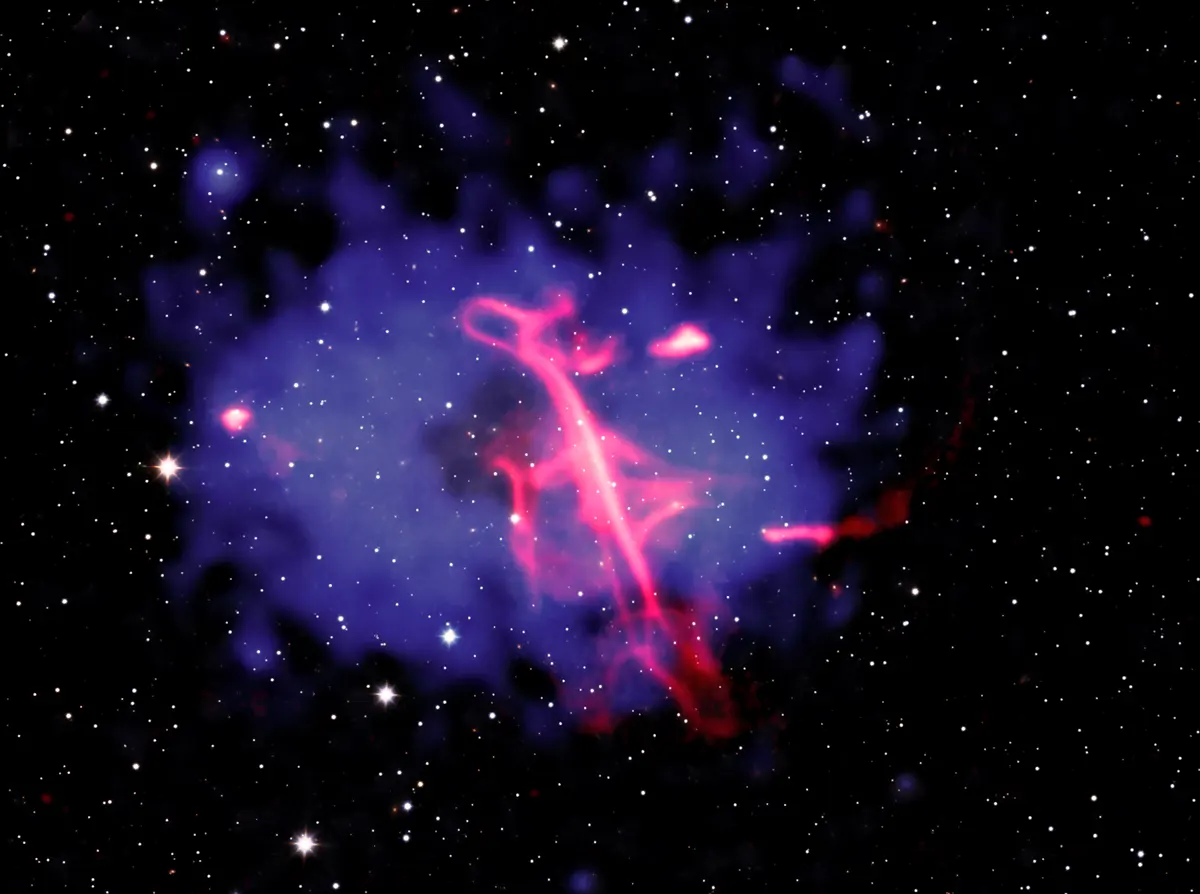
Across the sky, a vast radio structure nicknamed the “Treble Clef” resembles a musical symbol. The resemblance is a coincidence, not a connection to music. What makes it scientifically interesting is its size—more than two million light-years across—and the evidence that it may have been shaped by both a supermassive black hole and a collision between galaxy clusters.
What is the Treble Clef structure?
The object, catalogued as VLSS J0318.9+5755, was examined in radio data years before its origin was understood. Its distinctive shape is made visible by radio emission from energetic charged particles. Ordinary visible-light images alone do not reveal the full structure.
The source lies close to the plane of the Milky Way, where foreground stars, gas and dust make it harder to see distant objects. Astronomers therefore combine observations at different wavelengths to separate the components and infer the physical processes taking place.
Stage one: a supermassive black hole releases particles
Supermassive black holes can influence their surroundings even though light cannot escape from inside their event horizons. Material falling toward a black hole can form a hot accretion flow, and some systems launch jets containing charged particles and magnetic fields.
In the Treble Clef interpretation, an earlier outburst from a central black hole drove particles far beyond its host galaxy. Those particles produced radio emission as they moved through magnetic fields. Over time, the emission faded as the particles lost energy.
Stage two: two galaxy clusters collide
Galaxy clusters contain hundreds of galaxies and enormous quantities of hot, thin gas. When clusters interact, gravity and shock waves can disturb that gas and alter the conditions around old clouds of energetic particles.
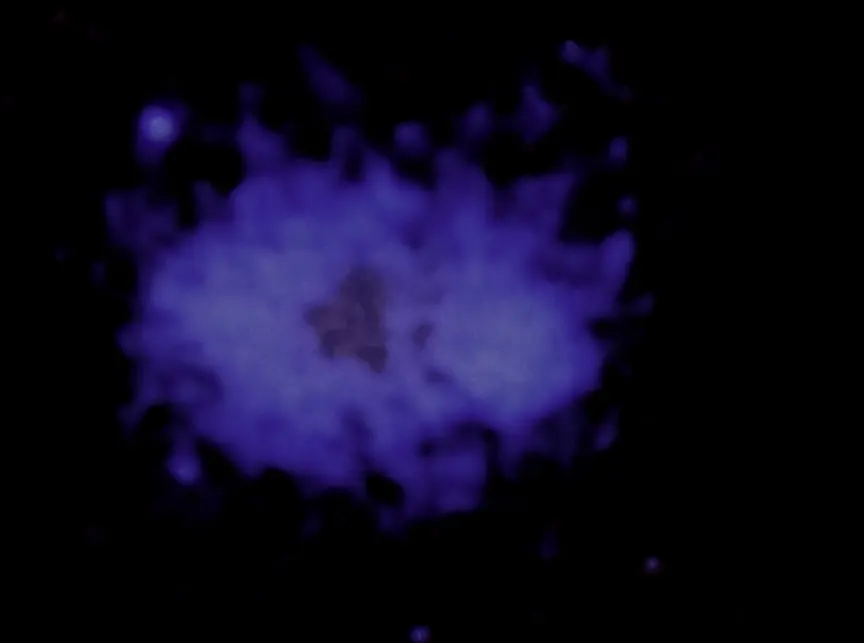
Chandra and the eROSITA X-ray telescope found hot gas associated with the region, supporting the conclusion that two galaxy clusters are merging. Researchers compared the observed X-ray distribution with a smoother, symmetrical model. The residual pattern helped reveal differences consistent with a collision that occurred hundreds of millions of years ago.
The collision may have compressed or re-energized the old radio-emitting material, making the structure bright again. This remains a scientific interpretation based on multiple observations, rather than a direct movie of the event.
Why astronomers combine radio, X-ray and infrared data
Different wavelengths reveal different ingredients. Radio observations trace energetic particles and magnetic fields. X-rays reveal extremely hot gas, including the gas in galaxy clusters. Infrared observations help map galaxies and stars through dust that can obscure visible light.
When these data are aligned, scientists can compare the shape of the radio emission with the distribution of hot gas and the galaxies in the system. A multiwavelength image is not simply a colourful photograph: each colour can represent a different measurement, and its interpretation depends on the instrument and processing used.
Why the discovery matters
The Treble Clef offers a possible example of how black-hole activity and large-scale cosmic collisions can work together. A black hole can inject energy into its surroundings, while a later cluster merger can reshape that material long after the original outburst has faded.
Such relics help astronomers reconstruct the history of galaxy clusters and understand how energy moves through the largest gravitationally bound structures in the universe. The exact timeline and geometry still depend on further observations and modelling.
Frequently asked questions
Is the Treble Clef really a musical object?
No. It is a nickname for a radio structure whose shape happens to resemble the musical symbol.
How large is it?
The radio structure extends more than two million light-years.
Can we see it with the naked eye?
No. It is studied using astronomical instruments, especially radio and X-ray observations.
Did the black hole cause the cluster collision?
There is no evidence that it did. The current explanation is that the black-hole outburst and the later cluster collision were two separate stages that affected the same region.
Trusted sources and further reading
Image note: The featured image is credited to its original NASA/ESA/STScI or mission team source. Please review the source page for the applicable credit and reuse guidance.