
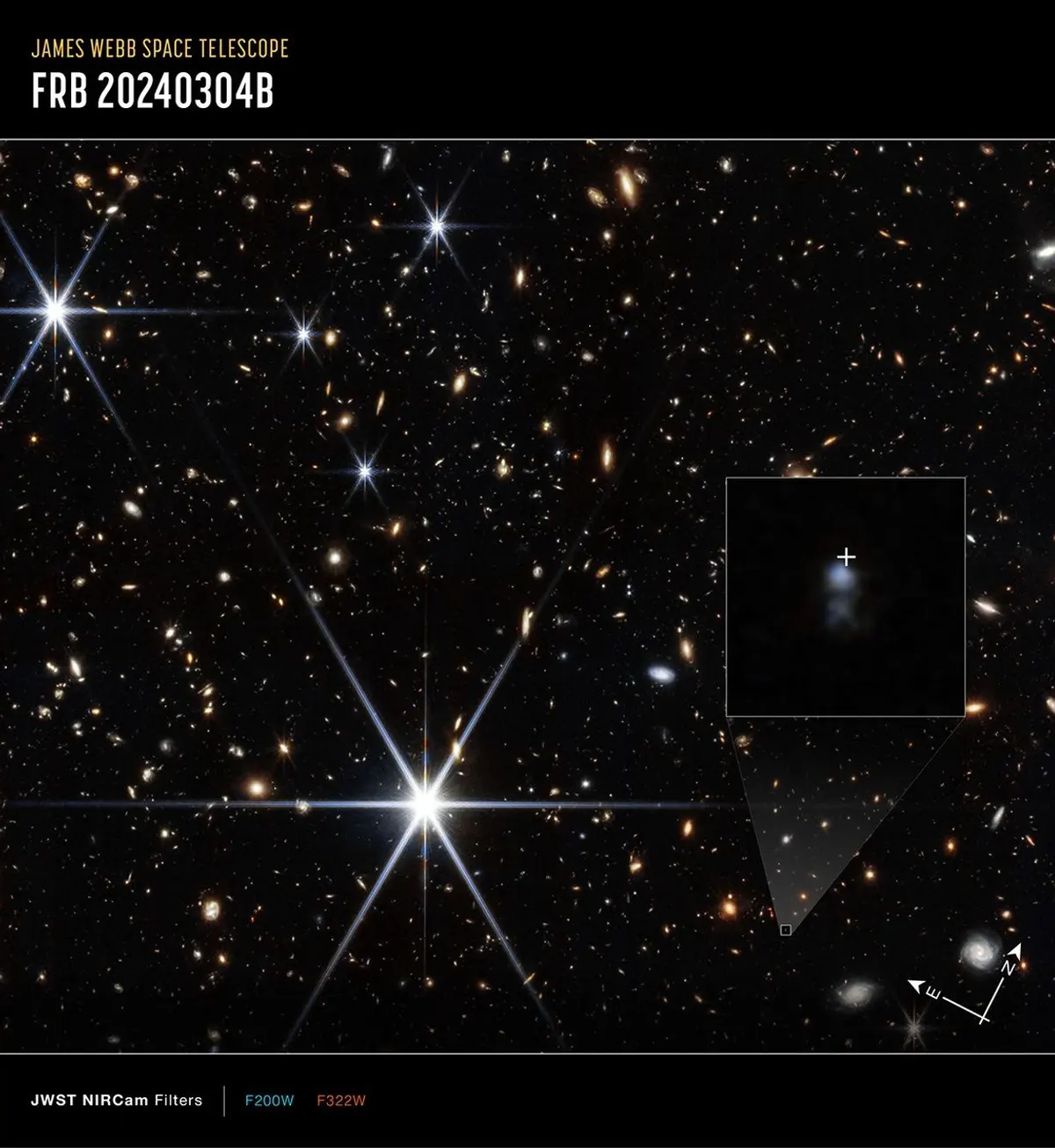
Fast radio bursts (FRBs) are extremely brief flashes of radio waves that can release enormous amounts of energy in only milliseconds. They arrive from across the universe, and most are so short that astronomers have to locate their positions quickly before the evidence becomes difficult to follow. Their physical origins remain an active area of research.
What is a fast radio burst?
An FRB is a short, intense pulse of radio emission arriving from beyond our Solar System. The first FRBs were identified in 2007, and researchers have since detected many more. Some repeat, while many have been seen only once. That variety makes it difficult to settle on one explanation for every burst.
Radio telescopes can measure the arrival time and direction of a burst. When several facilities work together, they can narrow down its location enough for other telescopes to search for the galaxy in which it occurred.
How Webb helped identify the host galaxy
The burst designated FRB 20240304B was detected on March 4, 2024, by the MeerTRAP team using the MeerKAT radio telescope. Radio observations suggested it was exceptionally distant. To confirm the distance, astronomers needed to identify and measure the galaxy at the burst’s position.
Ground-based telescopes had not been able to see the faint host clearly. Webb’s Near-Infrared Camera (NIRCam) detected the galaxy, while its Near-Infrared Spectrograph (NIRSpec) measured a redshift of 2.148. That places the observed galaxy in a period when the universe was roughly three billion years old.

Why the small host galaxy surprised astronomers
Many previously identified FRB host galaxies are relatively massive galaxies that are forming stars. This host was estimated to be around a thousand times less massive than researchers had expected, while still forming stars actively. Its unusual properties provide a useful test for ideas about how FRBs are produced.
One proposed explanation involves merging neutron stars, the dense remnants left behind by some stellar explosions. Another possibility is a magnetar: a neutron star with an exceptionally strong magnetic field. A young magnetar could produce a burst relatively soon after its massive parent star explodes. The host galaxy’s active star formation makes this second scenario worth investigating, but one observation does not prove a universal origin for all FRBs.
FRBs as probes of matter between galaxies
A burst’s radio signal travels through enormous distances before reaching Earth. Matter along that path affects the signal in measurable ways. By studying those changes, astronomers can investigate otherwise difficult-to-see gas and structures between galaxies, sometimes called the cosmic web.
The Webb study reported evidence along the line of sight for a galaxy cluster at a redshift of 0.3 and the nearby Virgo Cluster. This illustrates why FRBs can be useful beyond the mystery of what creates the flashes: they may also help map matter that is too faint to observe directly.
What the discovery does—and does not—tell us
The result demonstrates the value of combining radio observations with infrared imaging and spectroscopy. Radio telescopes pinpoint the burst; Webb can then characterize a very faint host galaxy and measure its redshift.
It does not mean scientists have solved every FRB. Different bursts may arise from different environments or mechanisms, and researchers need a larger, well-measured sample to determine which patterns are common.
Frequently asked questions
How long does a fast radio burst last?
Typically only milliseconds, although the exact signal profile varies.
Did Webb detect the radio burst itself?
No. Radio facilities detected and localized the burst. Webb was used to identify and study its host galaxy in infrared light.
What does redshift 2.148 mean?
It describes how much the galaxy’s light has been stretched by cosmic expansion and helps astronomers estimate its distance and era in cosmic history.
Do scientists know what causes all FRBs?
No. Magnetars are an important candidate for at least some bursts, but the full range of FRB origins is still being investigated.
Trusted sources and further reading
Image note: The featured image is credited to its original NASA/ESA/STScI or mission team source. Please review the source page for the applicable credit and reuse guidance.