Type Ia supernovae are thermonuclear stellar explosions involving white dwarfs. Their predictable light-curve behavior makes them powerful distance indicators, while their exact progenitor pathways remain an active field of research.
First, what is a white dwarf?
A white dwarf is the compact core left behind when a star like the Sun finishes its normal nuclear-burning life and sheds its outer layers. It is roughly Earth-sized but can contain a large fraction of the Sun's mass. Electron degeneracy pressure, a quantum-mechanical effect, supports the star against further collapse under ordinary white-dwarf conditions.
Most white dwarfs simply cool for extremely long periods. A Type Ia supernova requires a white dwarf in a system where interaction with a companion changes that quiet future. The important point is that the explosion is thermonuclear rather than the core-collapse death of a very massive star.
How a thermonuclear runaway can begin
A white dwarf in a binary system can gain mass or merge with another compact star. If conditions drive its carbon-and-oxygen-rich material to sufficiently high temperature and density, nuclear burning can accelerate dramatically. Heating speeds the reactions, and the degenerate matter does not initially expand and cool in the same self-regulating way as an ordinary stellar core. The result can be a runaway.
Within seconds, burning races through much of the white dwarf. The energy is sufficient to unbind the star, ejecting material at thousands of kilometres per second. Unlike many core-collapse supernovae, a standard Type Ia event does not leave behind the same original white dwarf; the thermonuclear disruption destroys it.
One label, more than one possible progenitor channel
Astronomers have long discussed a single-degenerate scenario in which a white dwarf gains material from a non-degenerate companion, and a double-degenerate scenario involving two white dwarfs. Other variants change how ignition happens and how much mass is present at the time of explosion.
Observations indicate that Type Ia supernovae are a recognizable family, but the exact mixture of progenitor pathways remains an active research topic. That uncertainty is important. A clear explanation should not imply that every Type Ia event follows one identical binary history even though the resulting explosions share useful observational similarities.
Why Type Ia supernovae measure distance
Type Ia supernovae can become bright enough to be observed across enormous distances. Their peak luminosities are not perfectly identical, but the way their light curves brighten and fade allows astronomers to standardize them. After calibration, an event's observed brightness can be compared with its expected luminosity to estimate distance.
This made Type Ia supernovae central to modern cosmology. Measurements of distant supernovae helped reveal that the expansion of the Universe is accelerating. New missions such as NASA's Nancy Grace Roman Space Telescope are designed to find and measure large samples, improving the statistics and helping researchers control systematic uncertainties.
What supernova remnants tell us
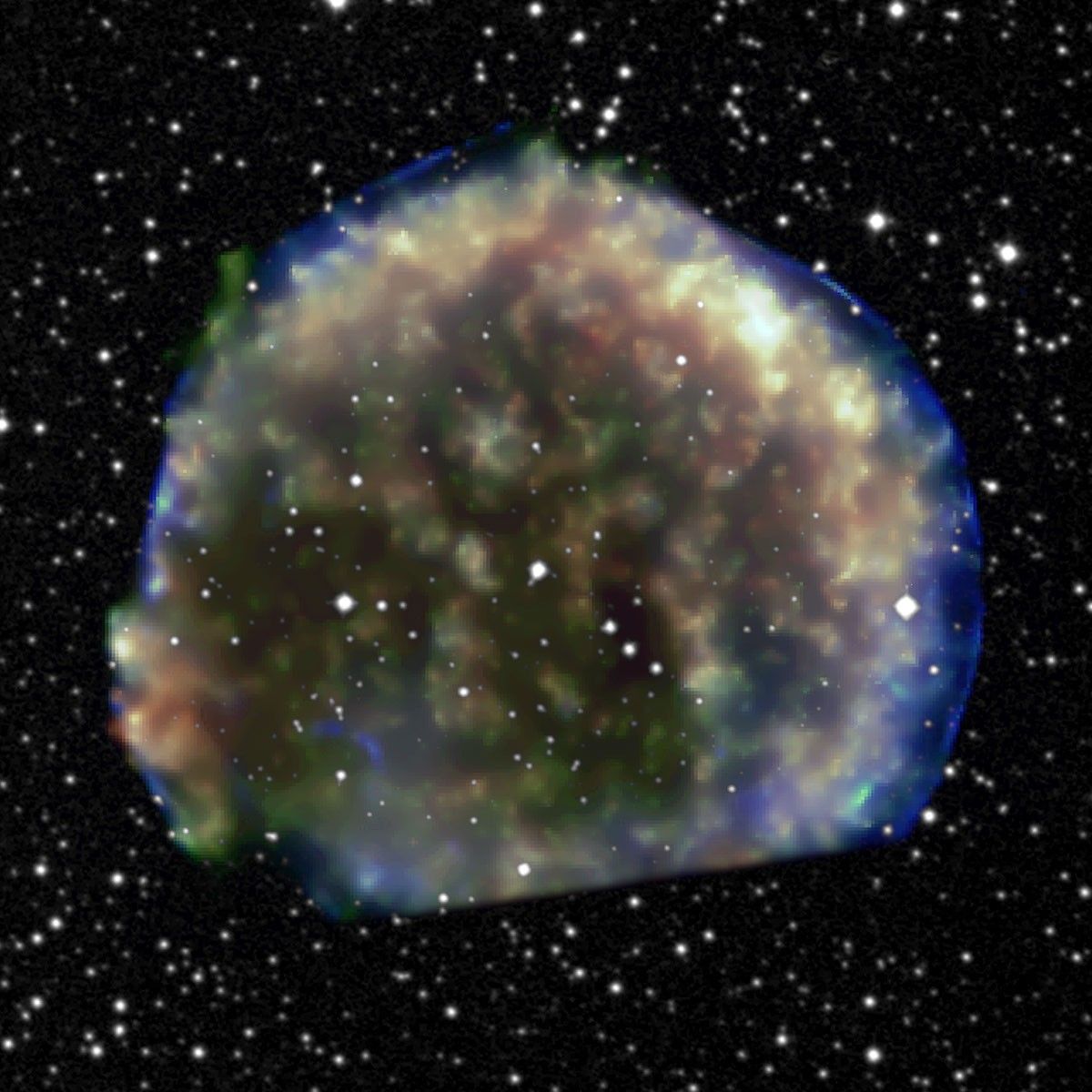
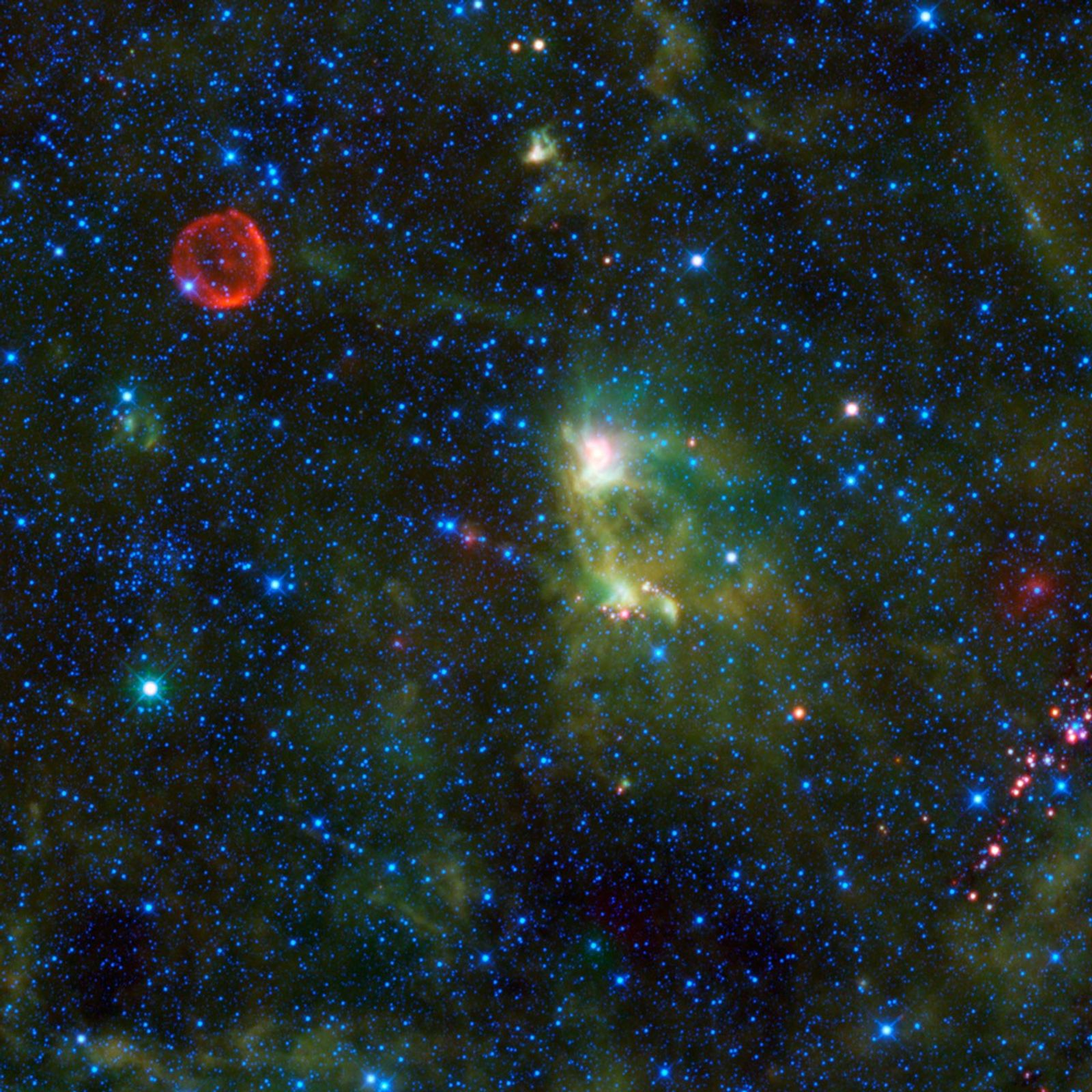
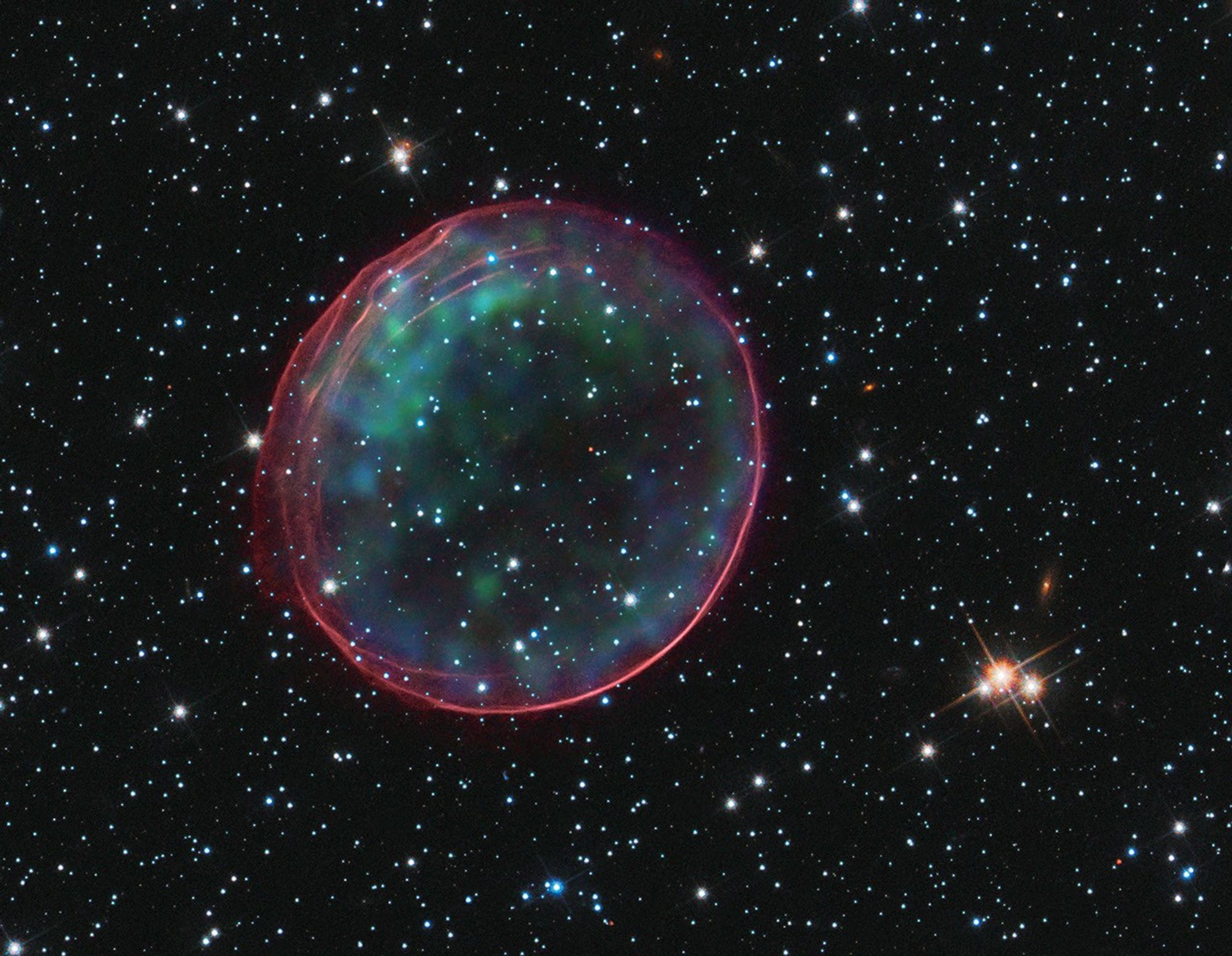
Centuries after an explosion, fast ejecta continue to collide with surrounding gas. The resulting supernova remnant glows across the electromagnetic spectrum. X-rays trace shock-heated gas and energetic particles, optical emission maps filaments and knots, and infrared observations reveal warm dust.
Tycho's supernova remnant is a famous Type Ia example linked to the 'new star' observed in 1572. By mapping the distribution of elements and the structure of the shock, astronomers test explosion models and search for clues about the companion system that existed before the blast.
Factories for heavy elements
Thermonuclear supernovae produce and eject large amounts of iron-group elements along with intermediate-mass elements. Over cosmic time, those explosions enrich interstellar gas. Later generations of stars and planets form from material that has been chemically processed by earlier stars and supernovae.
Chemical enrichment connects stellar evolution to galaxies and planets. The iron in rocky worlds and in living organisms was forged through astrophysical processes, including supernovae. Measuring element abundances in remnants helps researchers reconstruct both the explosion and the long-term chemical history of galaxies.
What Roman and future surveys can improve
Larger, better-characterized samples of Type Ia supernovae can sharpen measurements of cosmic expansion. Wide-field infrared observations are especially useful for reaching distant events and reducing some effects of dust. Researchers also compare nearby, well-observed explosions with remote ones to ensure that standardization remains reliable across cosmic history.
At the same time, detailed studies of remnants and pre-explosion systems target the progenitor question. The field therefore works at two scales: individual binaries and explosion physics on one side, and the expansion history of the Universe on the other.
FAQ
Does a Type Ia supernova leave a neutron star?
Normally no. Type Ia explosions are thermonuclear disruptions of white dwarfs, unlike core-collapse supernovae that can leave neutron stars or black holes.
Are all Type Ia supernovae exactly the same brightness?
No. They are standardizable rather than perfectly identical; astronomers use light-curve behavior and calibration to infer intrinsic luminosity.
Was Tycho’s 1572 supernova a Type Ia event?
Modern observations of its remnant identify it as a Type Ia supernova, making Tycho’s remnant a major laboratory for studying this class.