
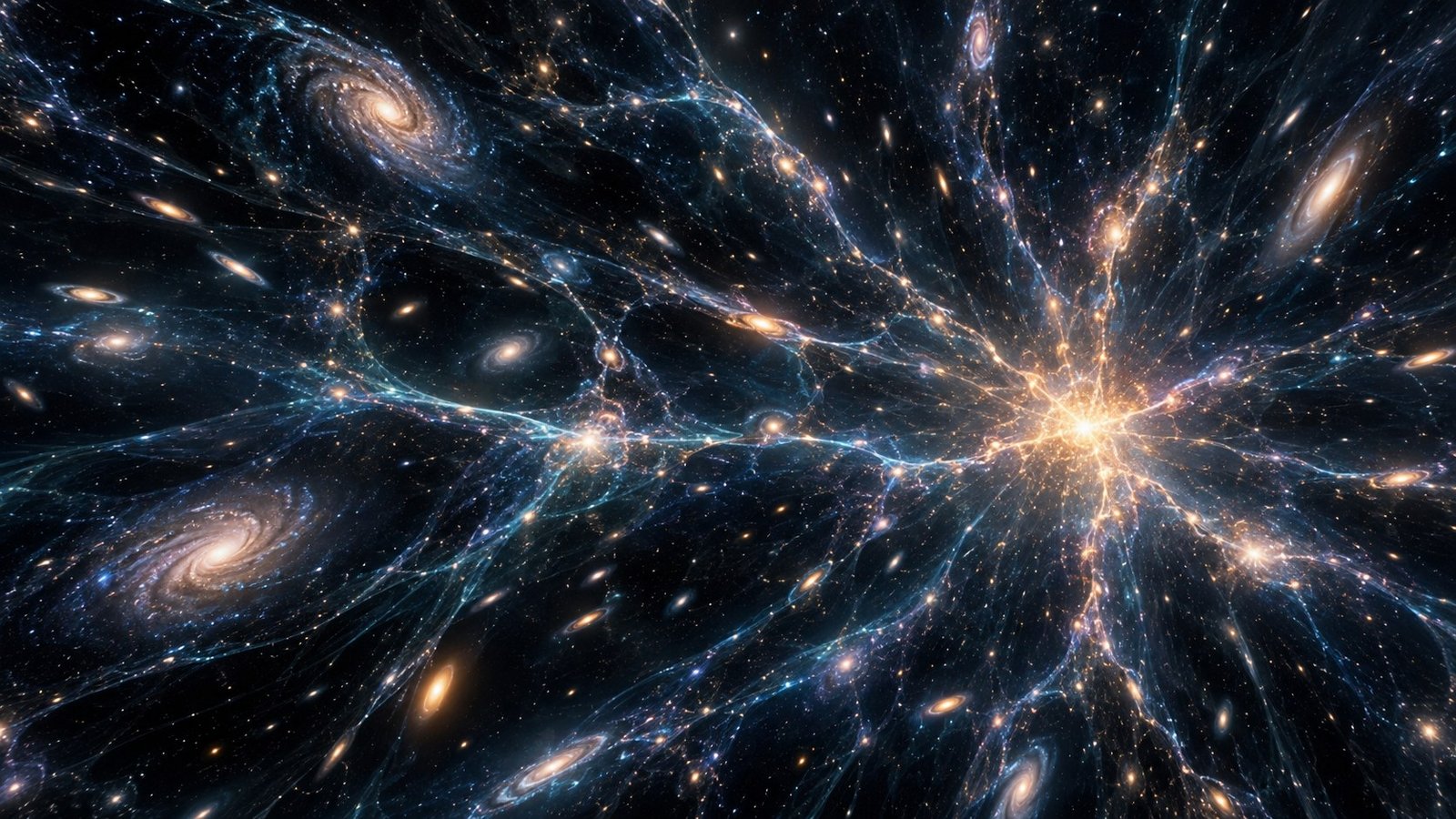
Astronomers have strong evidence that the expansion of the universe is accelerating. “Dark energy” is the name given to whatever is responsible for that acceleration, but the name does not mean scientists already know what the underlying physics is.
Expansion is not the same as an explosion
On large scales, galaxies are not simply flying through a fixed empty space from one central point. The distances described by the fabric of the universe itself can grow with time. A common analogy is dots on an inflating balloon, although the real universe has three spatial dimensions and no need for a center on the balloon’s surface.
The expansion rate has changed over cosmic history because matter, radiation and whatever drives acceleration contribute differently as the universe evolves.
How acceleration was discovered
In the late 1990s, teams studying distant Type Ia supernovae found that the explosions appeared dimmer than expected in a universe whose expansion was slowing under gravity alone. The measurements pointed toward accelerated expansion.
Since then, several kinds of observations — including the cosmic microwave background, galaxy clustering and large-scale distance measurements — have been combined to test cosmological models.
The cosmological constant idea
The simplest widely used model treats dark energy as a constant energy density of empty space, represented by the cosmological constant in Einstein’s equations. In the standard cosmological model, this description fits a wide range of observations remarkably well.
The puzzle is theoretical: the measured value is extremely small compared with straightforward expectations from quantum field ideas. Explaining that mismatch remains a major challenge.
Could dark energy change with time?
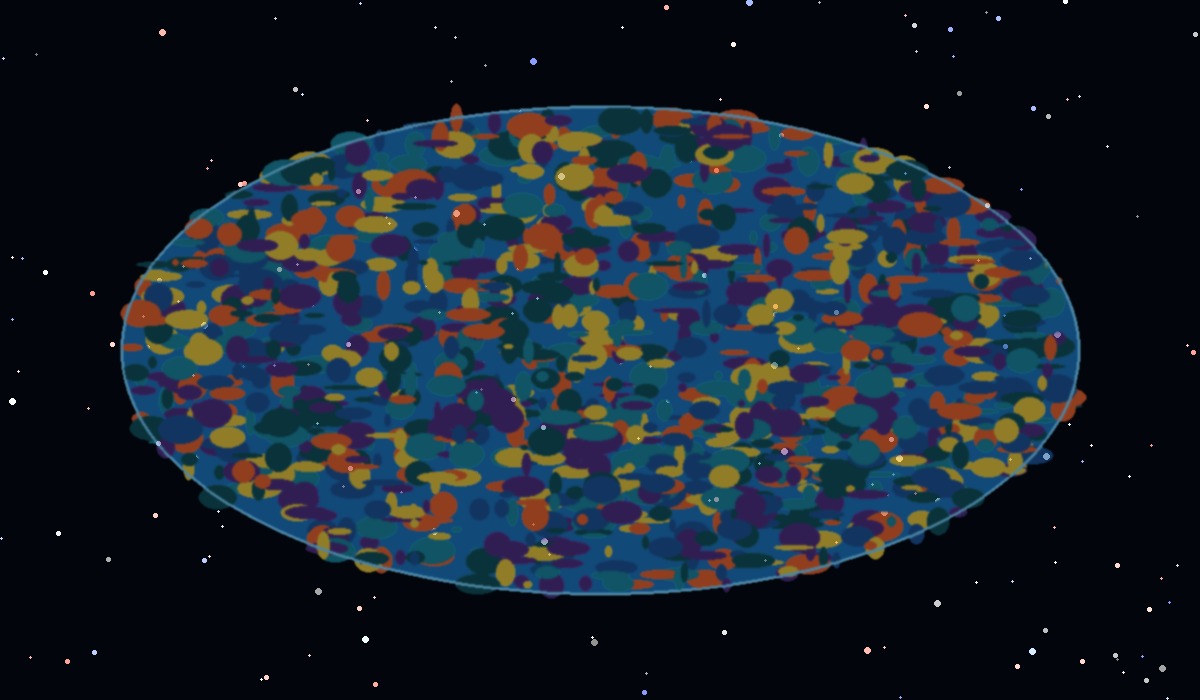
Some alternatives propose a dynamic field whose strength changes as the universe evolves. Others ask whether our understanding of gravity needs modification on the largest scales. These ideas must reproduce the many observations already explained by the standard model.
That is why large sky surveys are valuable. Small differences in how cosmic structure grows or how expansion changes with time can distinguish between competing models.
Why the mystery matters
Dark energy affects the long-term future of the universe and touches deep questions about gravity, quantum physics and the nature of space itself. The answer may be simple, or it may require physics beyond our current theories.
For now, the careful statement is that accelerated expansion is well supported, while the physical nature of dark energy remains unknown.
FAQ
Is dark energy the same thing as dark matter?
No. Dark matter helps explain additional gravity in galaxies and clusters, while dark energy is invoked to explain accelerated expansion on the largest scales.
Do scientists know what dark energy is?
Not yet. The name describes a measured effect, not a solved physical explanation.
Why do surveys like Euclid matter?
Because precise maps of structure growth and cosmic geometry can test whether dark energy behaves like a constant or something more complicated.