
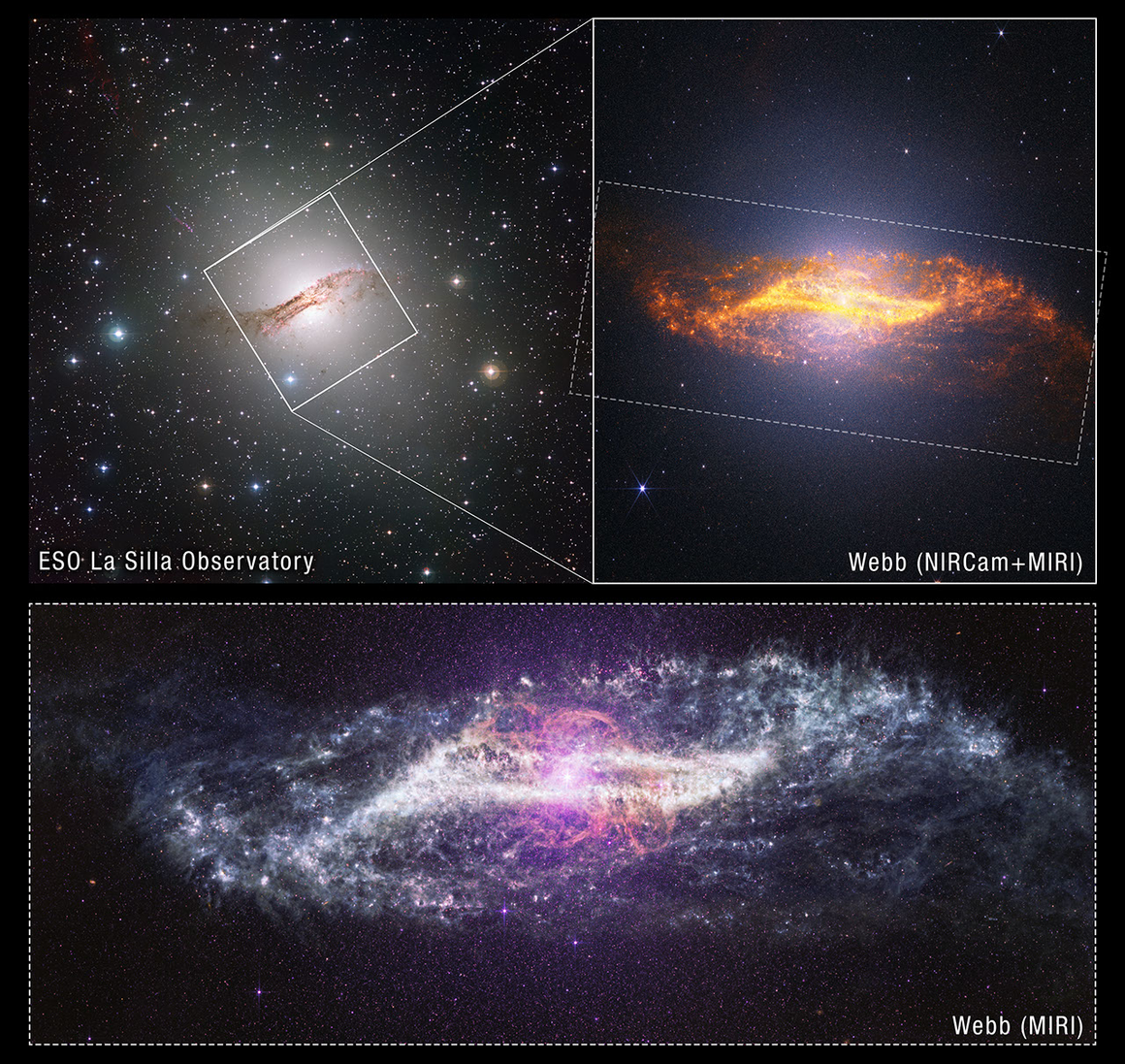
Centaurus A is one of the closest active galaxies and one of the clearest examples of a galaxy reshaped by a past collision. Its bright central region is crossed by a dark dust lane, while a supermassive black hole powers energetic activity at the core. Infrared observations expose stars and dust that are partly hidden in ordinary visible-light images.
Quick facts
- Centaurus A is roughly 11 million light-years from Earth.
- The galaxy’s unusual structure is linked to a merger between earlier galaxies.
- Its central black hole drives energetic jets visible at radio and X-ray wavelengths.
- Infrared imaging can trace warm dust and stars through the prominent dust lane.
Why this matters
Galaxy mergers rearrange gas, stars and angular momentum. Some gas can be compressed into new stars while some loses enough orbital energy to move toward the center, where it may feed a black hole. Centaurus A lets astronomers study these processes at unusually close range.
How to read this result
For a galaxy, different wavelengths separate starlight, dust, gas and high-energy activity that overlap in a single view. Centaurus A is roughly 11 million light-years from Earth. The galaxy’s unusual structure is linked to a merger between earlier galaxies. Together, those measurements give the visual feature a testable physical meaning and help researchers compare it with earlier observations and models.
What comes next
Combining Webb images with radio and X-ray data can connect small-scale structures around the nucleus with the much larger jets and lobes. That multiwavelength approach is essential because no single band shows the entire energy flow.