
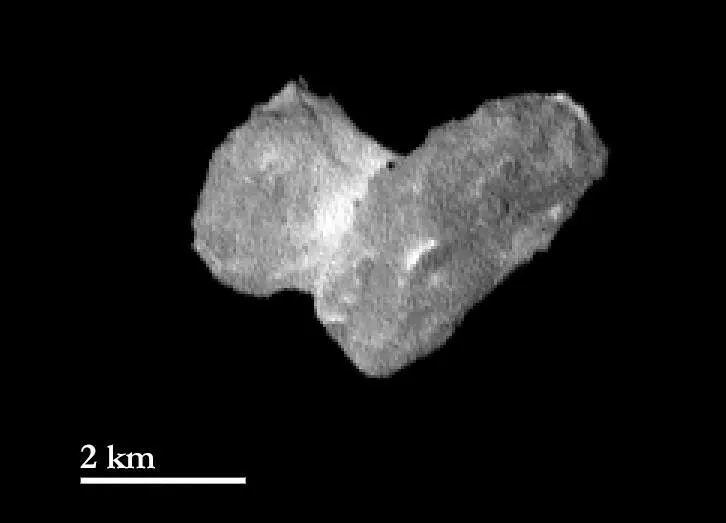
Comets are small bodies that travel around the Sun. Many contain material preserved from the early Solar System, when the Sun and planets were forming. When a comet approaches the Sun, its icy surface can release gas and dust, creating a glowing cloud and sometimes a long, visible tail.
What is a comet?
A comet is a natural object that orbits the Sun and contains ice mixed with dust and rocky material. Some comets follow short-period orbits and return to the inner Solar System within decades. Others travel on much longer orbits and may take thousands of years to return.
A comet far from the Sun may appear as a small, faint nucleus. As solar heating increases, escaping material can surround it with a coma and tails. These features can make a comet look much larger than its solid central body.
What are comets made of?
A comet's solid center is called its nucleus. It contains a mixture of frozen substances, dust and rocky grains. Water ice is important, but comets can also contain frozen carbon dioxide, carbon monoxide and other compounds.
The nucleus is not the same as the coma. The nucleus is the solid body, while the coma develops when material escapes from the surface and expands into space. The amount of activity depends on the comet, its orbit and how strongly sunlight heats its surface.
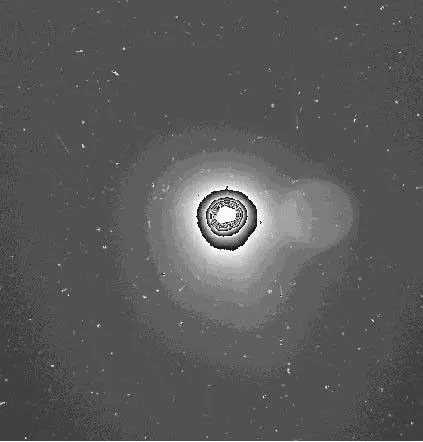
Why do comets develop a coma?
When a comet approaches the Sun, its surface warms. Some frozen material changes directly into gas, a process called sublimation. The escaping gas can carry dust grains away from the nucleus.
This material expands around the nucleus and forms the coma. Sunlight can illuminate dust particles, while certain gas molecules absorb energy and emit light. The coma may grow considerably as the comet becomes more active, although not every comet develops a bright appearance visible from Earth.
Why do comets have tails?
A comet can develop a dust tail and an ion tail. The dust tail contains particles released from the nucleus and pushed by sunlight. It often looks broad and curved because the particles follow their own paths around the Sun.
The ion tail contains electrically charged gas. The solar wind and its embedded magnetic field influence this material, usually creating a tail that points more directly away from the Sun.
This is why a comet's tail does not simply trail behind it like smoke behind a moving vehicle. The direction of the tail depends mainly on solar radiation, the solar wind and the motion of the released particles.
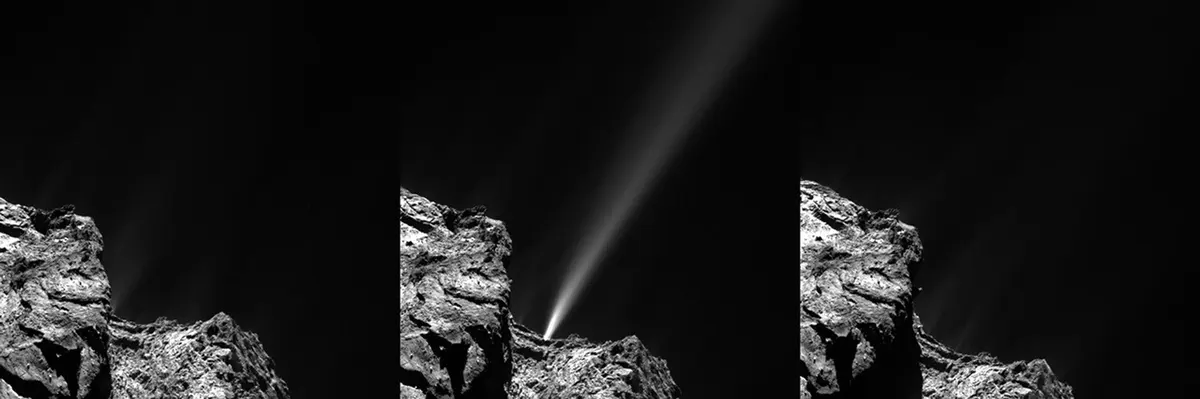
What Rosetta discovered
The European Space Agency's Rosetta mission studied Comet 67P/Churyumov-Gerasimenko at close range. The spacecraft observed the comet over an extended period as it moved around the Sun, allowing scientists to follow changes in its surface and activity.
Rosetta investigated the nucleus, escaping gas and dust, and the environment surrounding the comet. Its observations, together with measurements from the Philae lander, helped scientists investigate the physical and chemical properties of comet material.
These findings are valuable because comets preserve clues about conditions in the early Solar System. However, no single comet represents every comet: different objects can have different compositions, structures and activity.
Can comets threaten Earth?
Most known comets do not pose a threat to Earth. A collision is physically possible, but assessing risk requires scientists to calculate an object's orbit and determine whether its future path could intersect Earth's orbit.
Astronomers track objects that approach Earth's neighborhood and refine their orbital calculations as new observations become available. A comet's brightness alone does not tell us whether it is dangerous.
How to observe a comet
Some comets become visible without optical equipment, while others require binoculars or a telescope. Visibility depends on the comet's brightness, distance from Earth, position in the sky and local observing conditions.
Check a current astronomy forecast before heading outside. Choose a dark location with a clear horizon, and allow your eyes time to adapt to the darkness. Because comet brightness can change, older observing guides may not accurately describe what you can see today.
Common misconceptions
A comet's tail does not always trail behind it. The dust and ion tails are shaped by sunlight, solar radiation pressure and the solar wind, so they generally point away from the Sun.
The coma is not the solid comet itself. The nucleus is the solid central body; the coma is a cloud of gas and dust released as the comet warms.
Not every comet is bright or easy to see. Visibility depends on the comet's activity, distance, geometry and observing conditions. Many comets require binoculars or a telescope.
Frequently asked questions
What is the difference between a comet's nucleus and coma?
The nucleus is the solid central body. The coma is the surrounding cloud of gas and dust that develops as the comet releases material.
Why does a comet's tail point away from the Sun?
Solar radiation pushes dust particles, while the solar wind and magnetic field influence charged gas. These effects generally direct the tails away from the Sun.
Do comets produce their own light?
Comets do not shine through the same nuclear-fusion process as stars. Dust reflects sunlight, and some gases emit light after being energized.
What did the Rosetta mission study?
Rosetta studied Comet 67P/Churyumov-Gerasimenko, observing its nucleus, surrounding gas and dust, and changes in its activity as it travelled around the Sun.
Are all comets visible to the naked eye?
No. Many comets are too faint to see without a telescope or binoculars. Naked-eye visibility depends on the object's brightness and observing conditions.
Trusted Sources and Further Reading
- NASA Science: Comet 67P from 1,200 Miles Away
- NASA Science: Rosetta's Comet — Imaging the Coma
- NASA: Rosetta Comet Fires Its Jets
- NASA Science: Comets
Image credits: ESA/Rosetta and the credited OSIRIS mission team. Follow each original source for image details and usage terms.