
The James Webb Space Telescope was built to study the universe in infrared light. That choice lets it peer through dust, examine the atmospheres of distant planets, and detect light that has been stretched to infrared wavelengths while traveling across an expanding universe.
Why Webb observes in infrared
Visible light is only a small part of the electromagnetic spectrum. Many cool objects glow more strongly in infrared, while cosmic dust that blocks visible light can be partly transparent at longer wavelengths.
Very distant galaxies are another reason. As the universe expands, their light is redshifted into infrared wavelengths. Webb is designed to catch that stretched light and study galaxies from much earlier cosmic times.
The mirror that unfolds in space
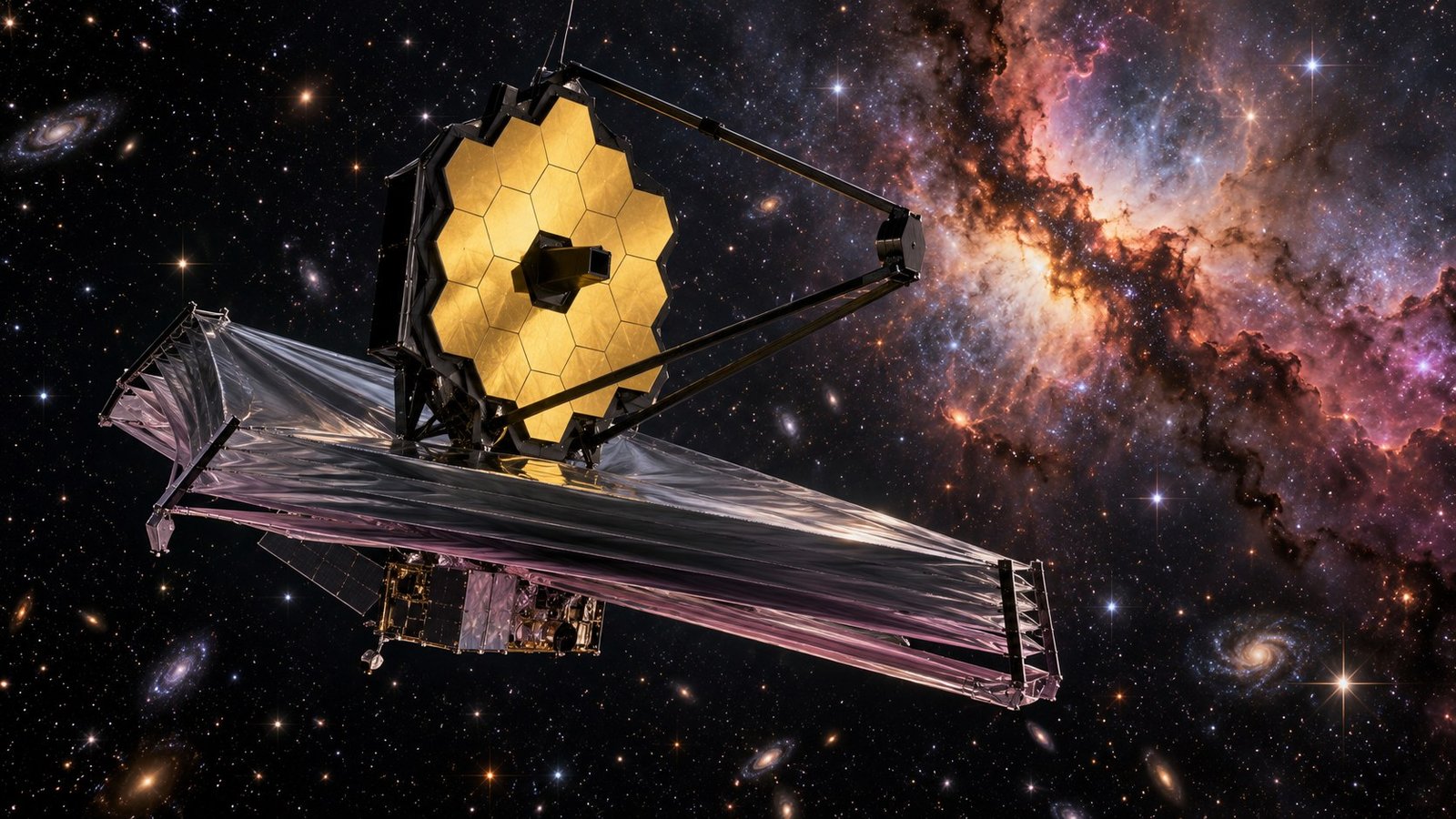
Webb’s primary mirror is made from 18 hexagonal segments coated with a thin layer of gold. Together they form a mirror about 6.5 meters across. The segmented design allowed the observatory to fold for launch and then deploy after reaching space.
The individual segments are adjusted with extraordinary precision so they behave like one optical surface. That alignment is essential for sharp images and accurate spectroscopy.
Why the telescope has a huge sunshield
Infrared astronomy works best when the telescope itself is very cold. Webb uses a multi-layer sunshield roughly the size of a tennis court to separate its warm, Sun-facing side from the cold telescope and instruments.
The observatory operates near the Sun-Earth L2 region, where its orientation can keep the Sun, Earth and Moon on the same general side of the shield.
What Webb can measure
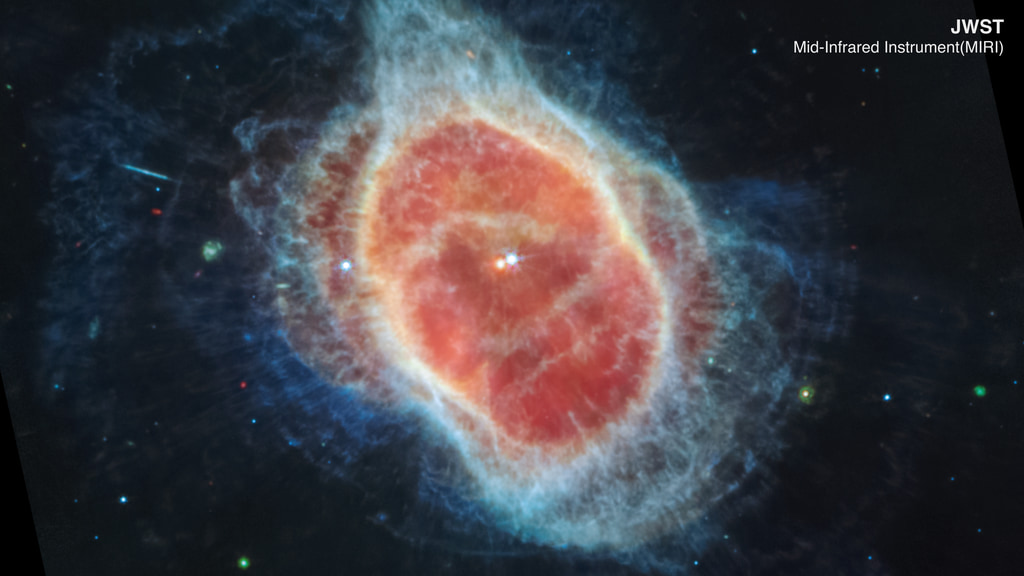
Webb does more than take dramatic images. Its instruments can split light into spectra, revealing chemical fingerprints, temperatures, velocities and other physical conditions. That makes it useful for studying star-forming clouds, galaxies, black-hole environments and exoplanet atmospheres.
For exoplanets, astronomers can compare starlight before, during and after a transit. Tiny wavelength-dependent changes can reveal which gases absorb light in the planet’s atmosphere.
Webb’s limits are part of the science
No telescope can answer every question. Webb does not observe the entire electromagnetic spectrum and it has finite resolution and sensitivity. Astronomers combine its data with Hubble, X-ray observatories, radio telescopes and ground-based facilities.
That teamwork is one of the most important ideas in modern astronomy: different instruments provide different pieces of the same physical story.
FAQ
Why is Webb’s mirror gold?
The thin gold coating reflects infrared light efficiently, which helps Webb’s instruments collect the wavelengths the observatory was designed to study.
Why does Webb stay so cold?
Warm objects emit infrared radiation. Keeping the telescope and instruments cold reduces their own infrared glow so faint astronomical signals are easier to detect.
Is Webb a replacement for Hubble?
No. Webb and Hubble observe different wavelength ranges and are often scientifically complementary rather than interchangeable.