Cosmological Redshift Explained: How the Expanding Universe Stretches Light
Cosmological redshift happens when the expansion of the universe stretches light traveling through space, shifting its wavelength toward the red end of the spectrum and beyond.
Published October 12, 2026 • Neela Asman Astronomy Desk
When astronomers observe very distant galaxies, their light is often shifted toward longer wavelengths. This effect is called cosmological redshift. It is one of the most important clues that the universe has expanded over time.
Light has both a wavelength and a frequency. As space expands while a photon travels across the universe, the wavelength is stretched. Visible light can shift toward redder wavelengths, while light originally emitted as visible or ultraviolet radiation may arrive at Earth as infrared light.
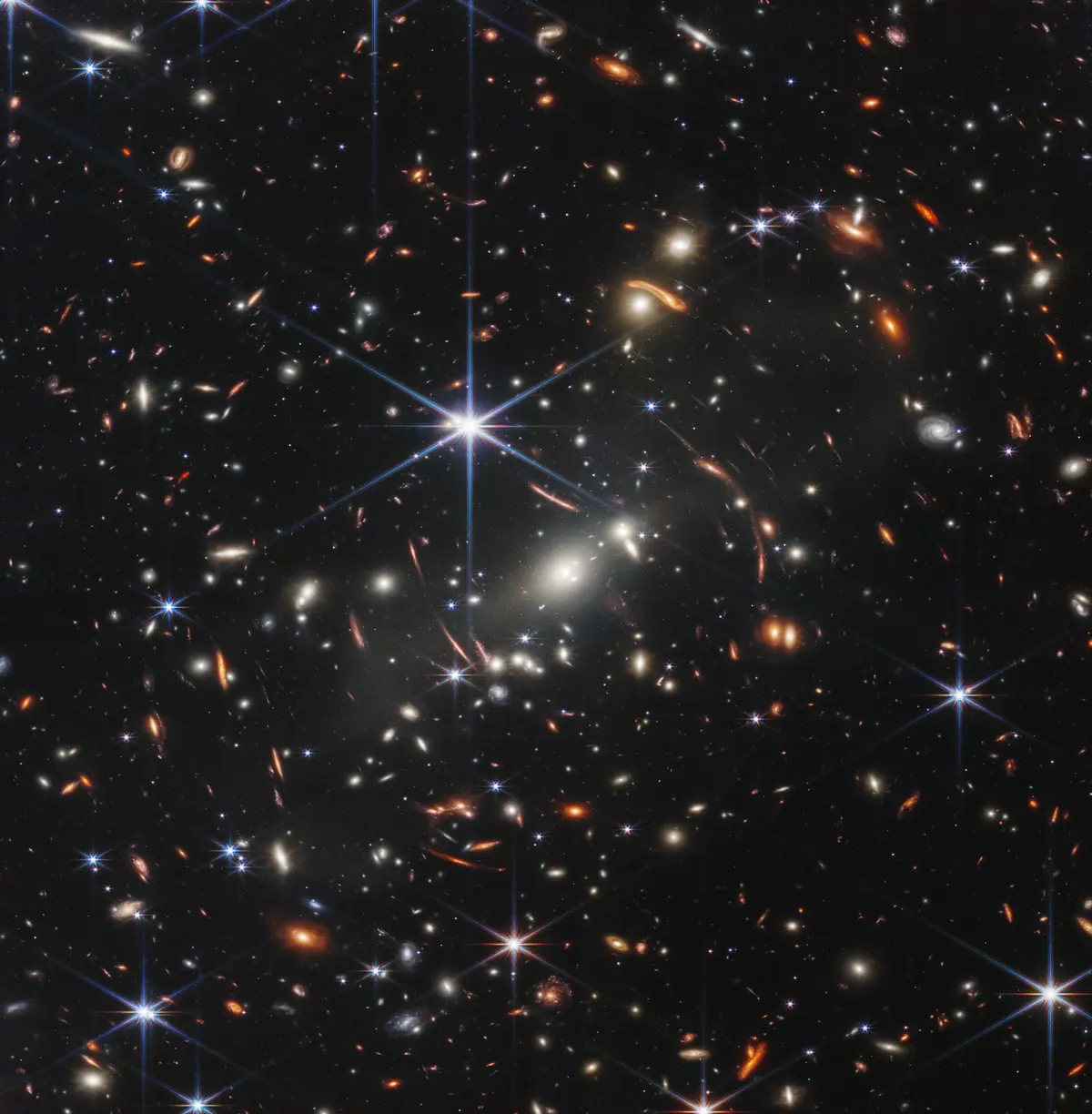
Image credit: NASA, ESA, CSA, and STScI. Webb’s First Deep Field shows distant galaxies observed in infrared light.
Key idea: Cosmological redshift is primarily caused by the expansion of space during the light's journey. It is not simply a galaxy moving through space like a car driving away from an observer.
What changes?The wavelength of traveling light increases
Common symbolRedshift is written as z
Where it mattersDistant galaxies and the early universe
Why astronomers use itTo study cosmic expansion and history
What cosmological redshift means
Every kind of light has a wavelength. Blue visible light has a shorter wavelength than red visible light, while infrared and radio waves have longer wavelengths still. When cosmic expansion stretches a light wave, its wavelength becomes longer than it was when emitted.
The word “redshift” describes the shift toward the red end of the visible spectrum, but the effect is not limited to visible light. Much of the light from very distant galaxies reaches us at infrared wavelengths because its wavelength has been stretched so strongly.
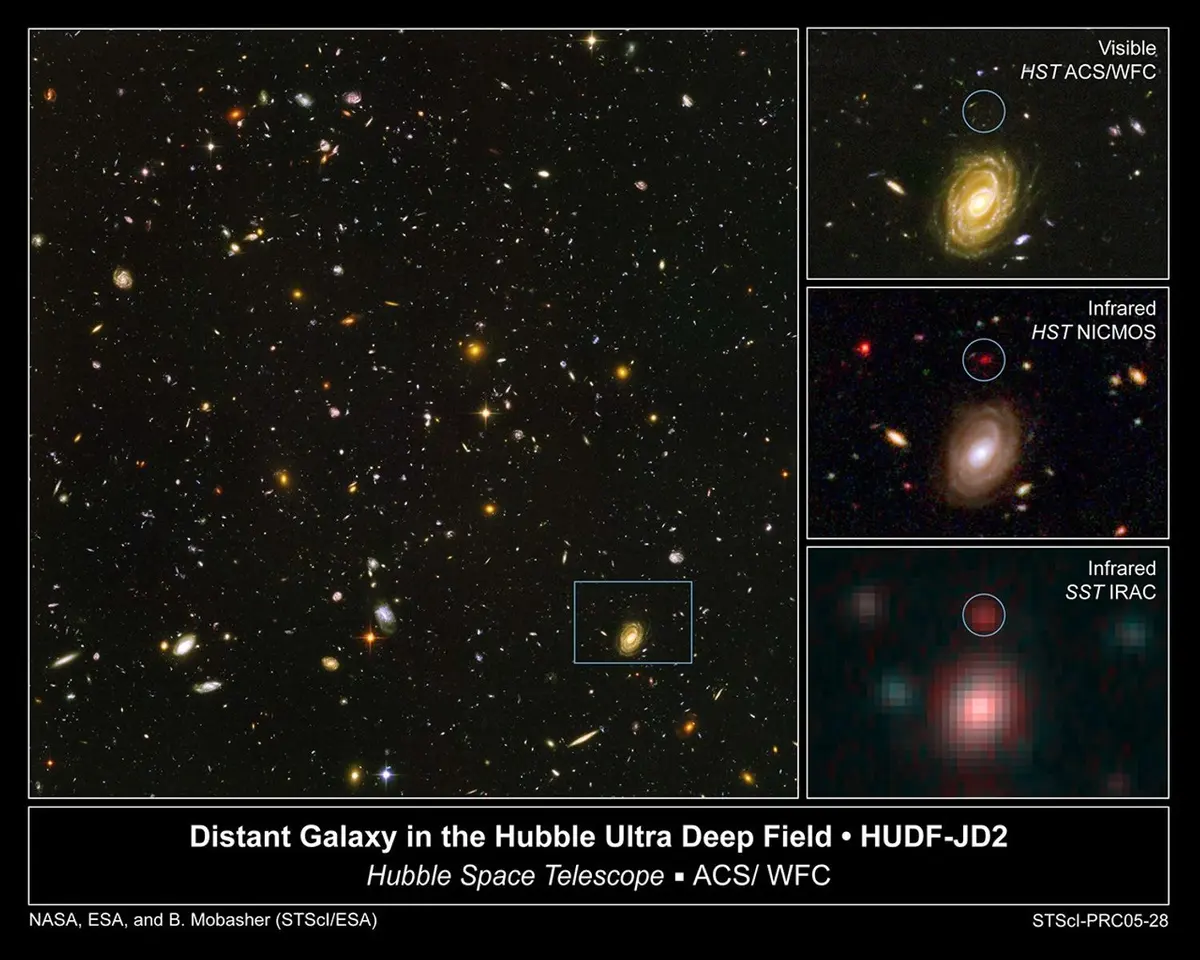
Image credit: NASA, ESA, and B. Mobasher (STScI/ESA). Hubble and Spitzer observations help identify a distant galaxy.
How the expansion of space stretches light
Imagine drawing wave crests on a strip of paper and then stretching the paper. The distance between the crests increases. Cosmological redshift is similar: as the universe expands, the wavelength of freely traveling light expands with it.
This analogy is only a guide. Space is not a material sheet, and the photon is not being pulled by a wind. In the standard cosmological description, the scale of the universe changes while the light travels, and the observed wavelength reflects that change.
What does the redshift value z tell us?
A common definition of redshift is z = (observed wavelength − emitted wavelength) / emitted wavelength. If the observed wavelength is twice the emitted wavelength, then z = 1. A larger positive cosmological redshift generally means the universe has expanded more between the time the light was emitted and the time it was observed.
For cosmological redshift, the wavelength ratio is related to the universe's scale factor: 1 + z equals the scale factor today divided by the scale factor when the light was emitted. Astronomers use redshift together with a cosmological model to estimate distances and look-back times; redshift alone is not a universal distance ruler without that model.
Cosmological redshift versus other redshifts
Not every redshift has the same cause. Doppler redshift describes the wavelength change associated with relative motion between a source and observer in a local setting. Gravitational redshift occurs when light climbs out of a gravitational potential. Cosmological redshift arises from the expansion of the universe over the light's journey.
Real astronomical observations can include more than one contribution. Astronomers account for local motions and other effects when they need a precise measurement of a galaxy's cosmological redshift.
Why redshift helps measure the universe
On large scales, galaxies with greater cosmological redshifts are generally seen at earlier stages of cosmic history. Their light has taken longer to reach us, so telescopes observe them as they were in the past, not as they are “right now.” The exact relationship among redshift, distance and age depends on the universe's expansion history.
For relatively nearby galaxies, the observed pattern is summarized by the Hubble–Lemaître law: on average, more distant galaxies recede from us faster as the universe expands. At larger redshifts, cosmologists use the full expansion model rather than a simple linear rule.
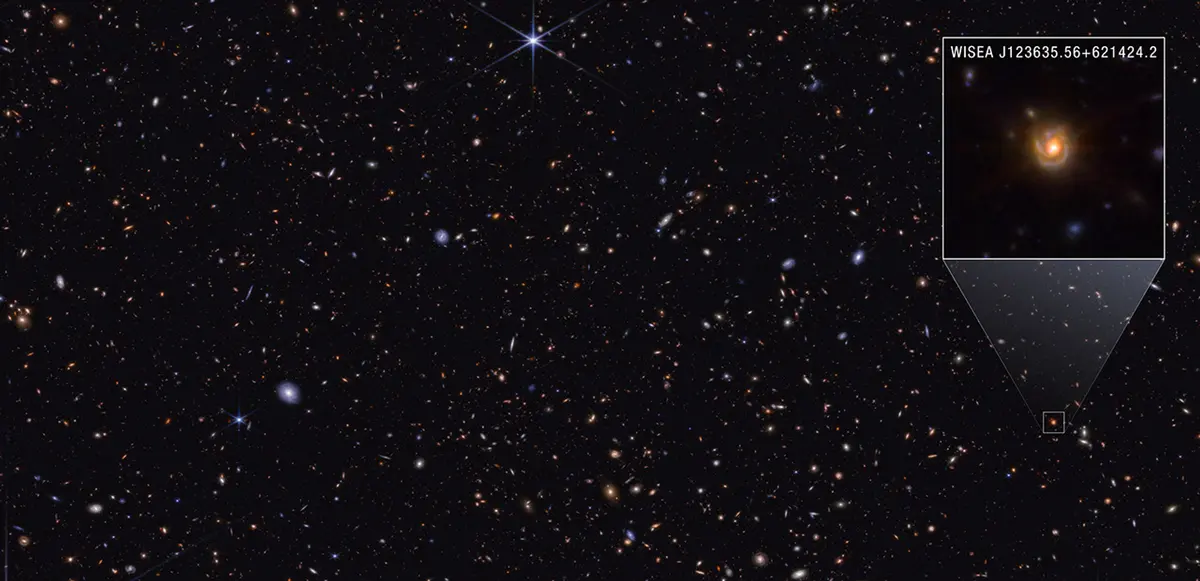
Image credit: NASA, ESA, and STScI. Webb’s observations reveal distant galaxies across cosmic history.
Redshift and the early universe
As the universe expanded, the light from its early hot stages was stretched to longer wavelengths. The cosmic microwave background is a famous example: radiation released when the universe became transparent has been stretched into microwaves and now fills the sky.
Redshift also lets astronomers investigate early galaxies. The James Webb Space Telescope observes infrared wavelengths that can reveal light emitted in ultraviolet or visible wavelengths by very distant objects, after cosmic expansion has stretched it.
Common misconceptions
Redshift does not mean a galaxy is literally red. It describes how its spectral features are shifted in wavelength. A galaxy can appear red for other reasons too, including dust and the types of stars it contains.
Expansion does not stretch every object. Bound systems such as people, planets and solar systems do not expand in the same way as the large-scale universe because local forces and gravity hold them together.
Redshift is not always a direct speed measurement. At cosmological distances, interpreting redshift as a simple recession velocity can be misleading. Astronomers use the framework of an expanding universe to interpret the measurement.
Frequently asked questions
Why is it called redshift?
Because visible light shifted to longer wavelengths moves toward the red end of the spectrum. At high redshifts, the light may shift beyond visible red into infrared or other wavelength bands.
Does cosmological redshift mean galaxies are moving through space?
Not exactly. It mainly reflects the expansion of space between distant galaxies as their light travels to us. Galaxies can also have local motions through space.
Can redshift tell us how old the universe is?
Redshift helps estimate how far back in time we are observing. To turn a redshift into a look-back time or distance, astronomers use a model of the universe's expansion.
Is the cosmic microwave background redshifted?
Yes. Its radiation has been stretched by cosmic expansion from a much hotter, shorter-wavelength state into the microwave wavelengths measured today.