
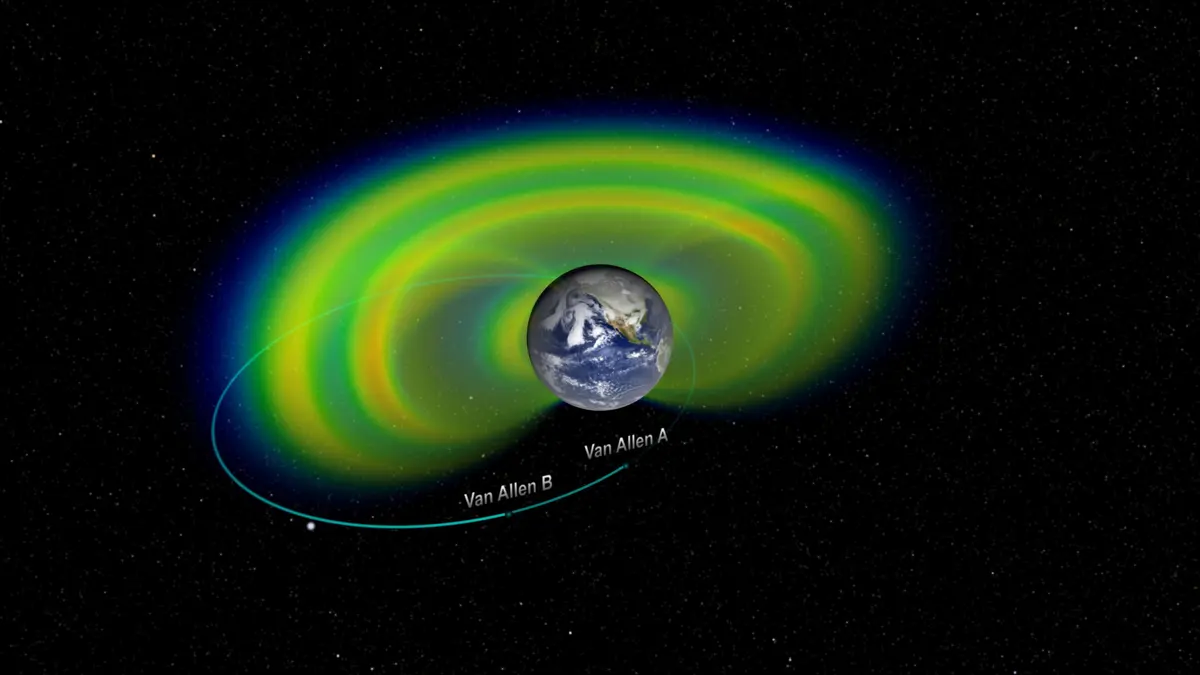
Discover how Earth’s magnetic field traps energetic particles, where the Van Allen radiation belts are found, and why they matter for satellites and human spaceflight. This guide explains the science behind the observations, what researchers have learned, and which questions remain open.
What are the Van Allen belts?
The Van Allen radiation belts are regions around Earth where energetic charged particles are trapped by the planet’s magnetic field. They are not solid rings; they are dynamic zones of radiation in near-Earth space.
The belts are commonly described as an inner and an outer region, though their shape and intensity vary with particle energy and changing space-weather conditions.
How does Earth trap particles?
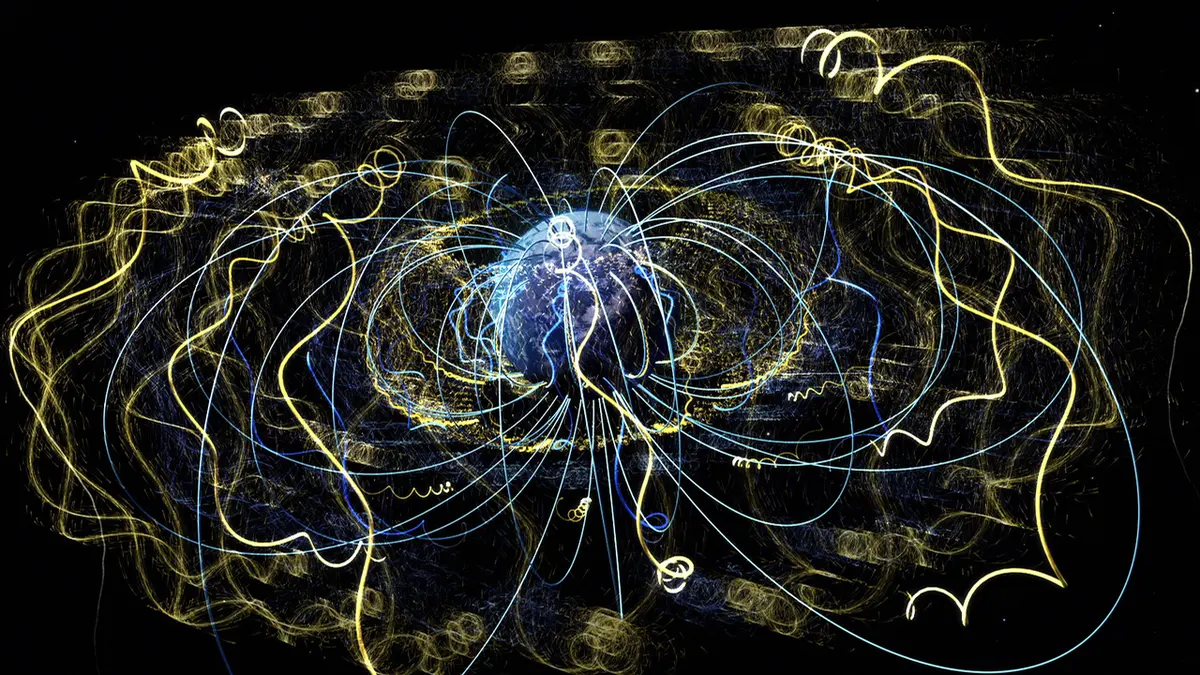
Earth’s magnetic field guides many charged particles into complex paths around the planet. Some particles bounce between regions near the magnetic poles while also drifting around Earth, forming radiation belts.
Particles can come from the solar wind and from processes in Earth’s magnetosphere. The belts change when solar storms and other disturbances inject or accelerate particles.
How were the belts discovered?
The belts were identified in 1958 using instruments aboard early U.S. satellites, including Explorer 1. The discovery showed that space near Earth contains radiation environments that had not been directly measured before the Space Age.
NASA’s Van Allen Probes later studied how particles enter, move through and leave the belts, revealing that their structure can change quickly during geomagnetic activity.
Why do the belts matter for spacecraft?
High-energy particles can damage electronics, degrade solar panels and create risks for astronauts. Spacecraft designers use shielding, careful component selection and mission planning to reduce exposure.
Many satellites operate in or pass through parts of the radiation environment, so engineers need models of particle levels and how those levels change during solar storms.
Are the belts a solid barrier to space?
No. The belts are regions of elevated radiation, not a physical wall. The risk depends on a spacecraft’s trajectory, speed, shielding, duration of exposure and the energy of the particles encountered.
Understanding the belts allows mission teams to plan safer routes and operations rather than treating them as an impassable boundary.
Frequently asked questions
Are the Van Allen belts solid rings?
No. They are dynamic regions of energetic charged particles trapped by Earth’s magnetic field.
Can spacecraft pass through them?
Yes. Spacecraft can cross them, but mission designers account for radiation exposure and electronics risks.
What did the Van Allen Probes study?
They investigated how radiation-belt particles are energized, transported and lost.
Trusted Sources and Further Reading
Image credits: Image credit: NASA; illustration and mission details should be checked at the linked NASA source. Follow each original source for image details and usage terms.