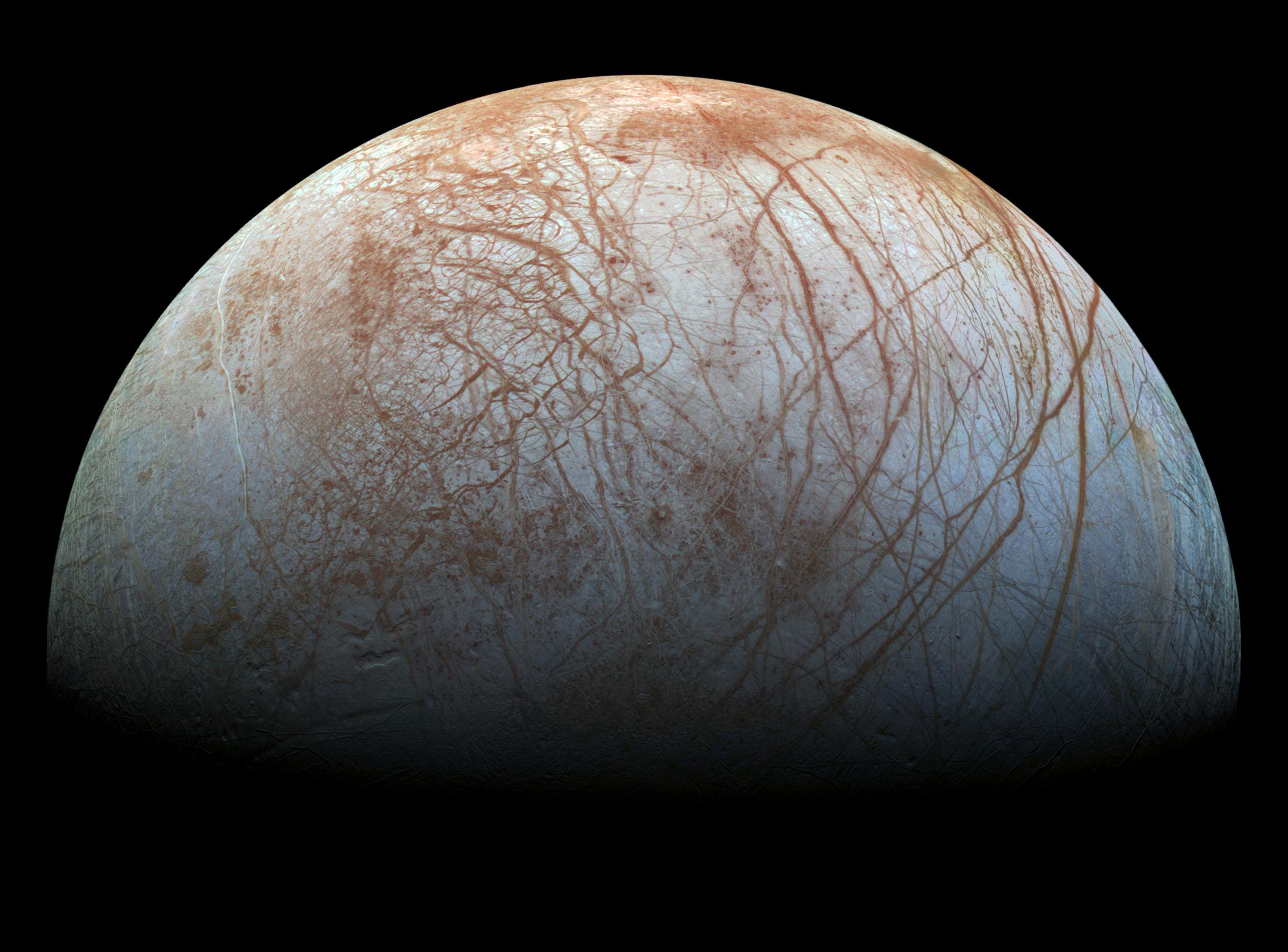
Europa looks quiet from a distance: a bright moon a little smaller than Earth’s Moon, circling giant Jupiter. Up close, however, its surface is a maze of dark cracks, ridges and disrupted patches of water ice. Those features helped turn Europa into one of the most important places in planetary science, because multiple lines of evidence point to a global ocean of salty liquid water hidden below the frozen crust.
The attraction is not simply that Europa has water. Habitability as scientists use the word requires a combination of liquid water, useful chemistry and a source of energy that could keep reactions going. Europa may offer all three. That does not mean life has been found there; it means the moon gives researchers a natural laboratory for asking whether an ocean world far from the Sun can provide conditions in which life might be possible.

Why scientists think an ocean exists beneath the ice
Europa’s smooth, relatively young-looking surface is the first clue. The moon has far fewer impact craters than many ancient Solar System bodies, suggesting the outer ice has been resurfaced on geologic timescales. Long fractures and broad bands also look like structures that could form when an ice shell is stressed, broken and rearranged.
A second clue comes from magnetic measurements. NASA’s Galileo spacecraft detected an induced magnetic response around Europa. One of the best explanations is a global layer of electrically conductive fluid below the ice, and salty liquid water is a strong candidate. Surface materials that appear to contain salts and sulfur-bearing compounds add to the case that the surface and interior may exchange material.
How an ocean can stay liquid so far from the Sun
At Jupiter’s distance, sunlight is weak compared with Earth. Europa does not need the Sun alone to keep its ocean from freezing, because Jupiter’s gravity continually flexes the moon. Europa follows a slightly non-circular orbit, so the strength and direction of the tidal pull change as it moves around Jupiter.
That repeated flexing can produce heat inside the moon. The process, called tidal heating, is also dramatic on nearby Io, where it powers intense volcanism. Europa is very different at the surface, but tidal energy may help maintain liquid water beneath the ice and could also drive geological activity at the ocean floor.
The three habitability ingredients scientists are looking for
Liquid water is the most obvious ingredient, but it is only one part of the story. Life on Earth depends on elements such as carbon, hydrogen, nitrogen, oxygen, phosphorus and sulfur. Scientists therefore want to know which compounds are present in Europa’s ice and whether material can move between the surface, the ocean and the rocky interior.
Energy is the third requirement. On Earth, sunlight powers much of the biosphere, but deep-ocean ecosystems can survive without direct sunlight by using chemical energy. If Europa’s ocean interacts with a rocky seafloor, water-rock reactions could create useful chemical gradients. Radiation at the surface can also transform compounds in the ice; if some of that altered material is transported downward, it could provide additional chemistry.
Why the surface is both dangerous and scientifically useful
Europa sits deep inside Jupiter’s powerful magnetosphere. High-energy particles bombard the surface, making it a harsh place for exposed organisms and for spacecraft electronics. Yet the same radiation can break apart water and other molecules, creating oxidants and new compounds.
The key question is whether surface products can be mixed downward and whether material from the ocean can reach the surface. Chaos terrain, ridges and possible plumes are especially interesting because they may preserve clues about exchange between the hidden ocean and the exterior. A sample returned from the deep ocean is not necessary for every question; chemistry on or above the surface may already reveal important constraints.

What Europa Clipper will actually measure
NASA’s Europa Clipper launched on October 14, 2024, and is scheduled to reach Jupiter in April 2030. The spacecraft will orbit Jupiter rather than Europa itself, a strategy that limits exposure to the most intense radiation while allowing repeated close passes of the moon. NASA plans 49 close flybys, with a first Europa flyby expected in 2031.
The spacecraft carries nine dedicated science instruments plus a gravity/radio-science investigation. Radar will probe the ice, cameras will map terrain, spectrometers will study surface and atmospheric composition, and magnetic and plasma instruments will investigate the ocean and the environment around the moon. Together, the measurements can reveal how thick the ice is, how deep or salty the ocean may be, and where exchange processes are active.
What would count as evidence for habitability — and what would not
A warm spot, a plume or an organic molecule would be exciting, but none would automatically prove life. Habitability is about environmental conditions. Scientists will look for combinations of measurements that show persistent liquid water, accessible chemical building blocks and energy sources operating together.
Finding direct biological evidence would require a much higher bar: multiple independent signatures that are difficult to explain through non-biological chemistry. Europa Clipper is designed to narrow the environmental possibilities and identify the most promising places and processes for later missions to investigate.
What to watch next
The mission’s cruise phase includes a gravity assist at Earth in December 2026 before Jupiter orbit insertion in April 2030. After the spacecraft reshapes its orbit around Jupiter, the first close science observations of Europa begin in 2031. Those encounters will build a global picture over many flybys rather than relying on one brief pass.
For readers following Europa, the biggest milestones will be early ice-penetrating radar results, improved estimates of ocean properties, high-resolution maps of chaos terrain and any well-supported evidence for active plumes or recent surface exchange. Each result will refine a larger question: is this hidden ocean merely wet, or is it chemically and energetically habitable?
FAQ
Has NASA found life on Europa?
No. There is no confirmed evidence of life on Europa. The current evidence shows that the moon may have environments with ingredients relevant to habitability.
How much water could Europa have?
NASA says Europa’s subsurface ocean may contain more than twice as much liquid water as all of Earth’s oceans combined.
Will Europa Clipper land on the moon?
No. Europa Clipper will orbit Jupiter and repeatedly fly past Europa. This reduces radiation exposure while allowing the spacecraft to survey many regions of the moon.