
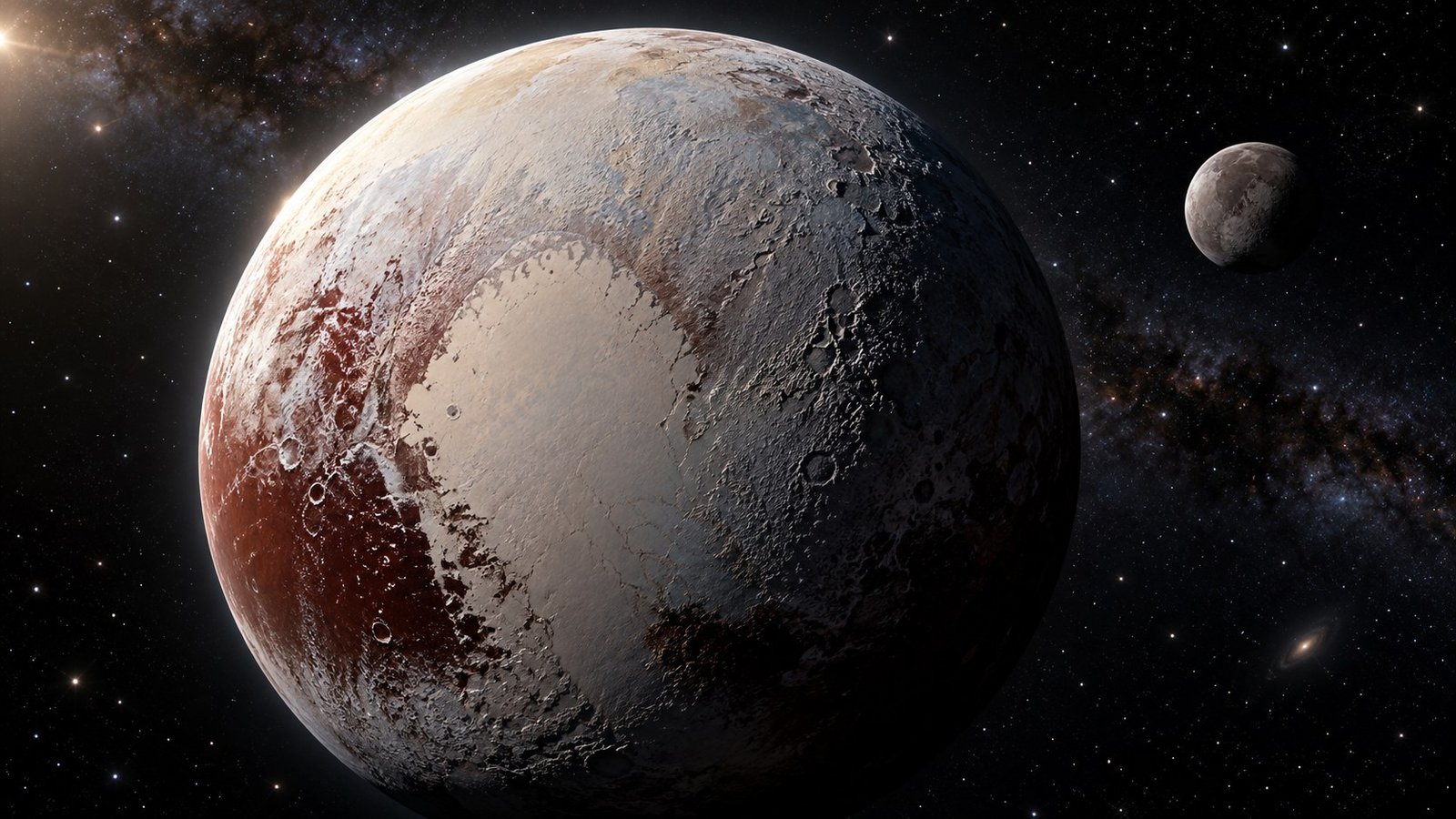
Dwarf planets are round worlds that orbit the Sun but do not dominate their orbital neighborhoods. They are scientifically important because many preserve clues about how the Solar System formed and evolved.
What makes a dwarf planet?
Under the International Astronomical Union definition, a dwarf planet orbits the Sun, has enough mass for its own gravity to make it nearly round, is not a satellite, and has not cleared the neighborhood around its orbit.
That last condition separates dwarf planets from the eight major planets. It does not mean a dwarf planet is unimportant or physically uninteresting.
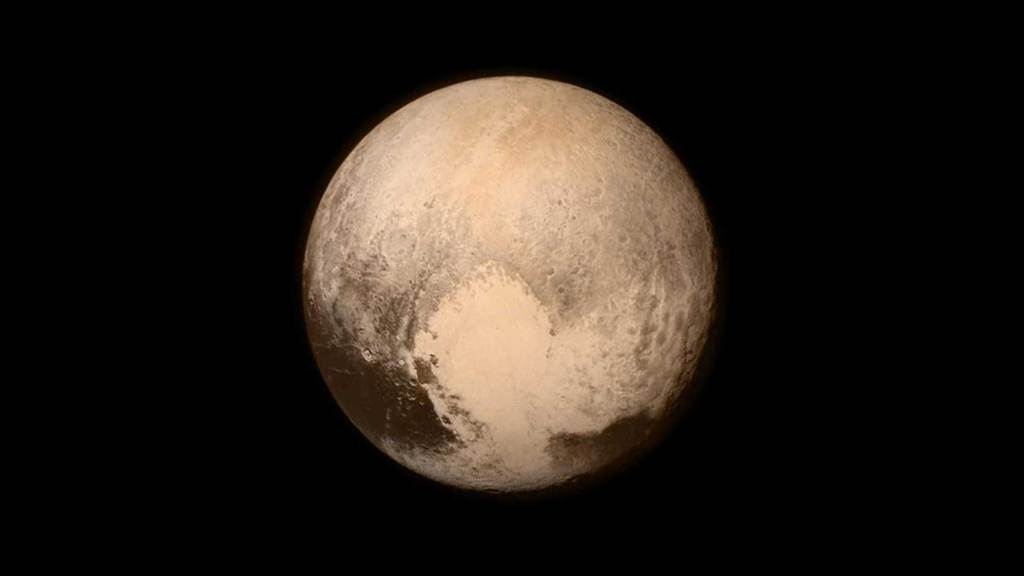
Pluto is a complex world
Pluto was reclassified as a dwarf planet in 2006, but spacecraft exploration later showed just how active and varied a small icy world can be. NASA’s New Horizons mission revealed mountains of water ice, broad plains and a thin atmosphere.
Pluto and its large moon Charon also form an unusually interesting system because their common center of mass lies outside Pluto.
Ceres is different from the outer dwarf planets
Ceres orbits in the asteroid belt between Mars and Jupiter. It is much closer to the Sun than Pluto and contains a mixture of rock, ice and salts. NASA’s Dawn mission found bright salt-rich deposits and evidence of a geologically active past.
Its location makes Ceres a bridge between the rocky inner Solar System and the ice-rich small bodies farther out.

Eris, Haumea and Makemake
Eris is a distant icy world whose discovery helped trigger the debate that led to the modern planet definition. Haumea is unusually elongated and rotates rapidly. Makemake is another bright Kuiper Belt object with an icy surface.
These worlds show that the outer Solar System contains a diverse population rather than a simple collection of leftover rocks.
Why dwarf planets matter
Small worlds are time capsules. Their surfaces, ices, moons and orbits preserve information about early collisions, migration and chemical conditions in the young Solar System.
Studying them helps astronomers test models of how planets assembled and how the architecture of our planetary system changed over billions of years.
FAQ
Why is Pluto called a dwarf planet?
Because it is round and orbits the Sun, but it has not cleared its orbital neighborhood the way the eight major planets have.
Is Ceres like Pluto?
Both are dwarf planets, but Ceres is much closer to the Sun and lives in the asteroid belt rather than the Kuiper Belt.
Why do astronomers care about these worlds?
They preserve clues about migration, collisions and chemistry in the early Solar System.