
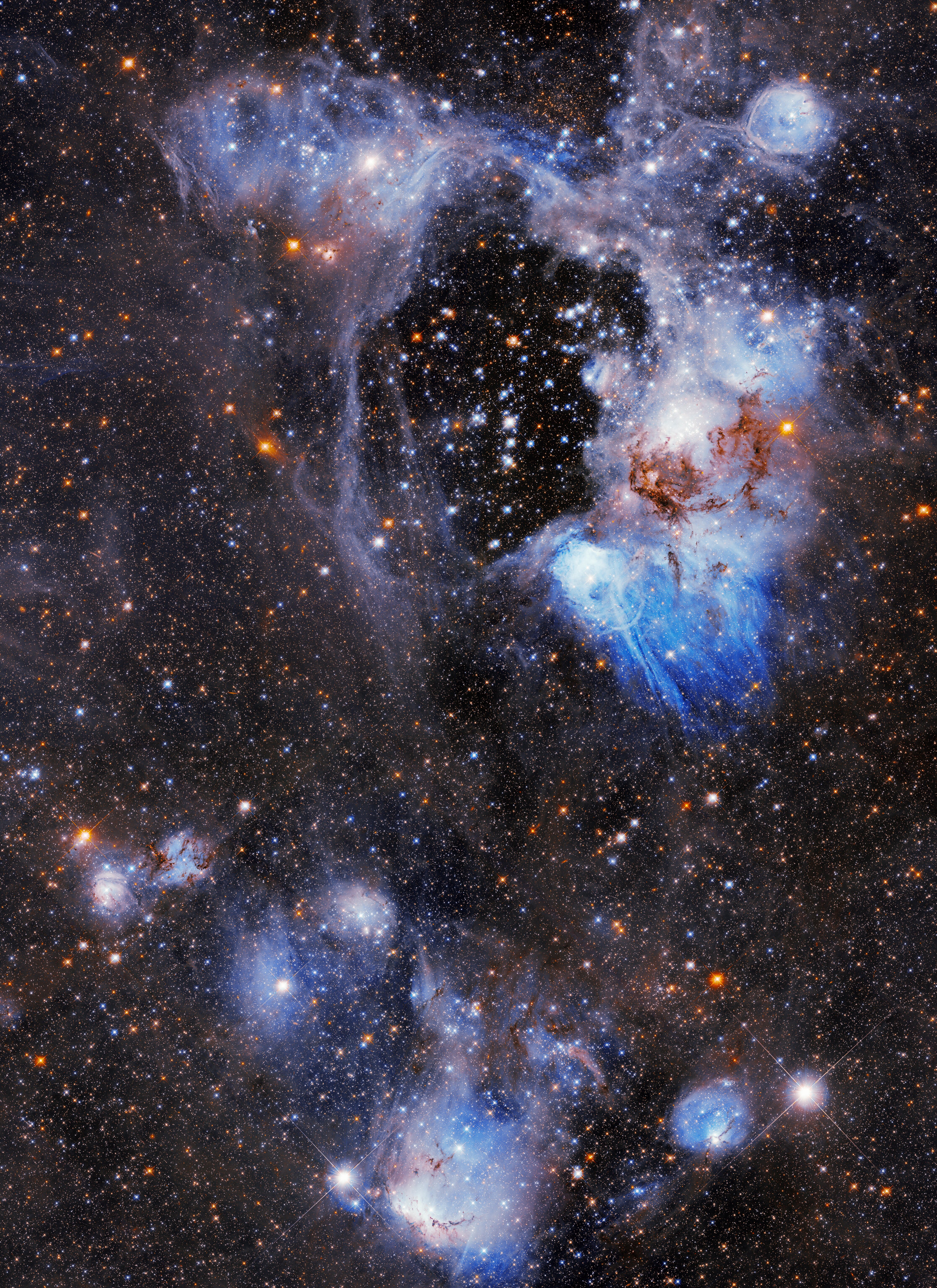
Some of the most dramatic structures in the Universe are not created by a single explosion. They are sculpted slowly by entire groups of massive stars. N44, a huge star-forming complex in the Large Magellanic Cloud, is a striking example. A 2026 Hubble release shows an enormous cavity surrounded by glowing gas, dark dust and thousands of stars at different stages of life.
The central cavity is known as a superbubble. It spans roughly 210 by 140 light-years. Over time, powerful stellar winds and supernova explosions from massive stars have pushed gas outward, clearing a giant void and piling material into a shell around the edge.
Where is N44?
N44 is located in the Large Magellanic Cloud (LMC), a satellite galaxy of the Milky Way about 160,000 light-years from Earth. Because the LMC is relatively nearby on a cosmic scale, astronomers can resolve individual stars and study how star formation unfolds in a galaxy with a different chemical environment from our own.
ESA’s Hubble image release highlights a dense field of stars, glowing nebular gas and dark dust. The image is not merely scenic; it is part of a larger effort to understand how long young stars spend in the stages before hydrogen fusion stabilizes them on the main sequence.
How do massive stars build a superbubble?
Massive stars produce intense radiation and very fast stellar winds. Those winds slam into surrounding interstellar gas, transferring momentum and energy. Over millions of years, the combined action of several massive stars can excavate a large cavity.
When some of those stars reach the end of their lives, supernova explosions add another burst of energy. The result is a bubble of hot, low-density gas surrounded by a denser shell. This process is often called stellar feedback because newly formed stars change the environment from which they were born.
Can old stars trigger new star formation?
They can, under the right conditions. As the expanding shell pushes into surrounding molecular gas, it may compress that gas into denser knots. Gravity can then take over, causing parts of the cloud to collapse and form new stars.
N44 is useful because Hubble can count faint pre-main-sequence stars in crowded regions. ESA reported that a Hubble survey catalogued nearly half a million stars in the broader field, including almost 30,000 pre-main-sequence stars. These young objects have not yet settled into the long, stable phase of hydrogen fusion that defines a main-sequence star like the Sun.
Astronomers are trying to put a clock on star birth
One of the hardest questions in star-formation research is timing. How long does a cold cloud take to collapse? How quickly does a protostar become visible? How long before fusion begins in the core? In a complex nebula, different stars are born at different times, so astronomers need large samples to reconstruct the sequence.
By measuring brightness, color and position, researchers can estimate the ages and masses of stars in N44. They can then compare those ages with the geometry of the superbubble to see whether stellar feedback likely triggered later waves of star birth.
Why the Large Magellanic Cloud is special
The LMC contains fewer heavy elements than the local neighborhood of the Milky Way. Astronomers call elements heavier than helium “metals,” even when they are not metallic in the everyday sense. Metallicity affects how gas cools, how dust forms and how efficiently stars can form.
That makes N44 a useful analogue for star formation in the earlier Universe, when galaxies were generally less enriched with heavy elements. By studying a nearby low-metallicity environment at high resolution, astronomers can test models that are difficult to verify in very distant galaxies.
Reading the Hubble image
The large dark interior of the bubble marks a region where gas has been swept away. Bright knots and glowing shells trace denser material energized by ultraviolet radiation. Dust lanes appear darker because they absorb visible light. The mix of blue, white, orange and red stars reveals a range of stellar temperatures and evolutionary stages.
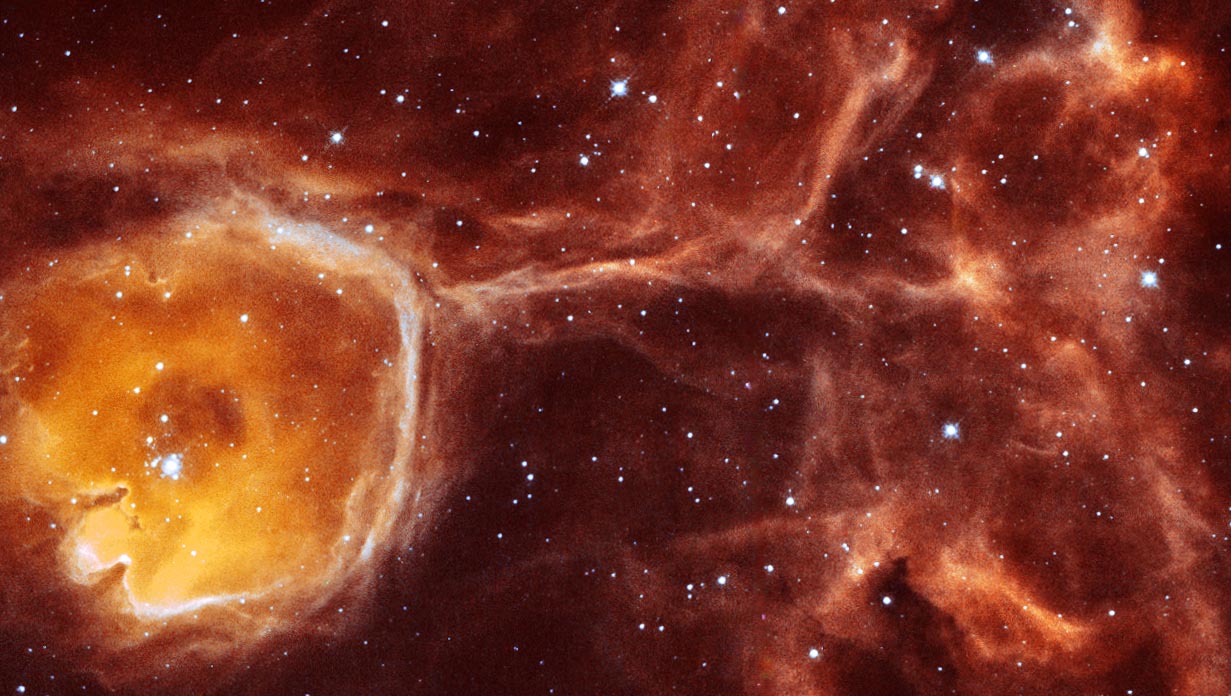
Near the upper-right area lies N44F, a smaller bubble created largely by the wind from a single hot massive star. That nested structure—small bubbles inside a much larger superbubble—shows that feedback operates on several scales at once.
Why this matters beyond one nebula
Star formation controls how galaxies evolve. New stars add light and chemical elements; massive stars inject energy; supernovae enrich gas and can either trigger or suppress future star formation. Understanding this balance helps astronomers explain why some galaxies form stars rapidly while others become quiet.
N44 therefore connects a local, visually stunning nebula to one of the biggest questions in astrophysics: how galaxies regulate their own growth.
FAQ
Is N44 inside the Milky Way?
No. It is in the Large Magellanic Cloud, a nearby satellite galaxy of the Milky Way.
What makes a superbubble “super”?
Its size and energy. A superbubble is generally created by the combined winds and supernovae of multiple massive stars rather than by one ordinary stellar wind bubble.
Are new stars still forming in N44?
Yes. Dense gas along the shell contains many young and pre-main-sequence stars, making N44 an active star-formation laboratory.