
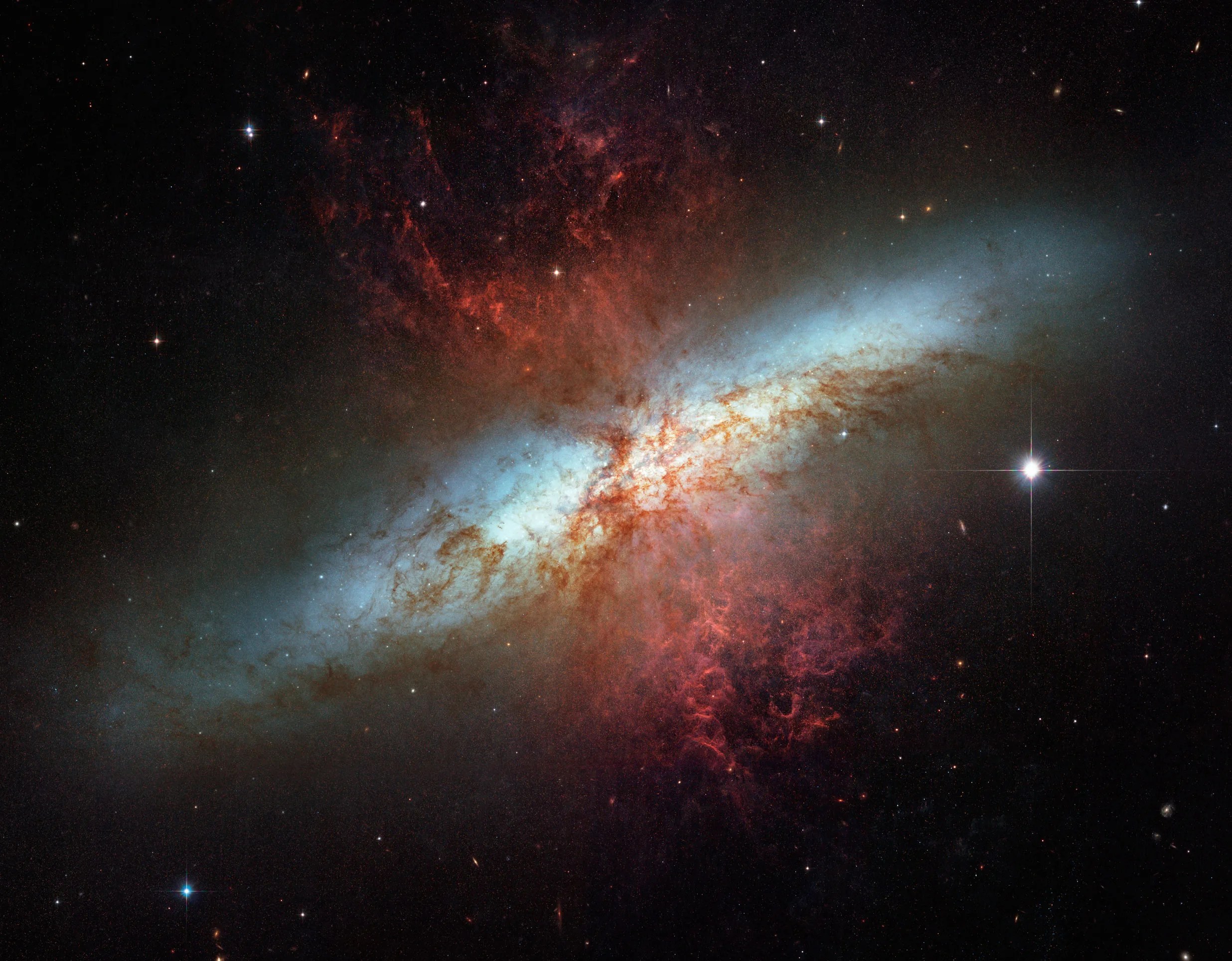
Messier 82 has always looked restless. Nicknamed the Cigar Galaxy because of its long edge-on shape, M82 is filled with intense star formation and enormous plumes of material streaming away from its disk. In 2026, NASA released a much deeper James Webb survey that turned this familiar galaxy into a detailed stellar census.
Webb’s near-infrared imaging resolved approximately 16.5 million individual stars in M82. That number is extraordinary not because the galaxy contains only that many stars—it contains far more—but because Webb can separate millions of stars across a galaxy around 12 million light-years away while also seeing through dust that hides much of the activity in visible light.
What is Messier 82?
M82 is a nearby starburst galaxy in the constellation Ursa Major. A starburst is a period when a galaxy forms stars much faster than usual. In M82, the star formation rate is about ten times that of the Milky Way, even though the intense phase will not last forever.
Scientists think gravitational interactions with neighboring galaxies helped disturb M82’s gas and trigger its unusual activity. The galaxy is seen almost edge-on, which gives it a narrow, elongated appearance from Earth.
Why infrared vision changes the picture
Visible light is easily scattered or absorbed by interstellar dust. That is why dusty galaxies can look opaque even when they contain large populations of stars behind the dark lanes. Infrared light passes through much of that dust more effectively.
NASA’s M82 science release explains that Webb’s long observing campaign and infrared sensitivity allowed the telescope to pierce the thick dust and reveal the structure of the disk at much higher detail. In the composite image, Hubble contributes information about ionized gas while Webb shows the stellar population and dust structures in infrared wavelengths.

How 16.5 million stars become a timeline
A galaxy’s stars do not all have the same age. Some are young and bright; others are older and cooler. When astronomers can resolve individual stars, they can use color and brightness to estimate ages and build a star-formation history.
Think of the galaxy as a city whose buildings were constructed in different decades. From far away the city is one glow, but from close enough you can date neighborhoods by architecture. Webb is doing something similar with M82: separating the “neighborhoods” of stars so researchers can determine when different parts of the galaxy formed.
The giant outflows above and below the disk
M82 is famous for material being pushed away from its central region. Massive young stars release strong winds, ultraviolet radiation and eventually supernova explosions. Together, they drive gas and dust out of the disk in two broad plumes.
These outflows are important because they regulate the galaxy. If too much gas is expelled, future star formation may slow. Some material can later fall back, while some may enrich the space around the galaxy. Feedback from stars therefore connects the life cycle of individual stars to the long-term evolution of an entire galaxy.
What triggered the starburst?
M82 belongs to a group of galaxies that includes the large spiral M81. Gravitational interactions between galaxies can distort their disks and drive gas inward. When large amounts of cold gas become concentrated, the conditions for rapid star formation improve.
The exact history of M82 is still being reconstructed. Webb’s data can help astronomers test when different bursts happened, whether star formation migrated through the galaxy over time, and how strongly the interaction shaped the disk.
Why Webb and Hubble are better together
Hubble’s visible-light observations show ionized gas and the effects of dust in ways that complement Webb. Webb’s infrared vision sees through much of that dust and resolves stars that are hard to isolate in optical images. Overlaying the datasets gives astronomers a more complete physical picture.
This multi-wavelength approach is common in modern astronomy. A galaxy can look dramatically different in X-rays, visible light, infrared or radio because each wavelength highlights different matter and physical processes.
What scientists will study next
The 2026 dataset is a foundation rather than a final answer. Researchers can model the ages of millions of stars, compare the stellar populations on opposite sides of the galaxy, and link star formation to the outflowing material.
As more observations are added, M82 will remain one of the best nearby laboratories for understanding starbursts, feedback and how galaxy interactions can transform otherwise ordinary systems.
FAQ
Does M82 really contain only 16.5 million stars?
No. Webb resolved about 16.5 million individual stars in this survey, but the total stellar population is much larger.
Why is it called the Cigar Galaxy?
Because we see its disk nearly edge-on, giving the galaxy a long, narrow shape in many images.
Is M82 exploding?
Not as a whole. It is undergoing unusually intense star formation, and many supernovae and stellar winds collectively drive large outflows of gas and dust.