
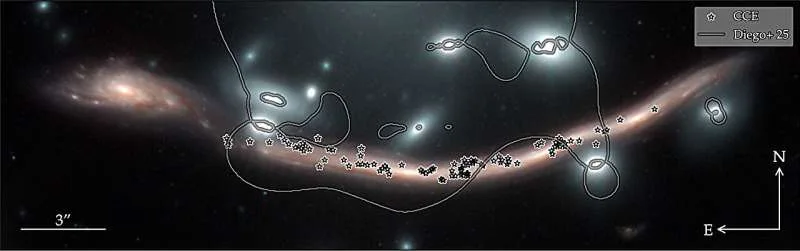
The Dragon galaxy is not famous because it is close. It is remarkable because a giant foreground galaxy cluster makes part of it visible in extraordinary detail. Using several years of James Webb Space Telescope observations, astronomers have now identified 104 unique magnified stellar events in the Dragon arc—more than twice the previous record reported for the same galaxy.
Why astronomers call it the Dragon
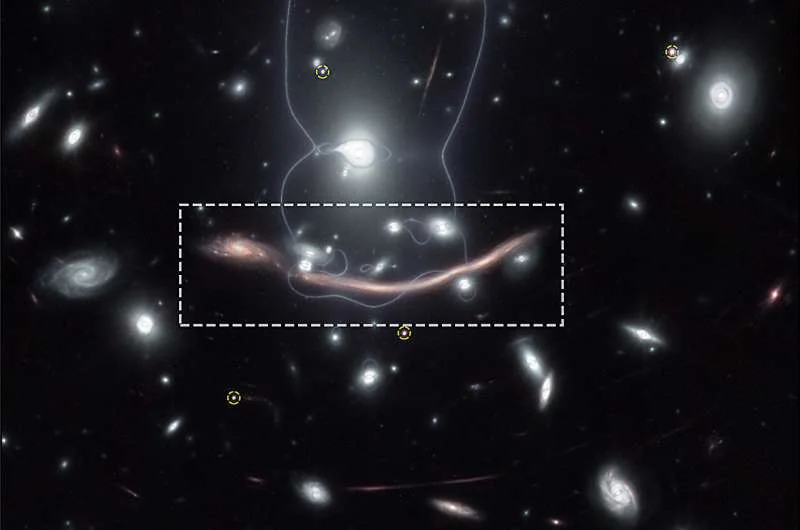
The Dragon is a distant galaxy whose light is stretched into a long arc by the gravity of the massive galaxy cluster Abell 370. The cluster sits between the galaxy and Earth, bending the light along multiple paths. This effect is called gravitational lensing.
The arc is not a physical stream of stars stretched across space. It is a distorted image of the background galaxy. Different parts of the cluster magnify the background light by different amounts, and some narrow regions can produce especially strong magnification.
Those high-magnification boundaries are known as caustics. When an individual star in the distant galaxy moves across one of these regions, its apparent brightness can rise dramatically for a limited time. Astronomers call this a caustic-crossing event.
How Webb’s observations revealed 104 events
The research team analysed JWST/NIRCam images collected between 2022 and 2024 in four infrared filters: F150W, F182M, F200W and F210M. Rather than relying on a single picture, they compared observations from different epochs and looked for point-like changes in brightness along the arc.
Image alignment and careful modelling were essential. The team corrected for small differences between observations, constructed point-spread functions, and compared each epoch with a reference made from the other available observations. They also masked bright regions and used a nearby part of the same galaxy—the Dragon’s “head”—to estimate ordinary brightness fluctuations that could otherwise be mistaken for microlensing.
The analysis produced 224 detections before repeated appearances were consolidated. After matching detections that likely represented the same physical event across different filters or epochs, the researchers retained 104 unique candidates. That is the largest sample of highly magnified stellar candidates identified in a single galaxy so far.
What the events reveal about massive stars
Only particularly luminous stars are likely to become detectable at these enormous distances. The study therefore focuses on the brightest members of the stellar population, including blue and red supergiants.
Blue supergiants are very hot and emit strongly at shorter wavelengths. Red supergiants are cooler and radiate more of their energy at longer wavelengths. Comparing the observed colours can help astronomers investigate the ages and properties of the stars that make up the distant galaxy.
The team found a roughly equal blue-to-red ratio among the analysed events. That balance is consistent with a galaxy containing both types of luminous stars and still forming stars. It is not a complete census of every star in the Dragon: the method is biased toward stars that become bright enough to detect through lensing.
Could the pattern help test dark matter?
The cluster’s gravity creates the large-scale lens, but stars and other compact objects inside the cluster can add smaller distortions. These tiny lensing structures—microcaustics—affect where and how often individual stars brighten.
The researchers examined how the events were distributed around the critical curve, a boundary in the lens model associated with very high magnification. They reported a parity asymmetry that remains in their preferred model and noted that it could be compatible with a fuzzy-dark-matter scenario.
That interpretation is still tentative. The predicted position of the critical curve differs among lens models, and an inaccurate curve location could also influence the apparent asymmetry. The study therefore does not establish the nature of dark matter. It shows how a much larger sample of microlensing events can become a new tool for testing models.
What astronomers may do next
The Dragon demonstrates that repeated deep observations can turn rare stellar brightenings into a useful statistical sample. Applying similar methods to other strongly lensed galaxies could help researchers compare stellar populations across cosmic time and improve maps of the matter inside galaxy clusters.
More frequent observations, additional filters and better-constrained lens models will be important. With those improvements, microlensing events may help astronomers study stars that would otherwise remain unresolved even for the most powerful telescopes.
Frequently asked questions
What is the Dragon galaxy?
The Dragon is a strongly lensed background galaxy at a redshift of about 0.725, seen as an elongated arc behind the galaxy cluster Abell 370.
How did Webb identify 104 stellar events?
Researchers compared multi-epoch JWST/NIRCam observations from 2022 to 2024, searched for temporary brightness changes, and combined repeated detections across filters and epochs.
What is a caustic-crossing event?
It is a temporary brightening that occurs when a star crosses a high-magnification region in a gravitational lens. Microlensing by stars in the foreground cluster can make the background star appear much brighter.
Does the study prove that dark matter is fuzzy?
No. The observed asymmetry may be consistent with a fuzzy-dark-matter interpretation, but uncertainties in the lens model can also affect the result. The authors describe it as a possible clue, not proof.
Why are 104 events important?
The larger sample gives researchers stronger statistics for studying the Dragon’s massive stars, microlensing patterns and the fine structure of the foreground cluster.
Sources & further reading
Image credits: Image: José María Palencia et al., Astronomy & Astrophysics (2026), based on JWST/NIRCam observations. Image: José María Palencia et al., Astronomy & Astrophysics (2026); colour composite from JWST/NIRCam data.
- Palencia et al. — The first statistical study of over 100 magnified stellar events at a redshift z ≈ 0.725 with JWST, Astronomy & Astrophysics (2026)
- Phys.org — JWST tracks more than 100 magnified stellar events in the Dragon galaxy (November 8, 2026)
- NASA — James Webb Space Telescope mission
Editorial note: This article distinguishes direct observations from model-based interpretations and links to the original research and institutional reporting.