
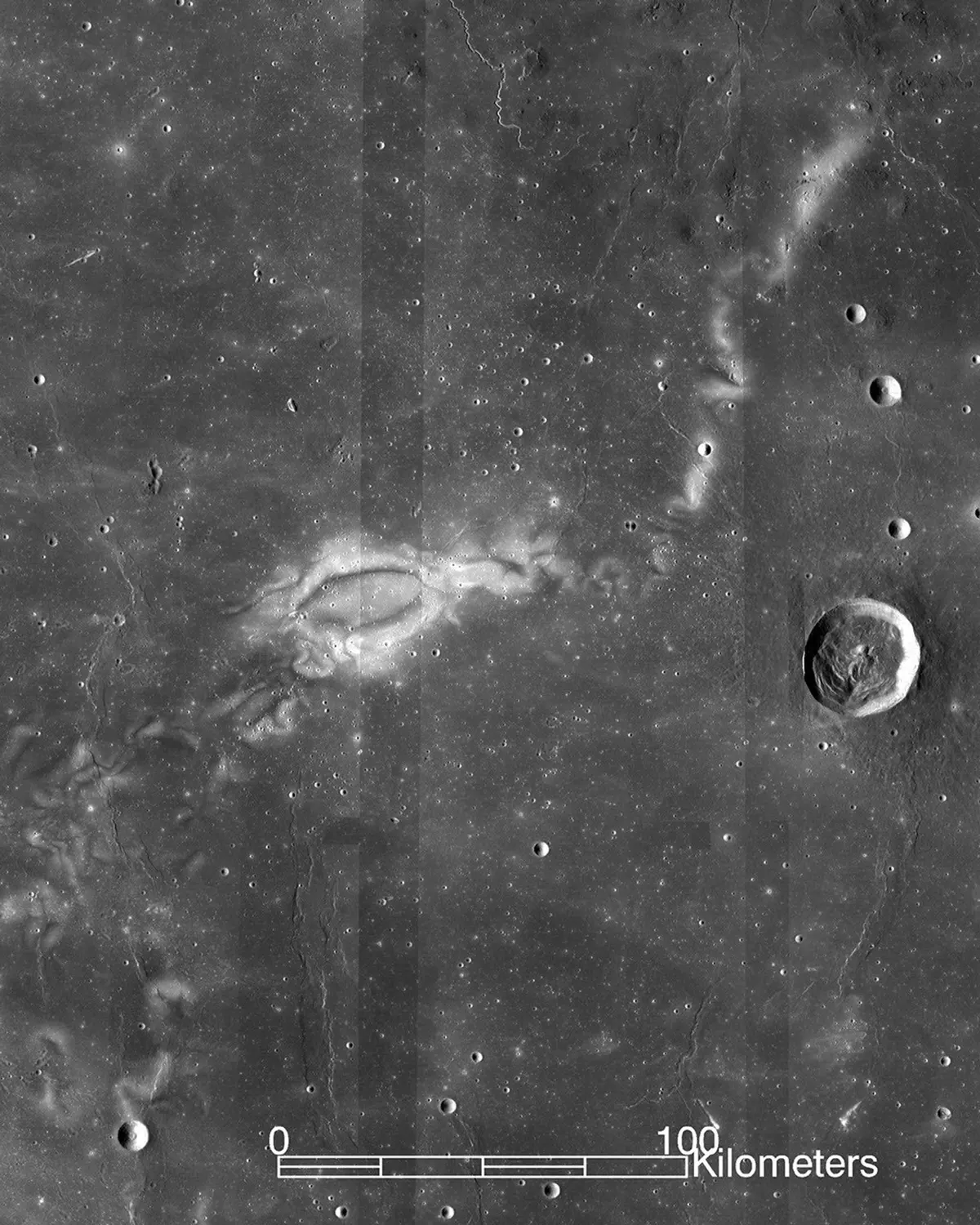
Across the Moon’s gray surface, some regions look as though bright ribbons have been painted over the ground. These features are called lunar swirls. They are not clouds, ice streaks or ordinary impact rays: their unusual brightness and winding shapes make them a special puzzle in lunar science.
What are lunar swirls?
Lunar swirls are sinuous patterns of lighter and darker material found at several locations on the Moon. Reiner Gamma, on the near side, is one of the best-known examples. Orbital images show fine tendrils and broad patches that are difficult to appreciate from ground-based views alone.
Why is magnetism involved?
The Moon does not have a strong global magnetic field like Earth, but parts of its crust preserve localized magnetic anomalies. One leading explanation is that these small magnetic regions deflect some charged particles in the solar wind. The surrounding soil is exposed differently, which may create a contrast in how the surface weathers and darkens.

What remains uncertain?
Not every detail is settled. Researchers are testing how magnetic shielding, solar-wind chemistry, dust movement and the Moon’s geological history combine to produce the observed patterns. Different swirls may not all form through precisely the same process.
How do scientists study them?
The Lunar Reconnaissance Orbiter maps surface brightness, shape and terrain at high resolution. Scientists compare those maps with measurements of crustal magnetism and computer simulations of charged particles near the surface. Future lunar missions could make measurements close to individual swirls.
Can you see a lunar swirl from Earth?
Some large swirls can be located in orbital maps and are discussed in lunar observing resources, but their fine structures are generally too subtle for most backyard telescopes. High-resolution spacecraft images remain the best way to examine their detailed shapes.
Frequently asked questions
Are lunar swirls made of ice?
No. They are patterns in the lunar surface material, not confirmed deposits of ice.
Does the Moon have a magnetic field?
It lacks a strong global field today, but parts of its crust contain localized magnetic anomalies.
Have scientists completely solved the mystery?
No. Magnetic shielding is an important explanation, but researchers continue to investigate the details and variations among swirls.
Trusted Sources and Further Reading
Image credits: NASA/Goddard Space Flight Center/Arizona State University; NASA/GSFC/Arizona State University. Follow the original source pages for image details and usage guidance.