

Voyager 2 and Hubble have watched enormous dark vortices appear, move and disappear in Neptune’s atmosphere. Here is what scientists know about these mysterious storms and the extreme winds around them.
Voyager 2 revealed a surprisingly active atmosphere
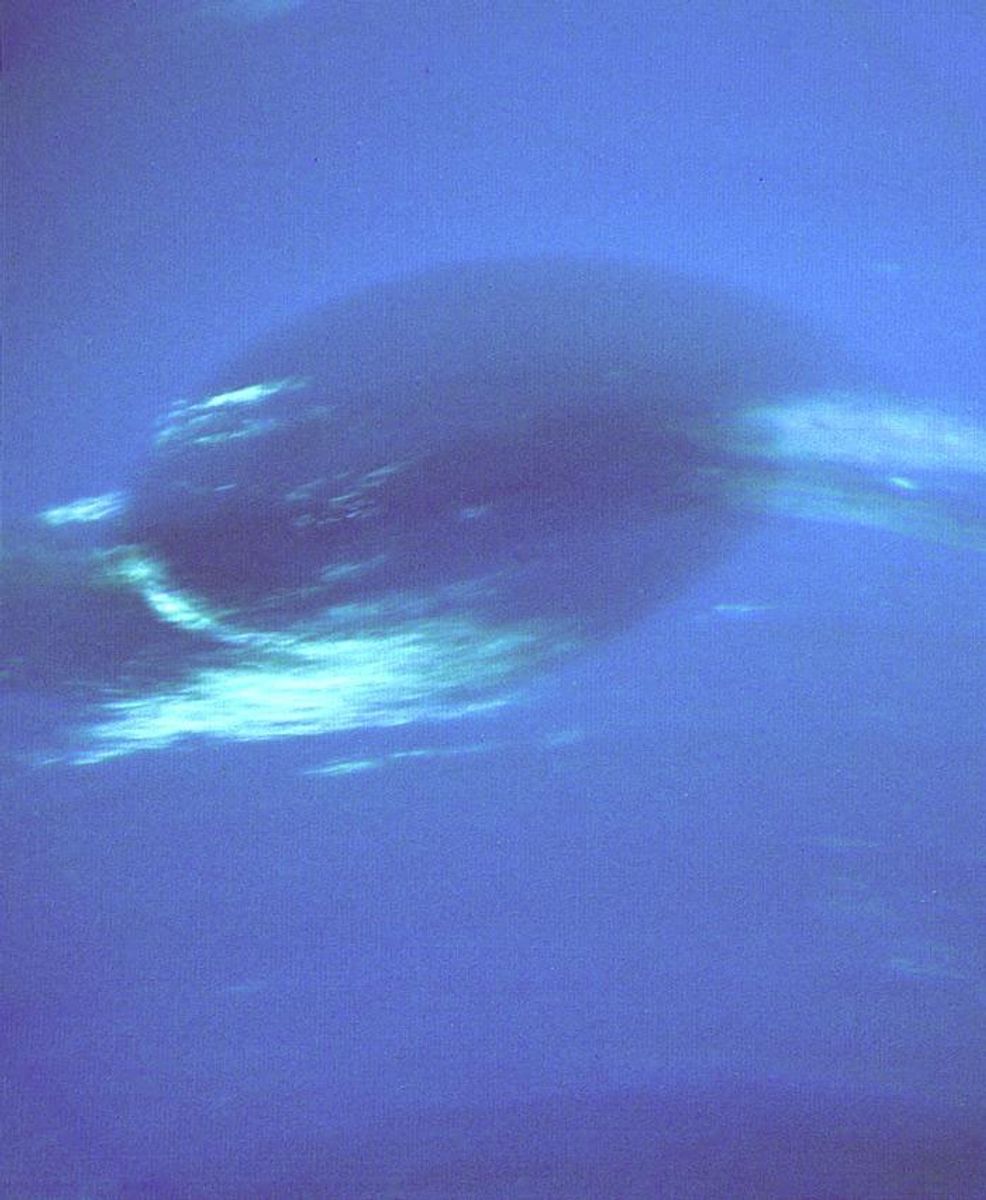
Before Voyager 2 reached Neptune, the distant planet was often imagined as a cold, quiet world receiving very little sunlight. The 1989 flyby changed that picture. Voyager saw bands of clouds, extremely fast winds and a giant dark oval now known as the Great Dark Spot.
The storm was similar in scale to Earth but unlike Jupiter’s long-lived Great Red Spot, Neptune’s major dark vortices can appear and disappear over much shorter timescales.
What a dark spot actually is
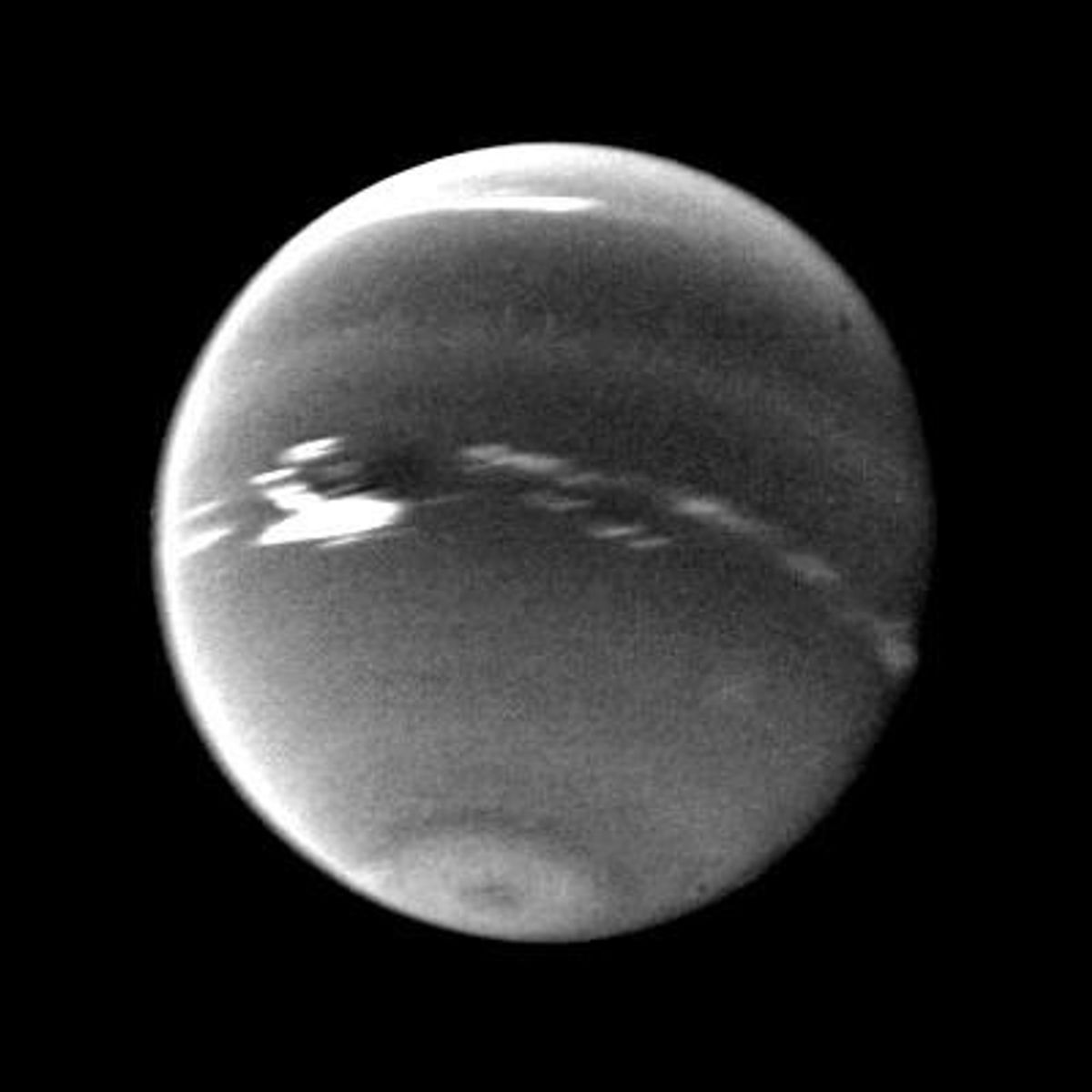
A dark spot is not a hole in the planet. It is a large atmospheric vortex, a rotating weather system embedded within Neptune’s deep atmosphere. Changes in cloud height and chemistry make the vortex appear darker at certain wavelengths.
Bright methane-ice clouds often form nearby where air is pushed upward, cools and condenses. Those white clouds can trace powerful winds around the darker circulation below.
Why Neptune has such extreme winds
Neptune receives far less solar energy than Earth, yet its atmosphere has some of the fastest winds measured in the Solar System. One important clue is that Neptune emits more internal heat than it absorbs from sunlight.
That internal energy, combined with rapid rotation and atmospheric dynamics, helps power weather even at a distance of roughly 30 astronomical units from the Sun.
Hubble shows that the storms are temporary
Years after Voyager, Hubble observations showed that the original Great Dark Spot had vanished. Other dark vortices later appeared at different latitudes. This demonstrated that Neptune’s storms are part of an evolving weather system rather than permanent surface features.
Repeated Hubble observations are valuable because Neptune has only been visited once by a spacecraft. Long-term telescope monitoring provides the timeline needed to watch storms form, drift, change direction and fade.
Why a future Neptune mission would matter
A dedicated orbiter or atmospheric probe could measure winds, temperatures, composition and the deep structure of storms far more directly than remote telescopes can. Neptune also has an unusual moon system, including Triton, making the planet a rich target for future exploration.
Until then, Voyager data and repeated Hubble observations remain the foundation for understanding this distant, dynamic atmosphere.
FAQ
Why is Neptune’s Dark Spots important?
It gives scientists a direct way to study how planets, moons or small bodies evolve and how conditions across the Solar System can differ dramatically.
Are these images real spacecraft or telescope observations?
Yes. The article uses real NASA spacecraft or telescope imagery and credits the mission or observing team in each caption.
Does this discovery prove life exists elsewhere?
No. Planetary discoveries can identify environments, chemistry and processes that are relevant to habitability, but evidence for life requires much stronger and more specific measurements.