
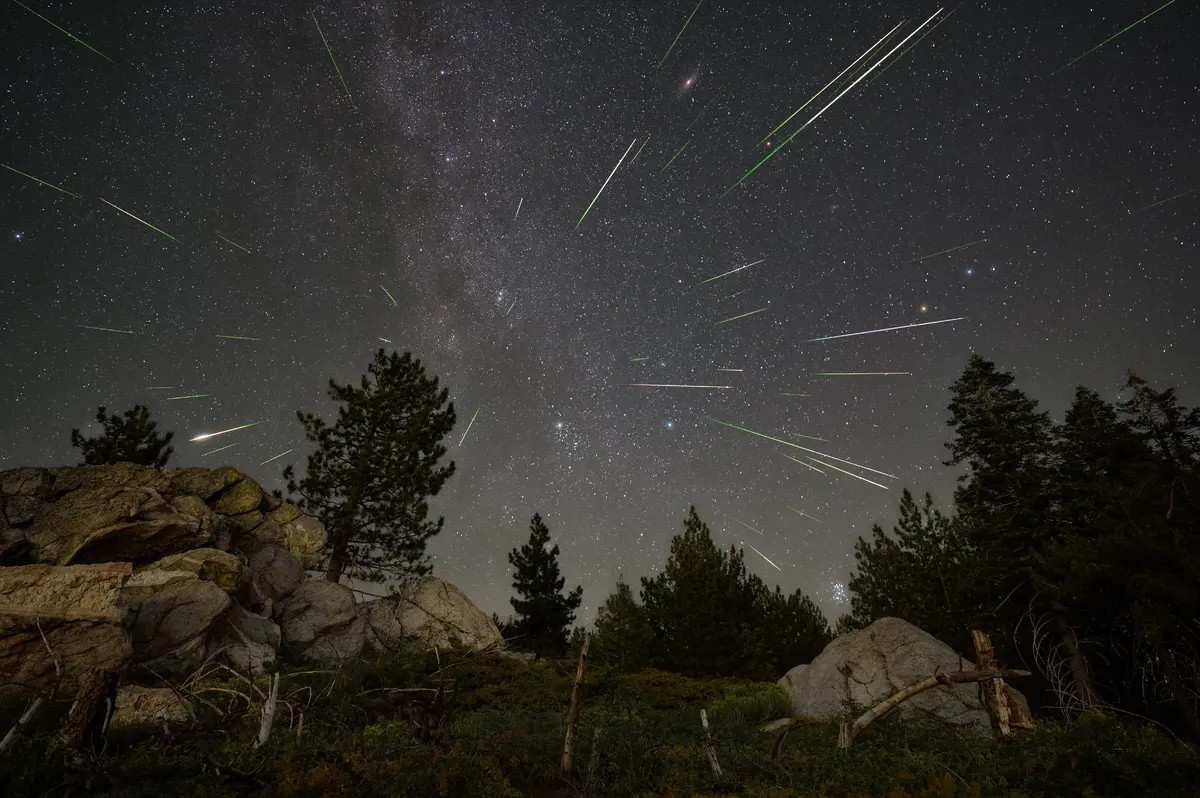
The Perseids are one of the best-known annual meteor showers. They are famous for bright streaks, occasional fireballs, and comfortable summer-night viewing across much of the Northern Hemisphere. The shower returns every year because Earth passes through a stream of debris left by Comet 109P/Swift–Tuttle.
What causes the Perseids meteor shower?
When a comet travels around the Sun, it sheds dust and small particles. Over many orbits, some of this material spreads along the comet’s path. Each year, Earth crosses the debris stream. Particles enter our atmosphere at high speed, heat the surrounding air, and produce the brief streaks of light called meteors. Most particles are tiny and burn up high above the ground.
The Perseids are associated with Comet 109P/Swift–Tuttle. Earth passes through its debris stream every year, which is why the shower is a regular feature of the annual night sky.
Why are they called the Perseids?
The meteors appear to radiate from a point in the constellation Perseus. Astronomers call this apparent origin the radiant. Perspective creates the effect, much as parallel railway tracks seem to meet in the distance. You do not need to stare directly at Perseus: meteors can appear across a large part of the sky.
The radiant helps astronomers identify a meteor shower, but it is not a single physical point from which the meteors are emitted. The particles are entering Earth's atmosphere along roughly parallel paths.
When is the best time to watch?
The Perseids are active during part of the Northern Hemisphere summer and usually peak around mid-August. The exact number visible depends on the year, moonlight, weather, light pollution, and the time of night. Check an up-to-date meteor-shower calendar before planning a trip, because peak dates and moon conditions change from year to year.
If you can, plan a viewing session when the sky is dark and the Moon is not washing out faint meteors. Staying outside for a longer period also gives you more opportunities to see activity.
Where should you look?
Choose a dark location away from streetlights and bright buildings. Give your eyes around 20 to 30 minutes to adapt to darkness, avoid checking a bright phone screen, and look at a broad area of sky rather than one small point. A reclining chair or blanket makes it easier to watch for a long time.
No telescope or binoculars are needed; their narrow fields of view make it easier to miss a meteor. If you use a phone to check a star chart, dim the screen as much as possible or use a red-light setting.
How many meteors will you see?
Published rates describe ideal dark-sky conditions near the peak and are not a promise for every observer. Urban skies, haze, clouds, and moonlight can reduce the number dramatically. Patience matters: a quiet ten-minute stretch may be followed by several meteors in quick succession.
Your results will depend on the viewing location, weather, darkness, and the shower's activity that night. Even under excellent conditions, the number you personally see can differ from the published ideal rate.
Meteor, meteoroid, or meteorite?
A meteoroid is a small natural object moving through space. The bright streak seen as it enters the atmosphere is a meteor. If a piece survives the journey and reaches the ground, it is called a meteorite. Most shower particles are too small to reach the surface.
Frequently asked questions
Can I watch the Perseids without a telescope?
Yes. The naked eye is ideal because it lets you watch a broad area of the sky. Choose a dark location and give your eyes time to adapt.
What causes the Perseids meteor shower?
The shower occurs when Earth passes through debris associated with Comet 109P/Swift–Tuttle. Small particles enter the atmosphere and create visible streaks of light.
Why are the Perseids named after Perseus?
Their meteors appear to radiate from a point in the constellation Perseus. This apparent origin is called the radiant.
When do the Perseids peak?
The shower usually peaks around mid-August. Exact observing conditions change each year, so check a current meteor-shower calendar before planning your viewing session.
Can I see the Perseids from a city?
You may see some meteors, but city lights make fainter ones harder to notice. A darker location away from streetlights usually provides a better experience.
References and Sources
- NASA Science: Perseids Meteor Shower
- NASA Science — additional astronomy and space-science background.
- NASA Solar System Exploration — educational resources and object guides.
Image credit: NASA. Review the original source page for image details and usage terms.