
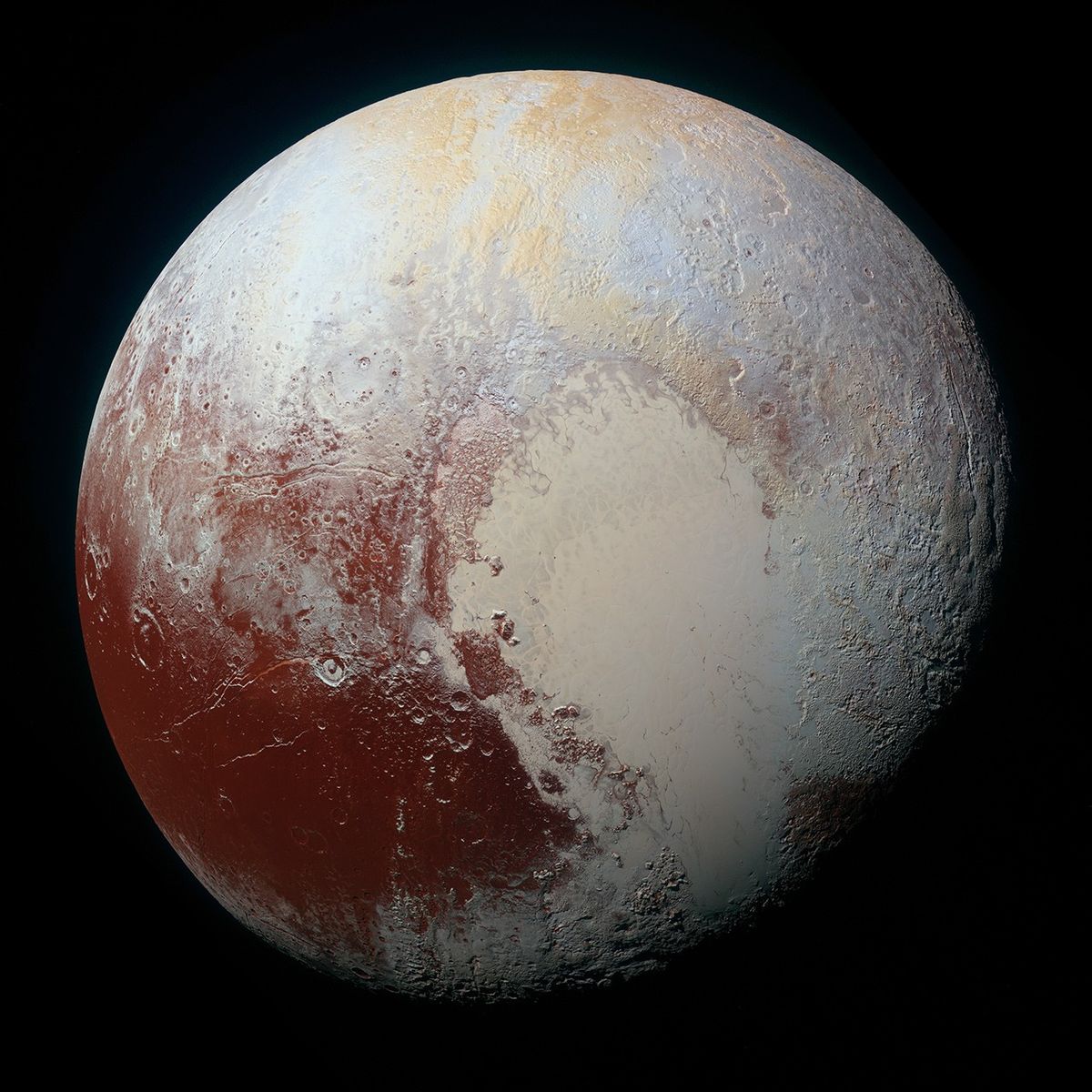
Pluto looked surprisingly complex when NASA’s New Horizons spacecraft flew past in 2015. Enhanced-color versions of the data exaggerate subtle differences that human eyes might miss, turning the surface into a map of contrasting terrains, ices and geological histories.
Quick facts
- Pluto’s bright heart-shaped region includes Sputnik Planitia, a vast basin filled largely with nitrogen ice.
- Water ice forms hard bedrock-like mountains in some regions.
- Methane and nitrogen frosts can migrate seasonally across the surface.
- Enhanced color is a scientific visualization technique; it is not meant to reproduce exactly what a person would see.
Why this matters
Color differences often correlate with composition, texture or the effects of sunlight on surface chemistry. By combining color with topography and spectroscopy, scientists can distinguish ancient cratered terrain from younger resurfaced areas and study how volatile ices move through Pluto’s thin atmosphere and across its surface.
How to read this result
For Pluto, color and brightness patterns are most useful when tied to composition, terrain and seasonal change. Pluto’s bright heart-shaped region includes Sputnik Planitia, a vast basin filled largely with nitrogen ice. Water ice forms hard bedrock-like mountains in some regions. Together, those measurements give the visual feature a testable physical meaning and help researchers compare it with earlier observations and models.
What comes next
New Horizons data remain valuable years after the flyby because researchers can reprocess measurements and compare them with improved laboratory models. Long-term telescopic monitoring also tracks Pluto’s atmosphere and seasonal brightness changes.