
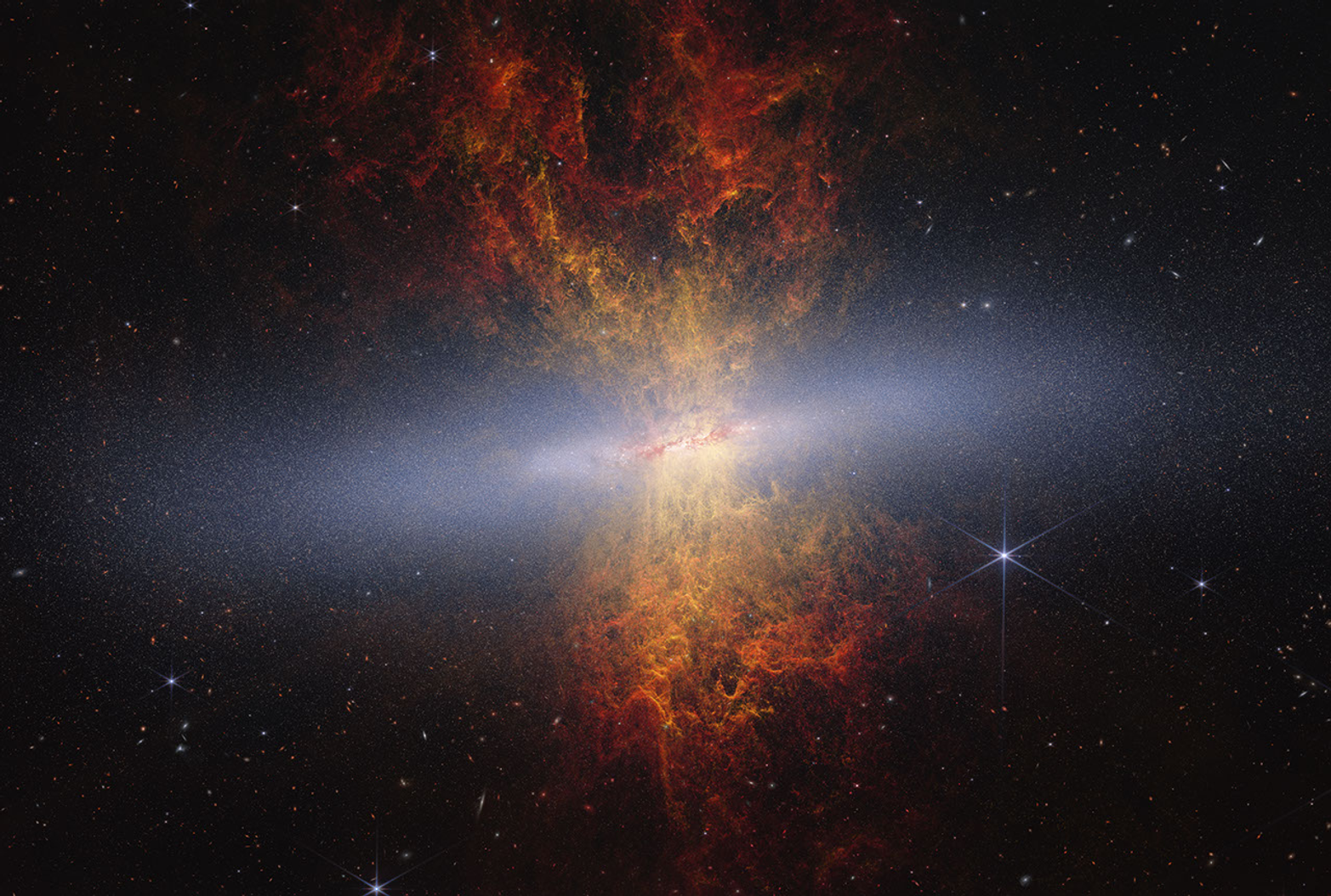
Messier 82, often called the Cigar Galaxy, forms stars at an unusually intense rate. That activity fills the galaxy with young clusters, glowing dust and outflowing material. Webb’s infrared sensitivity can look through some of the obscuring dust and resolve structures that are hard to separate in visible light.
Quick facts
- M82 is a nearby starburst galaxy whose central regions are forming stars rapidly.
- Infrared wavelengths can penetrate dust that blocks visible light.
- Massive young stars inject radiation, winds and supernova energy into the surrounding gas.
- Multiwavelength observations connect newly formed stars with hot gas and large-scale galactic outflows.
Why this matters
Starburst galaxies show what happens when star formation becomes concentrated and extreme. The same young stars that are being born can quickly disrupt their environment, driving material away from the galaxy’s disk. Studying M82 therefore helps astronomers understand the balance between fuel for future stars and feedback that removes or heats that fuel.
How to read this result
For a galaxy, different wavelengths separate starlight, dust, gas and high-energy activity that overlap in a single view. M82 is a nearby starburst galaxy whose central regions are forming stars rapidly. Infrared wavelengths can penetrate dust that blocks visible light. Together, those measurements give the visual feature a testable physical meaning and help researchers compare it with earlier observations and models.
What comes next
Astronomers can compare Webb data with Hubble, radio and X-ray maps to track different phases of gas. The best models must explain both the compact star-forming regions and the much larger wind extending away from the galaxy.