
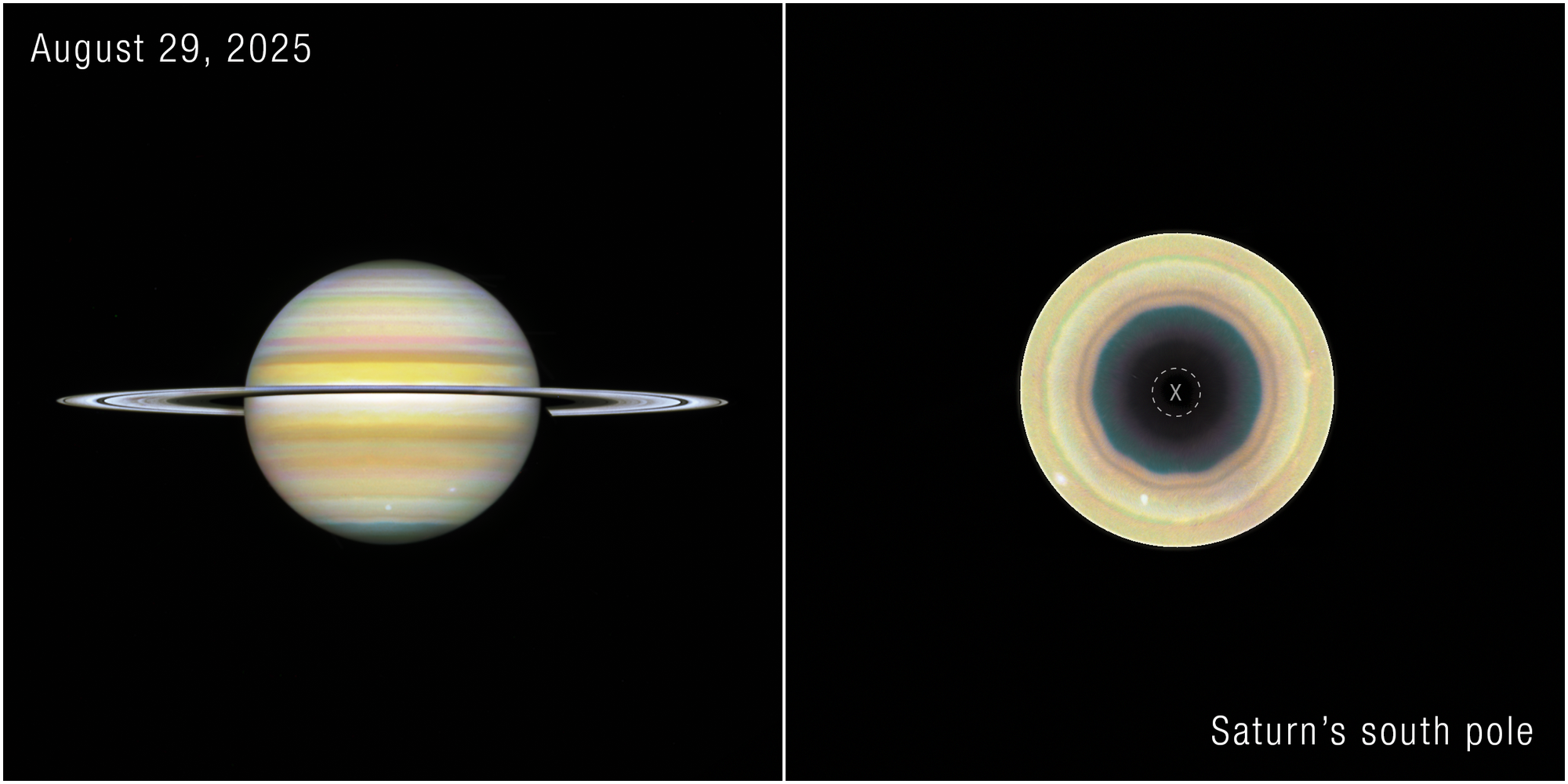
Saturn is already famous for the hexagon around its north pole. In 2026, Hubble observations drew attention to a different geometric feature: a ten-sided, or decagonal, pattern surrounding the planet’s south polar region. The feature is a reminder that giant-planet atmospheres can organize themselves into surprisingly stable waves and vortices.
Quick facts
- Polygonal patterns in planetary atmospheres can arise from waves interacting with strong jet streams.
- Saturn’s atmosphere is dominated by hydrogen and helium, with clouds and hazes at different pressures.
- Long-duration monitoring matters because seasonal change on Saturn is slow by Earth standards.
- Hubble can revisit Saturn regularly and provide consistent global views.
Why this matters
A polygon is not a rigid wall in the atmosphere. It is a pattern in moving gas. Studying its size, drift rate and relationship to nearby winds can reveal how energy moves through Saturn’s atmosphere. Comparing the south-polar decagon with the better-known northern hexagon also gives scientists a natural experiment: two poles on the same planet, exposed to different seasonal histories.
How to read this result
For a giant planet, an atmospheric pattern becomes useful when its geometry, motion and seasonal behavior are measured together. Polygonal patterns in planetary atmospheres can arise from waves interacting with strong jet streams. Saturn’s atmosphere is dominated by hydrogen and helium, with clouds and hazes at different pressures. Together, those measurements give the visual feature a testable physical meaning and help researchers compare it with earlier observations and models.
What comes next
Researchers will watch whether the decagon strengthens, fades, rotates or changes shape as Saturn advances through its seasons. Future data from Hubble and other observatories can help determine which atmospheric layers are involved.