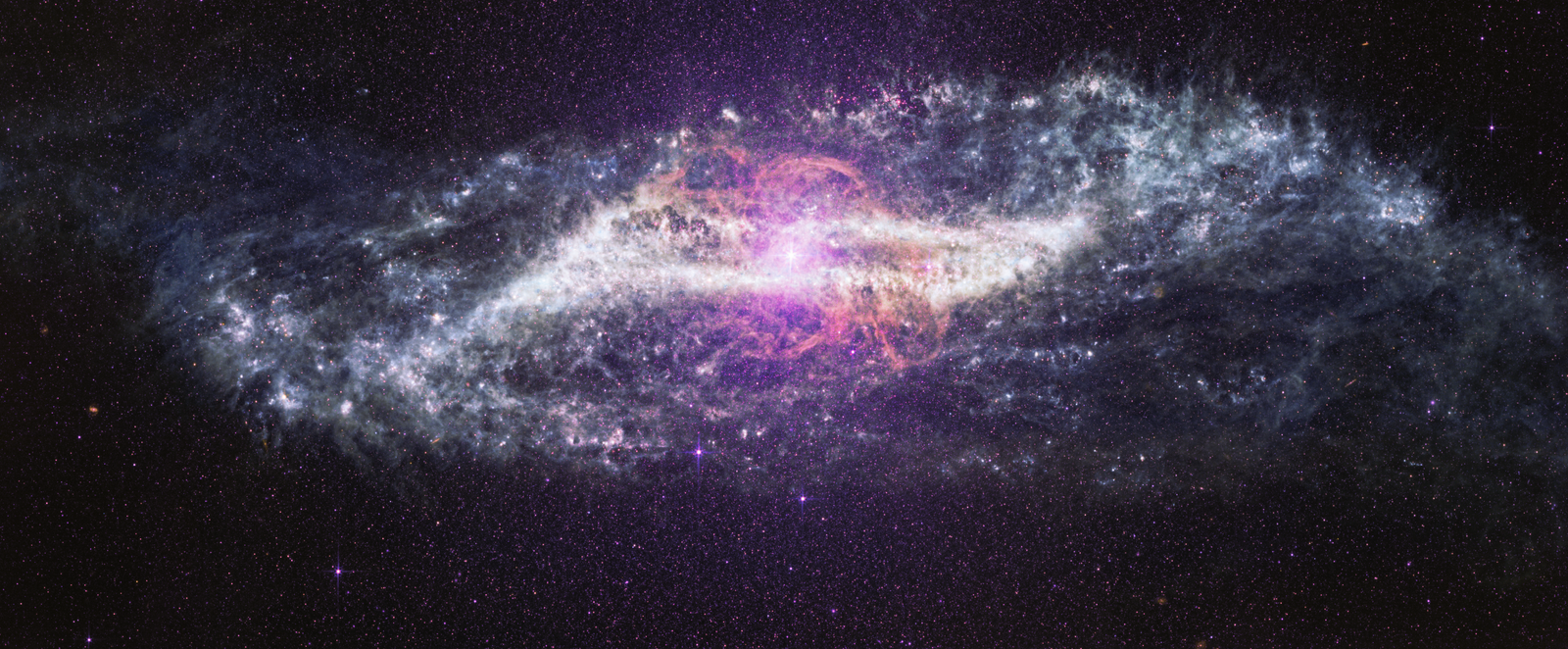
Centaurus A is one of the strangest nearby galaxies. In visible light it is famous for a thick dark lane of dust cutting across a bright elliptical glow. Radio observations reveal enormous jets powered by a central black hole. Now a 2026 James Webb view has pulled back the dust curtain and exposed a far more complicated structure.
Webb’s near- and mid-infrared instruments can see the galaxy in wavelengths that highlight warm dust and dense fields of stars. The result shows warped structures, a striking S-shaped feature, millions of resolved stars and evidence of the violent merger that reshaped the galaxy roughly two billion years ago.
What is Centaurus A?
Centaurus A, also known as NGC 5128, lies about 11 million light-years from Earth. That makes it one of the nearest active galaxies. Its central supermassive black hole is feeding on surrounding matter and launching energetic jets that extend far beyond the visible galaxy.
The galaxy’s unusual shape is a clue to its past. Astronomers think a major collision with another galaxy roughly two billion years ago mixed stars, gas and dust into the distorted system we see today.
Why Webb sees what visible-light telescopes miss
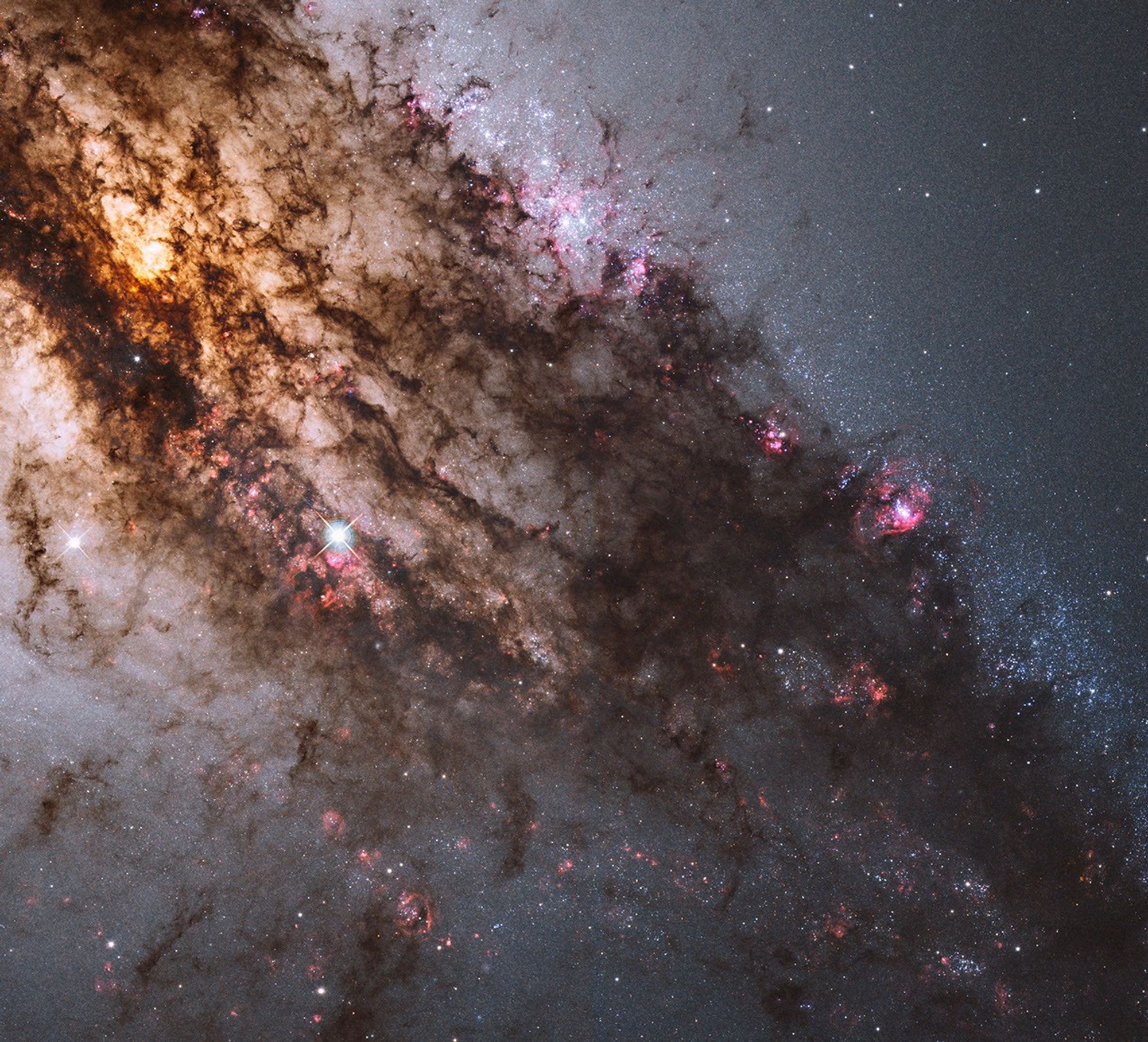
Dust blocks visible light efficiently. That is why Hubble images show Centaurus A’s center crossed by an opaque lane. Webb looks at longer infrared wavelengths, where much of the dust becomes more transparent or glows because it is warm.
NASA’s 2026 Webb release shows that the MIRI view reveals intricate dusty loops and a warped parallelogram-like structure. The combined NIRCam and MIRI data also expose huge numbers of stars hidden in earlier images.
Reading the scars of an ancient galaxy merger
Galaxy collisions rarely mean stars physically smash into each other; the distances between stars are too large. Instead, gravity rearranges the galaxies. Gas clouds collide, orbits are distorted, and material can be driven toward the center.
In Centaurus A, the dust lane and warped structures are evidence of this gravitational disruption. The merger likely triggered episodes of star formation and supplied gas that could eventually reach the central black hole.
The black hole at the heart of the galaxy
As gas spirals toward the central supermassive black hole, it forms a hot accretion flow. Magnetic fields can help launch narrow jets of particles moving at high speeds. Those jets and other outflows carry energy into the surrounding galaxy.
This is called black-hole feedback. It can have competing effects. Compressed gas may form stars, while heated or expelled gas may suppress future star formation. Astronomers want to understand which effect dominates under different conditions.

Millions of stars as a record of the past
Webb’s high resolution allows astronomers to separate individual stars in regions that previously looked smooth or obscured. Those stars preserve information about when they formed. By measuring their colors and brightness, researchers can build a timeline of the galaxy’s history.
That timeline may include stars born before the merger, a burst triggered during the collision and later generations formed from gas that settled into the remnant. This is why astronomers sometimes describe studies like this as galactic archaeology.
Why the strange dust shapes matter
The mid-infrared image shows dust in loops, ribbons and a distinctive S-shaped feature. Some bright points are dusty evolved stars; others are star-forming regions. The unusual geometry can reveal how gas moves under the combined influence of gravity, rotation and energy from the active nucleus.
Spectroscopy adds another layer. Instead of only mapping brightness, Webb can measure the fingerprints and velocities of gas. NASA reports fast-moving ionized gas and warm molecular hydrogen in a warped rotating structure near the center.
The bigger picture: how galaxies and black holes grow together
Nearly every large galaxy appears to host a supermassive black hole, but the exact relationship between black-hole growth and galaxy growth remains one of astronomy’s central questions. Centaurus A is valuable because the action is happening close enough for detailed study.
By comparing its stars, dust, gas and jets, astronomers can test how a merger funnels fuel inward, how the black hole responds, and how the resulting energy changes the galaxy. The same physics may have operated far more intensely in the early Universe, when galaxy mergers were more common.
What comes next
Future Webb observations can map the chemical composition and motion of gas across the central region. Radio and X-ray telescopes can trace the jets and hottest plasma, while optical observatories can study unobscured stars. Combining these wavelengths will provide a more complete model of the galaxy’s history.
Centaurus A is close enough to inspect almost piece by piece, yet complex enough to represent the violent processes that shaped many galaxies across cosmic time.
FAQ
Is Centaurus A a spiral or elliptical galaxy?
It has characteristics of an elliptical galaxy but also contains a prominent dusty disk, reflecting its complicated merger history.
Why does Webb see so much more detail?
Infrared light penetrates dust more effectively than visible light, and Webb combines high resolution with exceptional sensitivity.
Is the central black hole visible in the image?
The black hole itself does not emit light, but Webb can observe the heated dust and gas in its environment and study the motions influenced by the active nucleus.