
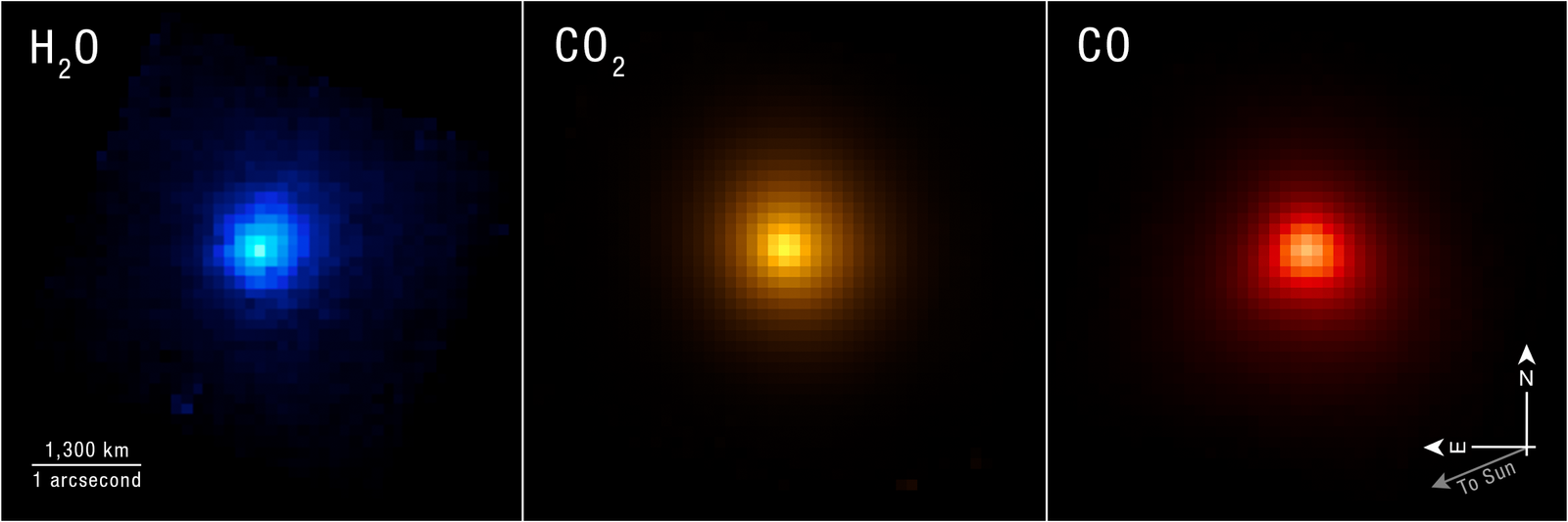
Objects from other planetary systems almost never pass close enough for detailed study. Interstellar comet 3I/ATLAS gave astronomers a rare chance to examine material that formed around another star. Webb’s infrared spectroscopy can identify gases and dust in the comet’s coma, letting scientists compare extraterrestrial chemistry with the familiar families of comets that orbit our Sun.
Quick facts
- An interstellar object follows a path showing it is not gravitationally bound to the Sun.
- Spectroscopy separates light into wavelengths that carry chemical fingerprints.
- As a comet warms, ices turn into gas and create a coma around the nucleus.
- Comparisons with solar-system comets can test whether planet-forming chemistry is broadly similar around different stars.
Why this matters
A single interstellar visitor is not a representative sample of the galaxy, but each one provides direct physical evidence from a planetary system we cannot visit. The chemical ratios in its gas and dust may reveal the temperatures and conditions where it formed, while its activity shows how unfamiliar material responds to our Sun.
How to read this result
For an interstellar comet, composition and motion matter together because they can reveal how material formed around another star. An interstellar object follows a path showing it is not gravitationally bound to the Sun. Spectroscopy separates light into wavelengths that carry chemical fingerprints. Together, those measurements give the visual feature a testable physical meaning and help researchers compare it with earlier observations and models.
What comes next
Researchers will combine Webb measurements with optical and radio observations taken at different points in the comet’s passage. Tracking how the coma changes with solar distance can separate stable composition from temporary activity.