
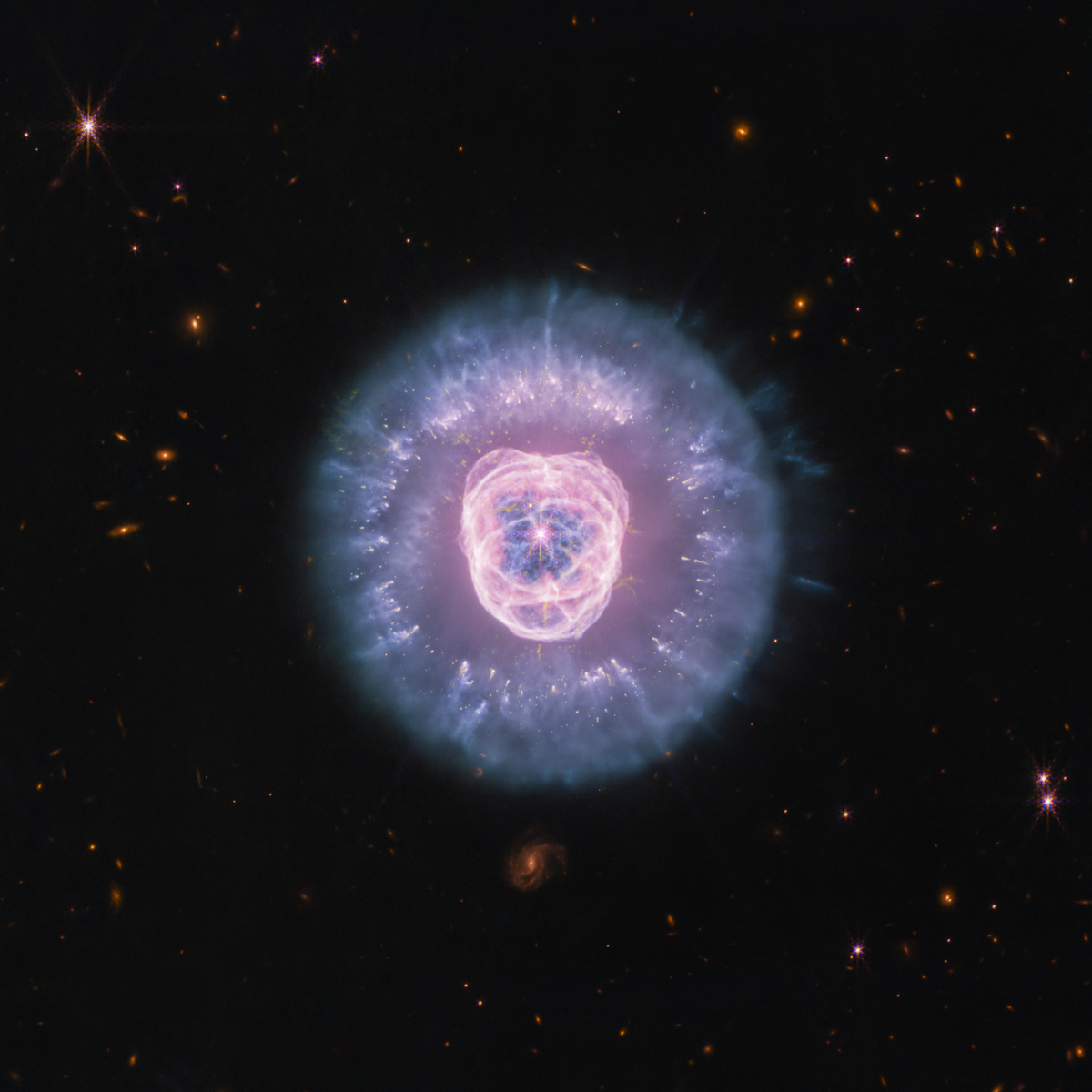
The Lion Nebula is a star-forming region where clouds of gas and dust are being reshaped by radiation from young stars. Webb’s 2026 view emphasizes the structures hidden at visible wavelengths: dense ridges, cavities, embedded sources and glowing material heated by nearby stars.
Quick facts
- Star-forming nebulae contain cold molecular material that can collapse into new stars.
- Young massive stars can erode surrounding clouds with radiation and winds.
- Near- and mid-infrared observations reveal different temperatures and grain populations.
- Dark-looking dust in optical images can become bright or transparent at infrared wavelengths.
Why this matters
The boundary between a bright cavity and a dense cloud is often where feedback and star formation interact most strongly. Radiation may compress gas enough to help trigger collapse in one place while dispersing it elsewhere. Webb gives astronomers the resolution and wavelength coverage needed to study both processes in the same region.
How to read this result
For a nebula, researchers connect visible structure with the winds, radiation and explosions that can shape the gas. Star-forming nebulae contain cold molecular material that can collapse into new stars. Young massive stars can erode surrounding clouds with radiation and winds. Together, those measurements give the visual feature a testable physical meaning and help researchers compare it with earlier observations and models.
What comes next
Spectroscopy of individual knots and stars can measure temperatures, ionized gas and molecular features. Researchers can then compare the ages of stellar populations with the geometry of the cloud to reconstruct the nebula’s recent history.