
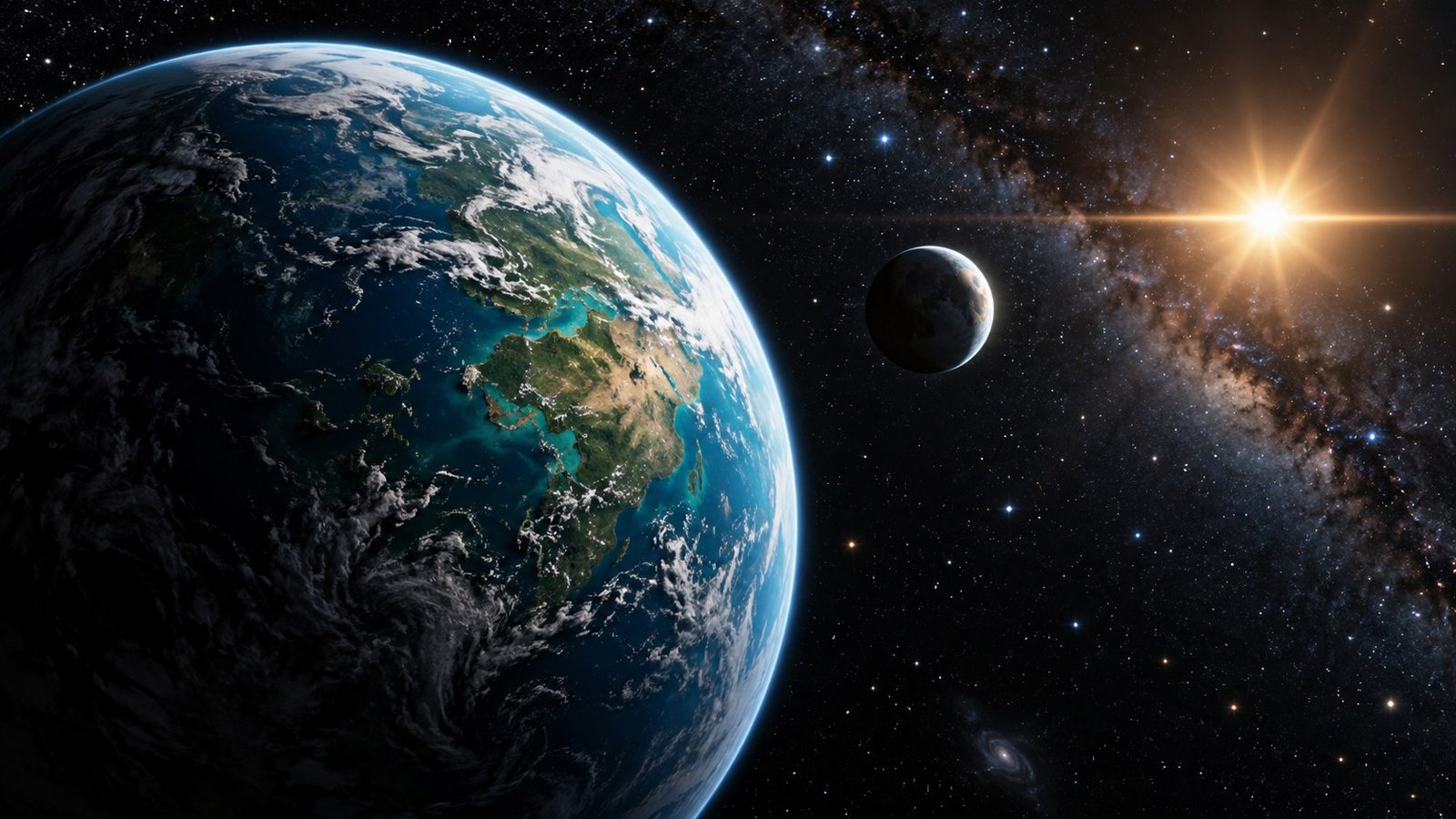
Thousands of planets are now known beyond our Solar System, but most are far too faint to see as tiny dots beside their stars. Astronomers usually discover them by measuring what a planet does to the light or motion of its host star.
Why exoplanets are difficult to see
A star can be millions or billions of times brighter than a nearby planet, and the two appear extremely close together from Earth. That glare is why the most productive planet-hunting methods look for indirect clues rather than a clear photograph.
The job is a little like noticing an unseen companion by watching how it affects something brighter. A planet can briefly block starlight, tug its star back and forth, bend light from a background star, or in special cases be separated from the star with advanced optics.
The transit method
When a planet crosses in front of its star from our point of view, the star becomes slightly dimmer. Repeated dips at regular intervals can reveal the planet’s orbital period. The depth of the dip gives astronomers an estimate of the planet’s size compared with its star.
Space telescopes such as Kepler and TESS made this method famous because they can monitor many stars with great precision. A transit alone is not always enough, so astronomers check whether the signal repeats and whether another explanation could mimic it.

Radial velocity: measuring a star’s wobble
A planet and its star orbit a common center of mass. The planet is small, but its gravity still makes the star move slightly toward and away from us. Spectrographs can detect this motion through tiny shifts in the star’s spectrum.
Radial-velocity measurements are especially useful because they provide information about a planet’s minimum mass. When a planet both transits and produces a measurable stellar wobble, astronomers can combine size and mass to estimate density.
Direct imaging, microlensing and astrometry
Direct imaging blocks or suppresses much of the star’s light so a large, young planet far from its star can sometimes be detected. Gravitational microlensing uses the way gravity bends light when one star system passes in front of another. Astrometry looks for minute changes in a star’s position on the sky.
Each technique is sensitive to a different part of the planet population. Together they help astronomers avoid building a picture based on only one type of world.

What happens after a candidate is found
A candidate must be checked carefully. Scientists look for repeating signals, compare observations from different instruments, and rule out stellar activity or eclipsing binary stars. Follow-up observations can refine the orbit and sometimes reveal an atmosphere.
Finding a planet is therefore the beginning of the investigation, not the end. The next questions are about its temperature, composition, atmosphere, moons, and whether the system resembles anything we know nearby.
FAQ
Can astronomers actually photograph exoplanets?
Yes, but direct imaging is difficult because a planet is usually far fainter than its host star. Coronagraphs and careful image processing can make some large, widely separated planets visible.
Which method has found many known exoplanets?
The transit method has been extremely productive because missions such as Kepler and TESS can monitor large numbers of stars for small, repeating brightness dips.
Why are several detection methods useful?
Different techniques reveal different properties. Combining transit and radial-velocity measurements, for example, can provide both a planet’s size and mass, allowing astronomers to estimate its density.