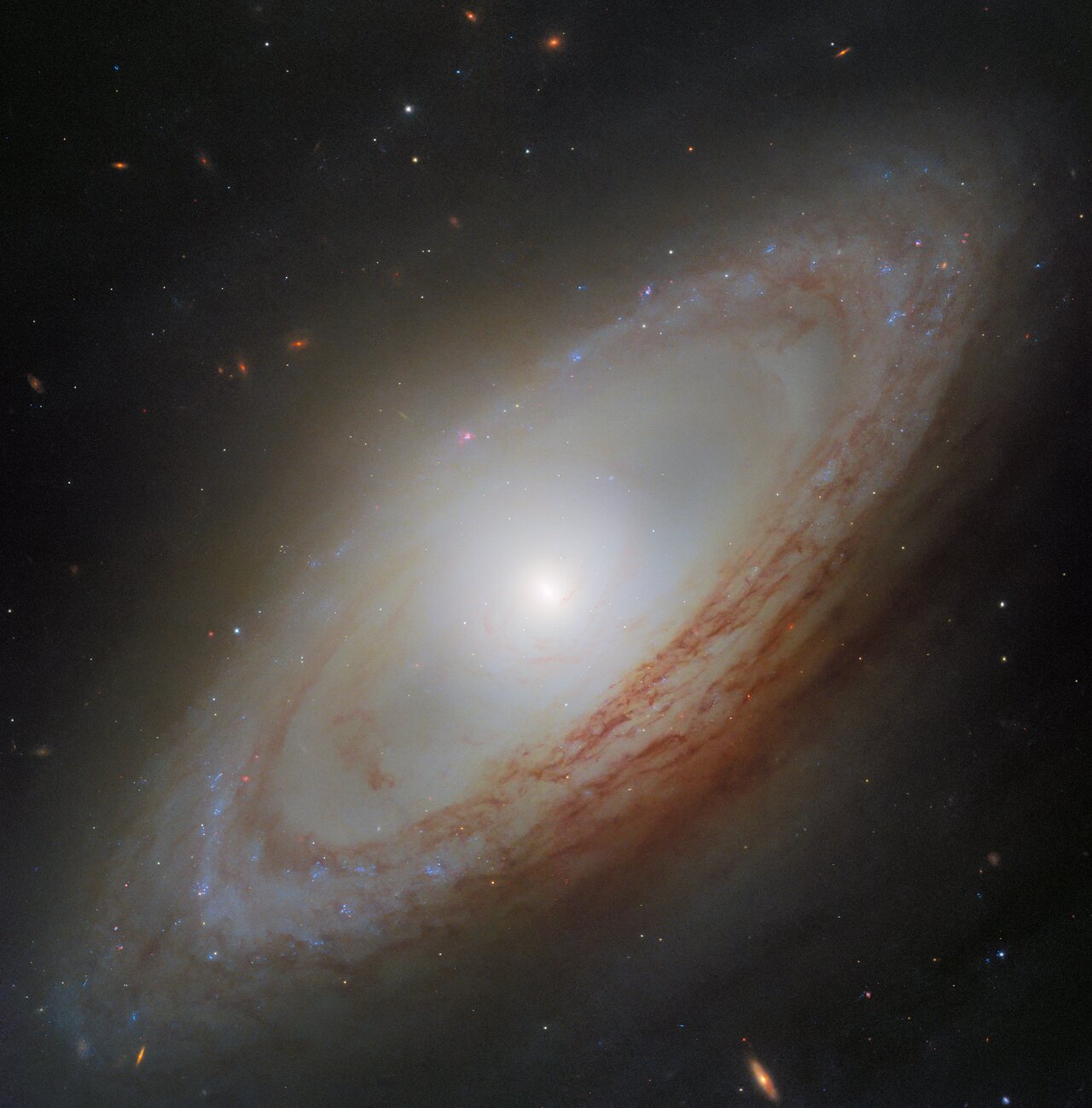
Hubble’s new view of NGC 4698 reveals a Virgo Cluster spiral whose central stars and gas rotate at right angles to its main disk, hinting at a complex past.
What Hubble’s new image shows
NGC 4698 is a spiral galaxy with a bright, pale central bulge surrounded by a thinner disk of stars, gas and dust. Hubble’s 2026 portrait resolves red-brown dust lanes and small blue and reddish patches where younger stars and star-forming regions appear. The outer spiral structure is delicate rather than tightly wound all the way to the center.
One of the first visual clues is that the spiral arms seem to avoid the innermost region. Instead of curling directly into the nucleus, they are most prominent farther out and form a ring-like pattern around the central glow. That shape alone is unusual, but the galaxy becomes far stranger when astronomers add measurements of how its stars and gas are moving.
A central region that is almost at right angles
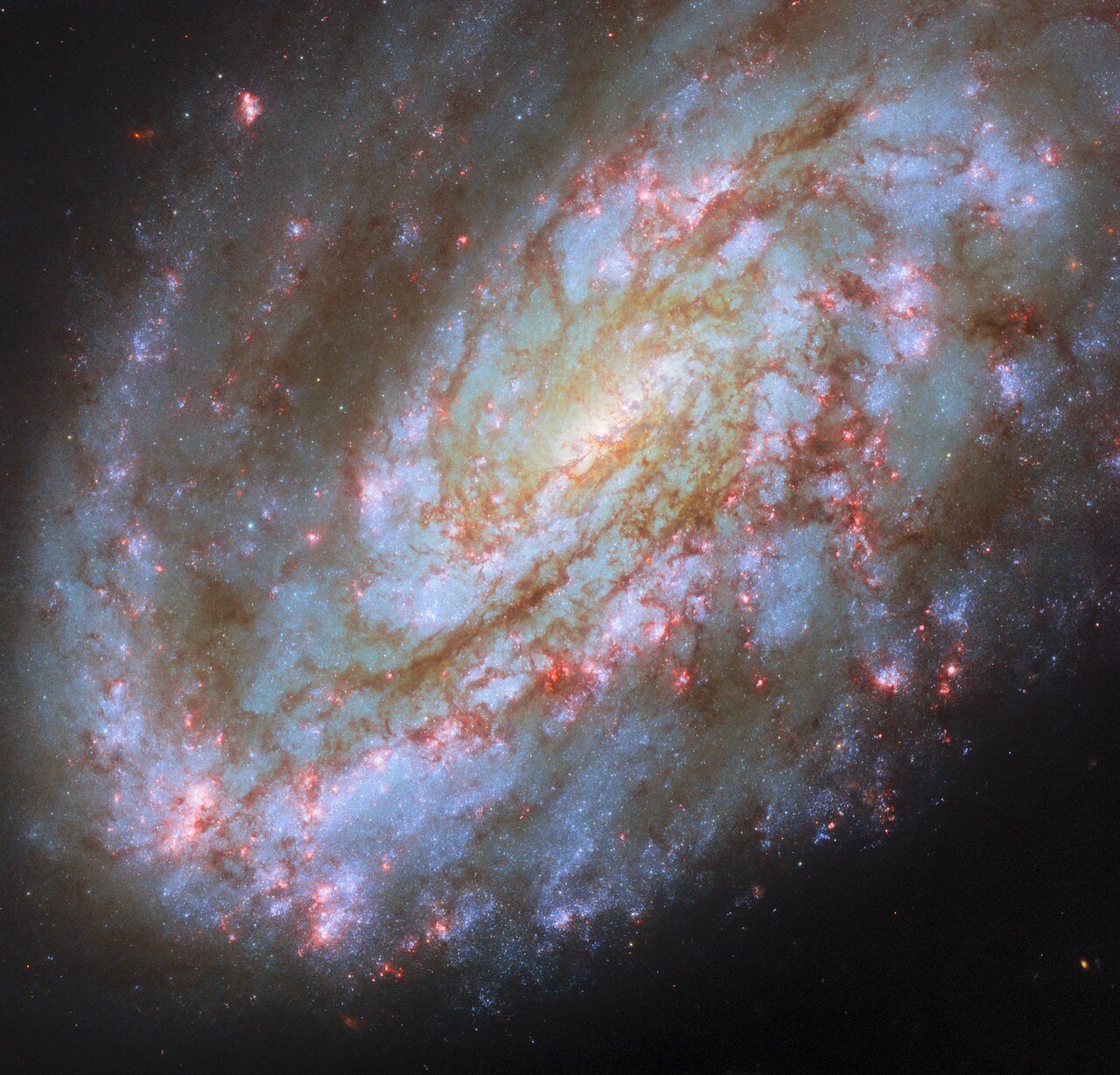
The most remarkable result is geometric: NGC 4698 is one of a small number of spirals whose elongated bulge extends out of the plane of the disk at roughly a right angle. The ghostly central light can be seen peeking above and below the dusty disk in the Hubble image.
Motion measurements add a second surprise. Stars and gas near the center rotate perpendicular to the main galactic disk. A normal spiral is not expected to build its inner and outer components with such dramatically different rotation axes, so the mismatch is evidence that the galaxy’s history has not been simple or isolated.
How can a galaxy become so misaligned?
A leading explanation is that NGC 4698 acquired gas from outside itself. Gas falling in from a different direction can settle into a new plane rather than immediately matching the orientation of the older disk. Over time, that material can form stars and create an inner structure with a rotation axis that preserves the direction of the incoming gas.
NASA and ESA also note observations consistent with a past minor merger, including a short tail of hydrogen extending from one side. A smaller companion would not need to destroy the main galaxy to leave a lasting signature. Even a relatively modest encounter can redistribute gas, change angular momentum and feed material toward the center.
The active black hole at the center
At the heart of the bulge is a supermassive black hole containing millions of times the Sun’s mass. Scientists have found signs that it is actively growing, meaning gas is being drawn inward strongly enough to power activity around the nucleus.
That does not mean the black hole caused the whole right-angle structure. Instead, both the feeding black hole and the misaligned inner region may be connected to the galaxy’s supply of gas. When galaxies acquire or disturb gas through interactions, some material forms stars while a smaller fraction can migrate toward the nucleus.
Why the Virgo Cluster matters
NGC 4698 belongs to the Virgo Cluster, the nearest large cluster of galaxies gravitationally bound together. A cluster is not an empty collection of isolated islands. Galaxies move through a shared environment containing hot diffuse gas and many neighboring systems, so gravitational encounters and gas-stripping processes can influence their evolution.
The observing program behind the new image is designed to study galaxies across Virgo at high resolution. By comparing star clusters, nebulae, dust lanes and larger structures, researchers can ask how a galaxy’s path through the cluster changes its ability to keep gas and form new stars.
Why Hubble uses several filters
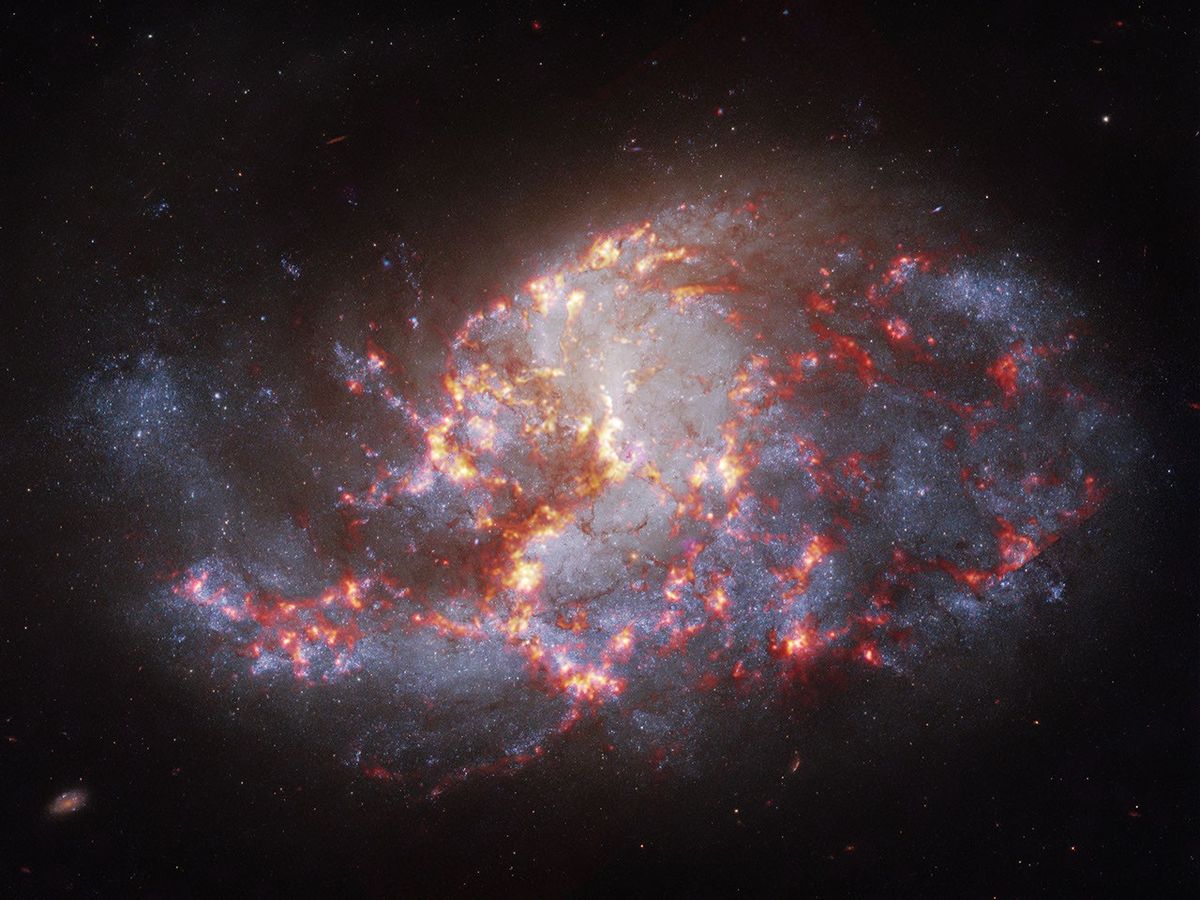
The released image combines ultraviolet and optical observations from Hubble’s Wide Field Camera 3. Different filters emphasize different stellar populations, dust and energized gas. Blue and ultraviolet light tends to highlight hot young stars, while redder optical light helps reveal cooler populations and dusty structure.
Combining those measurements into a color image gives a scientifically useful view that is also intuitive to read. The photograph is therefore more than a pretty portrait: it is a map of several physical components layered together.
What NGC 4698 teaches us about galaxy evolution
Galaxies grow by using gas, forming stars and interacting with their surroundings. NGC 4698 is a good reminder that this growth does not always happen neatly in one plane. Material can arrive with a different angular momentum direction, and a galaxy can preserve the evidence for a long time.
That makes misaligned galaxies valuable laboratories. Their structures allow astronomers to reconstruct past accretion and merger events that may no longer have an obvious companion nearby. With Hubble resolving the stellar and dusty detail, future spectroscopy can connect that visible structure to the velocities of stars and gas.
FAQ
Is NGC 4698 colliding with another galaxy right now?
The current NASA release does not describe an ongoing major collision. Evidence instead points to externally acquired gas and possibly a past minor merger.
Can Hubble directly see the galaxy rotating?
No. The still image shows structure. Rotation directions are measured with spectroscopy, which tracks Doppler shifts in the light from stars and gas.
Why is the galaxy important?
Its nearly perpendicular inner and outer rotation makes it a useful case for studying how gas accretion and smaller mergers can reshape spiral galaxies.
Official sources & further reading
- NASA Science — Hubble Spots an Out-of-Sync Galaxy
- ESA/Hubble — A galaxy spinning out of sync
- ESA/Hubble — One-sided spiral (NGC 4654)
Image credits are shown with each image. External source links open official NASA, ESA/Hubble or Chandra pages.