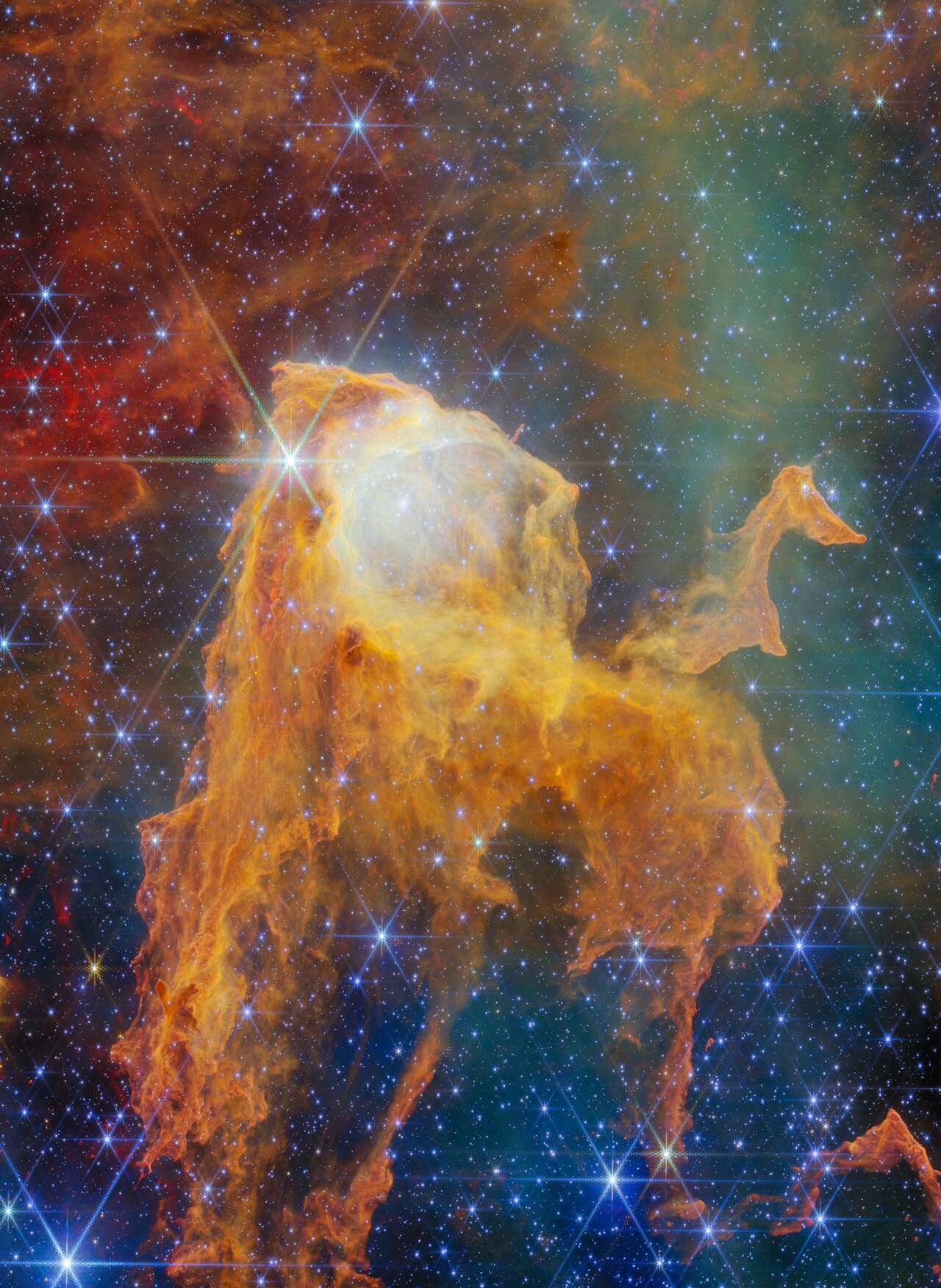
Inside the Carina Nebula, young stars are carving light-filled cavities through dark clouds of gas and dust. One compact region has a particularly memorable nickname: the Treasure Chest. In a 2026 Picture of the Month, the James Webb Space Telescope used its Near-Infrared Camera to look through the dust and reveal the young cluster inside with exceptional clarity.
The Treasure Chest contains roughly 70 stars. Researchers estimate the cluster is about 1.3 million years old, making it extremely young on stellar timescales. Its most massive member is an O-type star roughly 19 times the mass of the Sun, energetic enough to strongly influence the surrounding cloud.
The image is useful because star formation is not only about stars switching on. Radiation, winds, disks and nearby massive stars all interact with the cloud. Webb lets astronomers study those processes while the cluster is still embedded in the material from which it formed.
What is the Treasure Chest?
The Treasure Chest is a compact young cluster embedded in a cometary globule: a dense cloud shaped by radiation and winds from nearby massive stars. The cloud’s illuminated edges and internal cavities give the region its sculpted appearance.
Because the stars are so young, much of the original dust has not yet been dispersed. Many cluster members also show evidence of circumstellar disks, the flattened reservoirs of material that can become the starting point for planetary systems.
This combination — a very young age, substantial remaining dust and stars of different masses — makes the Treasure Chest an excellent laboratory for testing how a cluster emerges from its birth cloud.

Why Webb can see deeper into the cloud
Dust grains are efficient at blocking visible light, which is why some star-forming regions appear as dark silhouettes in ordinary optical images. Near-infrared wavelengths pass through more of that dust. Webb’s NIRCam can therefore detect stars that are faint or hidden in visible-light observations.
Infrared imaging also reveals heated dust and structures shaped by radiation. In the Treasure Chest, bright rims, knots and wisps trace places where energetic starlight interacts with the cloud. The result is both visually dramatic and physically informative.
Astronomers can combine Webb data with Hubble and ground-based observations to compare how the same gas looks at different wavelengths. That helps separate obscuration from true differences in stellar populations.
What a 1.3-million-year-old cluster can teach us
For a Sun-like star with a lifetime of billions of years, 1.3 million years is barely the beginning. At this age, many stars are still settling onto the main sequence and losing or reshaping the disks around them. Massive O-type stars evolve faster and begin changing their surroundings almost immediately.
A young cluster gives astronomers a chance to compare stellar mass with disk survival, local radiation intensity and position inside the cloud. If disks disappear faster near the most luminous stars, that can influence the chances for planet formation in crowded environments.
Researchers can also measure the cluster’s initial mass distribution — how many low-, medium- and high-mass stars formed together. That distribution is a key ingredient in models of how galaxies build their stellar populations.
The influence of Eta Carinae and the larger nebula
The Treasure Chest does not evolve in isolation. Eta Carinae, one of the most luminous stellar systems in the Carina Nebula, lies nearby on the sky. Massive stars throughout the region flood surrounding clouds with ultraviolet radiation and drive powerful winds.
Those external forces can compress one side of a cloud while eroding another. In some places compression may help trigger new star formation; in others the same radiation can strip material away before stars or disks finish growing. The balance depends on distance, density and timing.
Webb’s detailed view lets astronomers examine the boundary between the embedded cluster and the externally illuminated cloud, providing evidence for how environmental feedback operates on small scales.
What happens to the young circumstellar disks?
Circumstellar disks are important because they contain the raw material for planets, moons, asteroids and comets. In a dense cluster, those disks face a harsher environment than an isolated young star. Ultraviolet radiation can heat disk surfaces and drive gas away, a process known as photoevaporation.
Webb can search for infrared signatures of warm dust around individual cluster members. Comparing disk-bearing stars across the region may reveal whether the most exposed objects are losing material faster than stars shielded deeper inside the cloud.
Such measurements connect stellar astronomy directly to planet formation: the birth environment of a star can influence how much time its disk has to assemble planets.
What to watch next
Spectroscopic follow-up can measure temperatures, chemical species and motions in both stars and gas. Repeated observations can also identify variable young stars, accretion activity and changes in illuminated structures.
Researchers will continue comparing the Treasure Chest with clusters of different ages and radiation environments. A sequence of clusters can show how quickly clouds are dispersed and how long disks survive under intense feedback.
The 2026 Webb image captures the region at a particularly valuable moment: the stars are visible, but the nursery around them has not yet disappeared.
FAQ
How far away is the Treasure Chest region?
It lies in the Carina Nebula, roughly 7,500 light-years from Earth.
How many stars are in the cluster?
Researchers estimate that the compact cluster contains about 70 stars.
Is the Webb image on this page real?
Yes. It is a real NIRCam observation released by ESA/Webb, NASA and CSA, not a generated illustration.