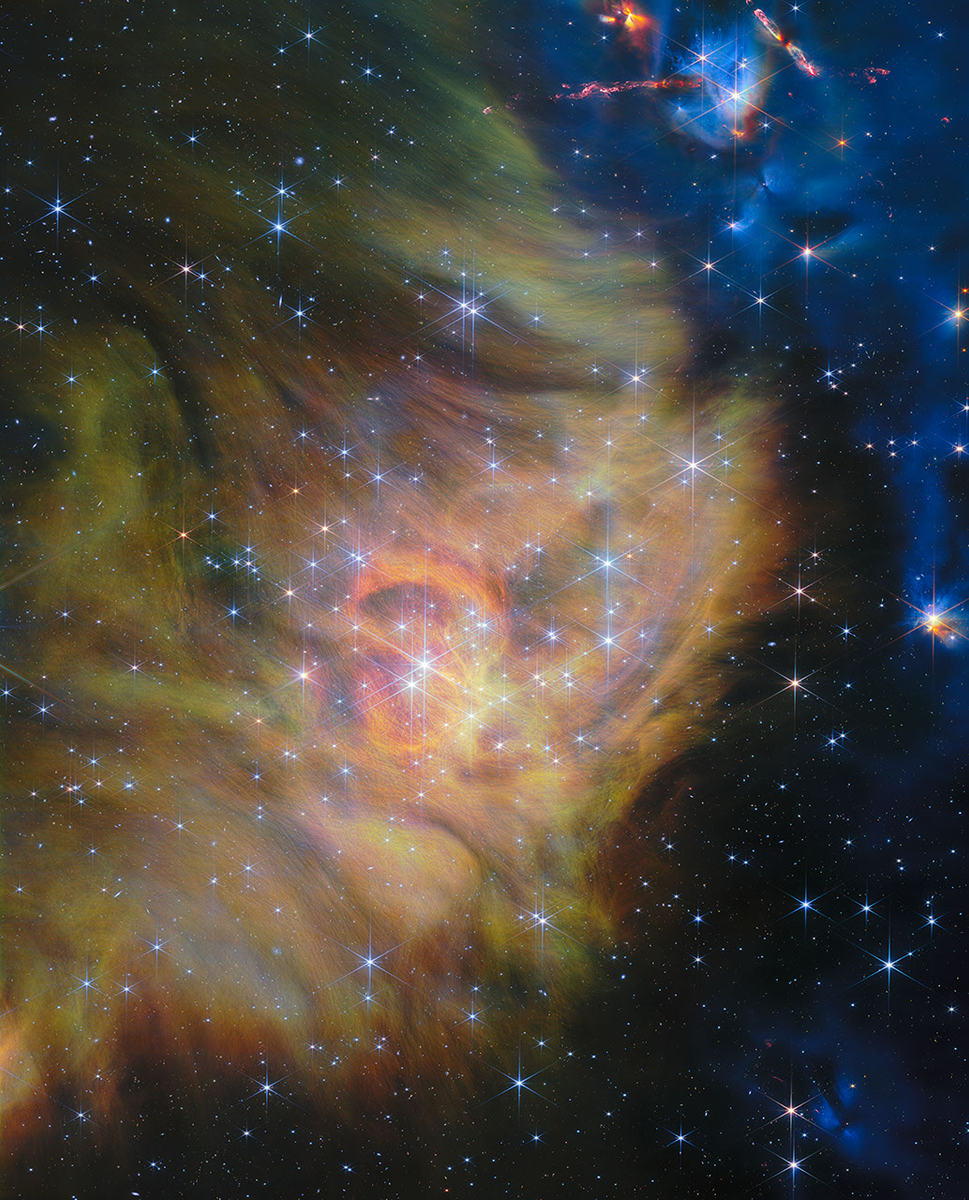
Webb’s huge new panorama of IC 348 reveals extremely low-mass brown dwarfs, a possible disk around one of them, and dramatic newborn-star jets.
A giant new view of a nearby stellar nursery
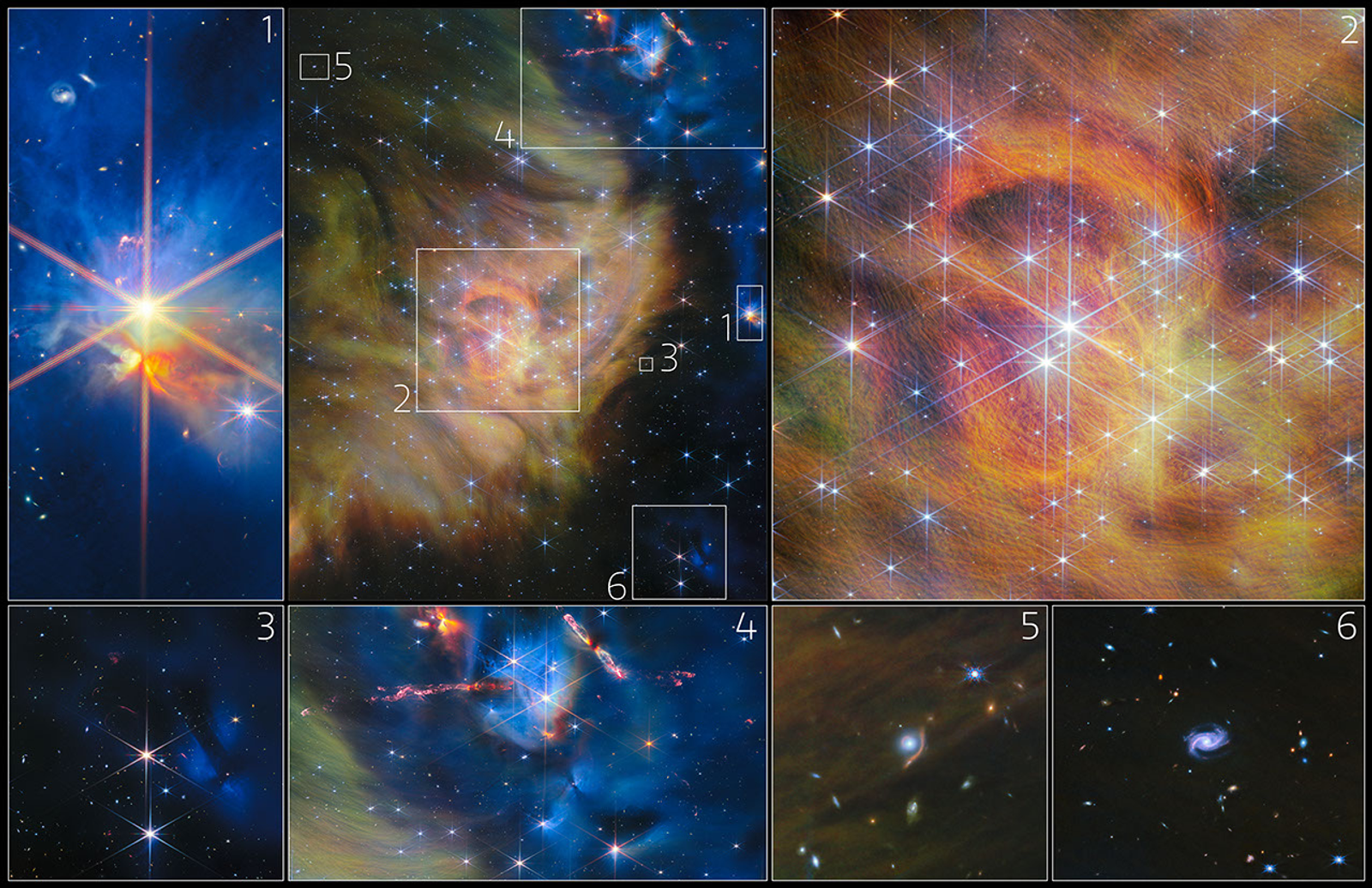
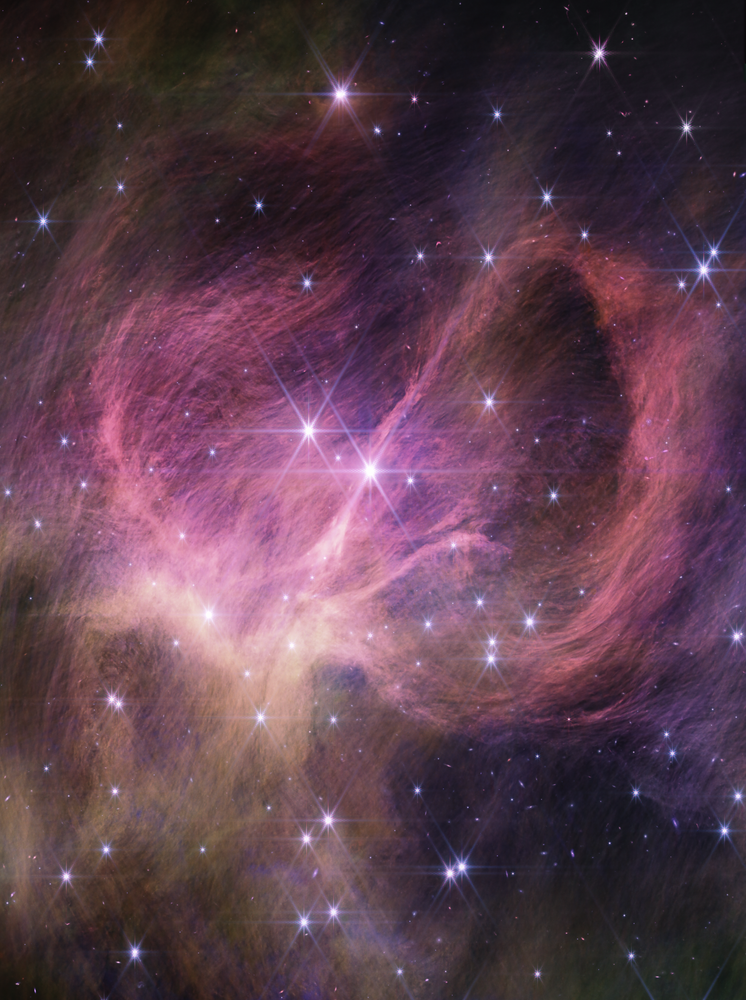
IC 348 is a young star-forming region about 1,000 light-years away in Perseus. In Webb’s 2026 panorama, warm dust and gas form broad yellow-green structures while sharp stars fill the frame. In the upper right, newborn stars drive bright blue and red jets into the material around them.
The view is scientifically valuable because IC 348 is young and nearby enough for very low-mass objects to retain heat from formation. Infrared light lets Webb identify objects that are faint or hidden at visible wavelengths.
What exactly is a brown dwarf?
Brown dwarfs occupy the mass range between stars and giant planets. They are thought to form through gravitational collapse in molecular clouds, similar to stars, but their cores do not become hot and dense enough to sustain fusion of ordinary hydrogen into helium.
That makes the lower mass boundary of star-like formation a major open question. If a cloud fragment can collapse into an object only a few times Jupiter’s mass, theories must explain how such a tiny fragment avoids being disrupted before it becomes a compact body.
Objects only twice Jupiter’s mass challenge models
Webb observations revealed brown dwarfs in IC 348 with masses as low as roughly twice Jupiter’s mass, or about 0.19 percent of the Sun’s mass. NASA describes them as the least massive brown dwarfs known in the study and notes that their existence pushes below the range predicted by some star-formation models.
The team first used NIRCam to identify candidates from their colors and brightness, then followed up with NIRSpec spectroscopy. Spectra allow researchers to estimate temperatures, surface properties and masses much more reliably than brightness alone.
A disk around a planet-mass object
One of the lightest new brown dwarfs shows evidence for a disk. Disks are common around young stars and are the raw material from which planets can form. Finding one around an object that is itself only a few Jupiter masses raises an intriguing possibility: very small planetary systems may form around bodies that never became stars.
The observation does not mean planets have already been confirmed there. A disk is a sign of available material and active youth, not a completed planetary system. Follow-up observations will be needed to determine its composition, structure and evolution.
An unidentified hydrocarbon signature
NIRSpec also detected a spectral feature attributed to an unidentified hydrocarbon in the lowest-mass brown dwarfs. Hydrocarbons contain hydrogen and carbon, but the precise molecule responsible for this feature has not yet been pinned down.
The fact that the signature appears in extremely low-mass objects may indicate unusual atmospheric chemistry at low temperatures and gravities. Spectroscopy is powerful precisely because a point of light can carry chemical fingerprints invisible in an image.
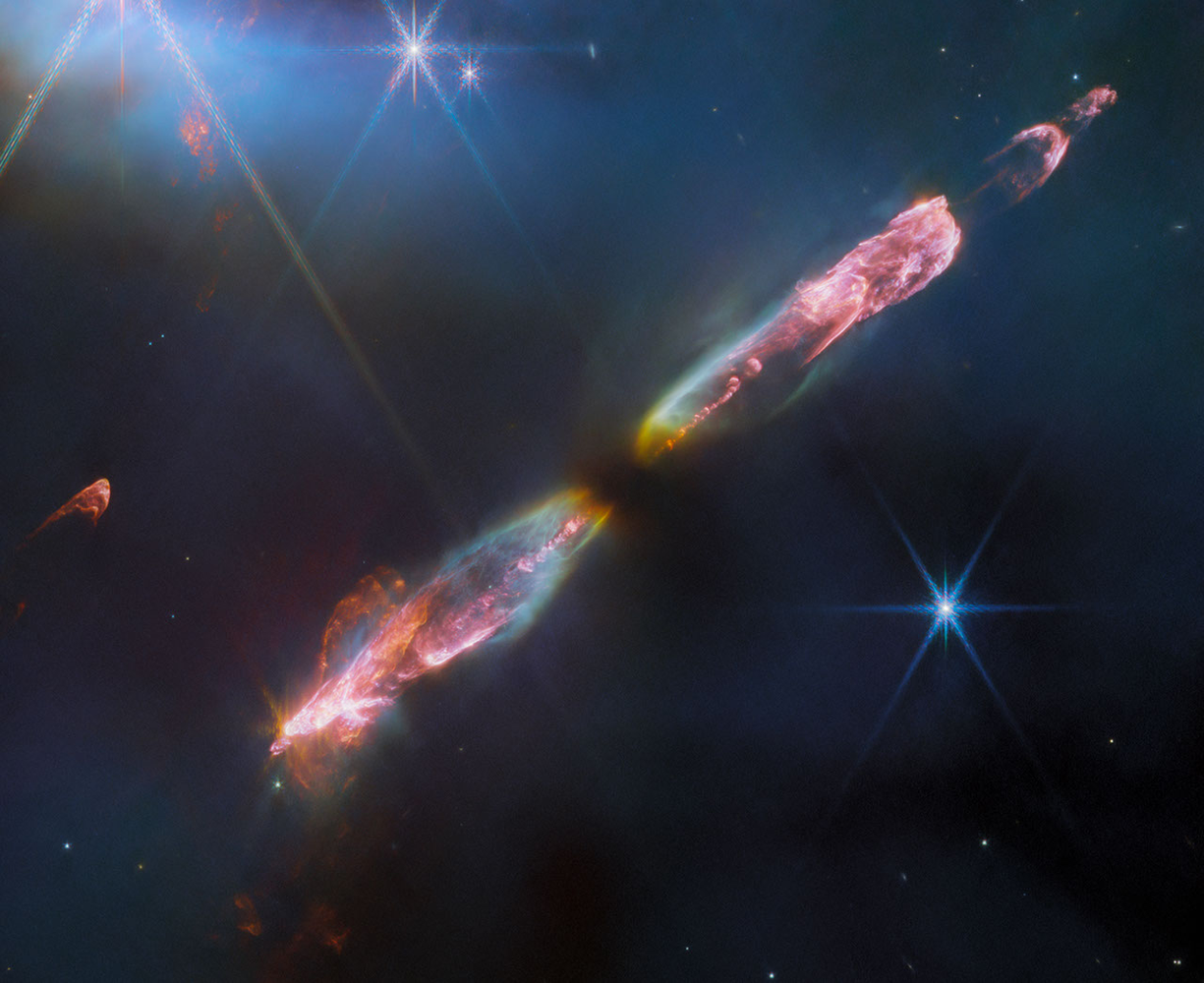
The same panorama also catches violent stellar birth
IC 348 contains protostars that are still accreting material. Some launch fast jets that slam into nearby gas and dust, producing luminous Herbig-Haro objects. Webb resolves these shocks in remarkable detail.
HH 797 in the region is associated with two nearly parallel outflows, while nearby HH 211 shows narrow jets and broader shocks from a very young source. These features reveal that star formation is not a quiet collapse: young stars actively reshape their environment as they grow.
Why Webb is unusually good at this job
Dust that blocks visible light becomes more transparent in the infrared. Webb’s large mirror and sensitive instruments can therefore see embedded young objects and detect faint heat from tiny brown dwarfs in the same field.
NIRCam provides the deep, sharp images needed to select candidates. NIRSpec then separates their light by wavelength, turning each candidate into a physical measurement. The combination of imaging and spectroscopy is what makes the low-mass census credible.
What astronomers will look for next
One major goal is to find out whether IC 348 is unusual or whether similarly tiny brown dwarfs are common in other stellar nurseries. Surveys of different environments can test whether density, radiation and turbulence change the minimum mass that can form through cloud collapse.
Longer observations may also reach still fainter objects. The earlier Webb study suggested that deeper surveys could approach Jupiter-mass scales, where the observational distinction between star-like brown dwarfs and free-floating planets becomes especially challenging.
FAQ
Are brown dwarfs failed stars?
The phrase is common but incomplete. Brown dwarfs are a distinct class of objects that form like stars yet never sustain ordinary hydrogen fusion.
Are the new IC 348 objects planets?
Their masses overlap giant planets, but the team interprets them as likely brown dwarfs because they appear to have formed independently in the cluster rather than in a planetary system.
Why does Webb use infrared light?
Young low-mass objects glow strongly in infrared, and infrared wavelengths can pass through more of the dust that hides star-forming regions in visible light.
Official sources & further reading
- NASA Science — Webb Reveals Dynamic Panorama of Star Formation
- NASA Science — Webb Identifies Tiniest Free-Floating Brown Dwarf
- NASA Science — Webb Snaps Supersonic Outflow of Young Star
Image credits are shown with each image. External source links open official NASA, ESA/Hubble or Chandra pages.