
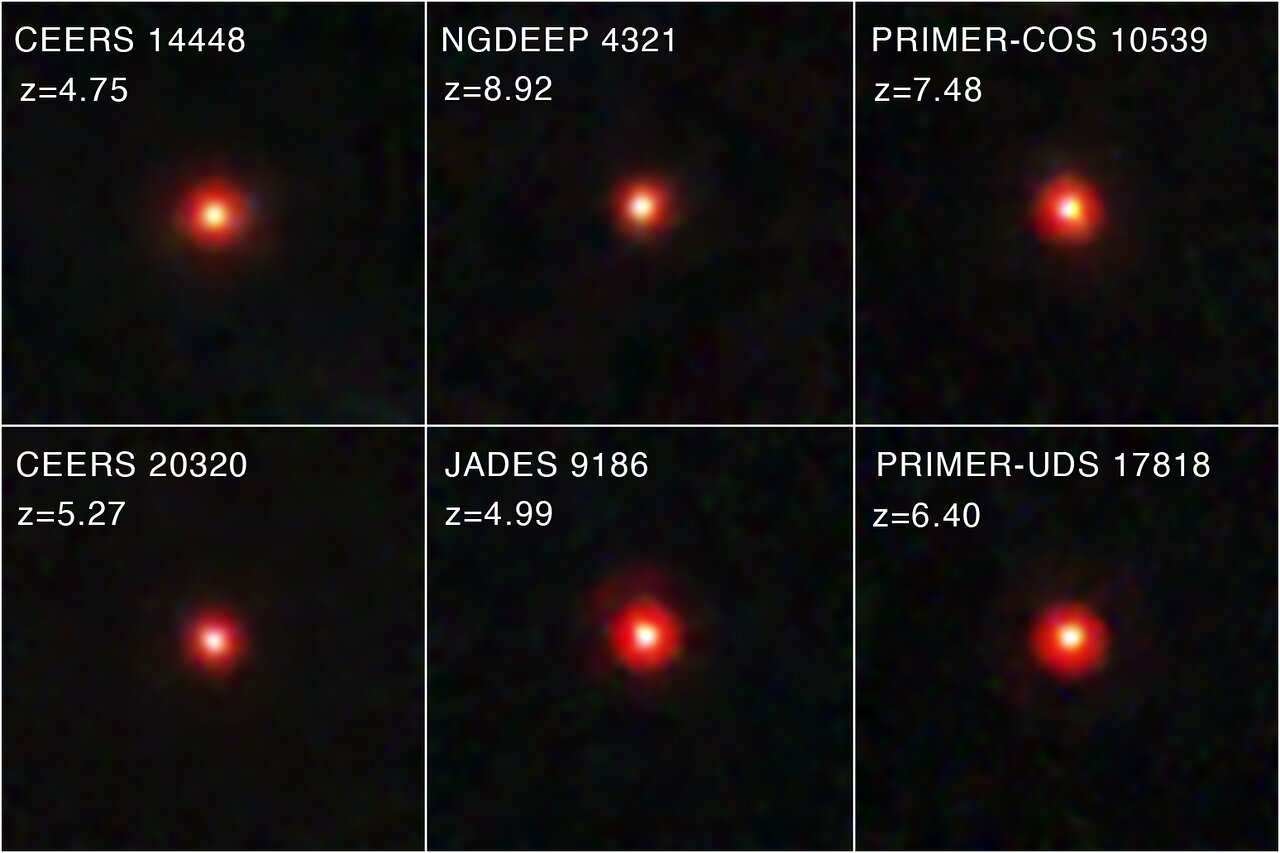
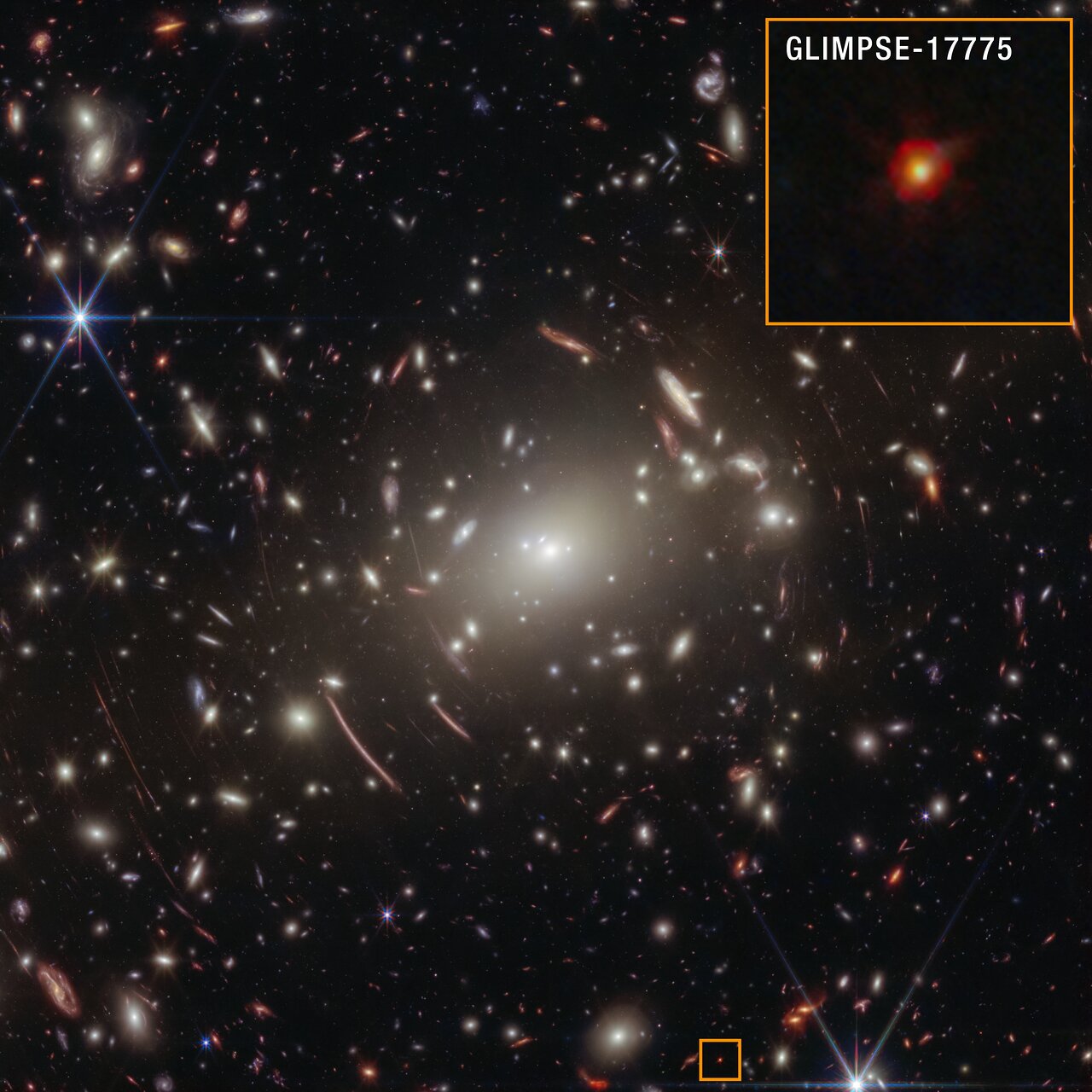
Soon after the James Webb Space Telescope began deep surveys of the early universe, astronomers noticed a population of tiny, compact and very red sources. They became known informally as “little red dots,” or LRDs. Their colors and spectra suggest powerful activity in small regions, but their exact nature has been difficult to fit into familiar categories of galaxies and active black holes.
In July 2026, a team using Webb and Hubble proposed a possible evolutionary clue based on a lower-redshift spiral galaxy nicknamed the Saguaro, formally WISEA J123635.56+621424.2. Its nucleus resembles a prototypical little red dot, while its surrounding host galaxy is clearly visible because the system is closer than the earliest LRDs.
The result does not mean every little red dot is simply a Saguaro-like galaxy seen farther away. Instead, it demonstrates how observational bias can hide extended host-galaxy structure at high redshift, leaving only a compact red nucleus visible.
What are little red dots?
Little red dots are compact sources found in Webb deep fields, especially at high redshift. “Red” refers to their observed colors and spectral energy distribution, while “little” reflects how unresolved or compact they appear even with Webb’s sharp imaging.
One leading idea is that many LRDs contain actively feeding supermassive black holes. Gas falling toward a black hole can release enormous energy from a region much smaller than a galaxy. However, LRDs do not always look like familiar nearby active galactic nuclei, and many are weak or undetected in X-rays.
Their apparent abundance early in cosmic history, followed by a rapid decline at lower redshift, has raised another question: do these objects disappear, transform, or simply become easier to recognize as ordinary galaxies once their host structures are detectable?
Why the Saguaro galaxy is useful
The Saguaro sits at a lower redshift than most classic LRDs, so Webb and Hubble can resolve a surrounding spiral host galaxy in addition to its bright compact nucleus. That combination makes it a bridge between a dot-like high-redshift object and a more familiar galaxy with visible structure.
The research team separated light from the nucleus and host and compared ultraviolet, visible and infrared behavior. The nucleus is relatively bright in ultraviolet and infrared light compared with visible wavelengths, matching a key property of distant little red dots.
Weak X-ray emission detected by Chandra provides additional evidence that the nucleus hosts an active galactic nucleus. The source appears heavily obscured and X-ray weak, which may help explain why many distant LRDs do not show the strong X-ray signatures expected from conventional quasars.
How distance can hide a galaxy around a bright nucleus
Looking farther into the universe does more than make an object smaller. Surface brightness dims strongly with redshift, and the wavelengths astronomers observe are shifted. Extended, low-surface-brightness spiral arms can become difficult to detect even when a compact central source remains visible.
The team tested this effect by asking how the Saguaro would look if placed at a much higher redshift. The surrounding galaxy fades dramatically while the compact nucleus remains detectable. That experiment illustrates a selection effect: some objects classified as isolated-looking red dots may sit inside host galaxies that current observations cannot easily recover.
This matters because classifications affect physical interpretation. If astronomers assume the visible dot contains nearly all the system’s stellar mass, they may infer very different galaxy growth histories than if substantial faint host light is hidden.
What the result suggests about black-hole growth
If at least some LRDs are phases of obscured active black holes inside developing galaxies, they could trace a period when black holes and their hosts grow together. Dust and gas around the nucleus would both feed the black hole and reshape the light we observe.
A central challenge in early-universe astronomy is explaining how massive black holes appeared so quickly. Little red dots may provide a window into that growth, but determining black-hole masses from broad spectral lines is difficult when geometry, obscuration and radiation pressure are uncertain.
The Saguaro does not solve that problem by itself. It gives researchers a lower-redshift object where the host can be studied more directly, providing a test case for methods that are otherwise applied to much more distant sources.
Why one explanation may not fit every LRD
Astronomical populations often contain multiple physical classes that look similar in limited data. Some LRDs may be dominated by active nuclei, some may contain compact starbursts, and some may combine both. Dust can further change their colors and apparent sizes.
That is why spectroscopy is essential. Emission-line widths, line ratios, continuum shape and X-ray or radio measurements can distinguish between different energy sources. Webb’s ability to obtain infrared spectra for extremely faint objects is central to this work.
Future samples will also reveal whether Saguaro-like systems are common enough to explain the observed number of LRDs across cosmic time or whether they represent only one branch of a broader family.
What to watch next
Researchers will search for more lower-redshift galaxies with LRD-like nuclei and compare their host shapes, stellar masses, dust content and black-hole activity. Larger samples can test whether the apparent disappearance of little red dots at later epochs is partly a classification effect.
Deeper Webb imaging may recover faint host galaxies around some high-redshift LRDs directly. Chandra and future X-ray observations can test how often the nuclei are genuinely X-ray weak versus simply heavily obscured.
The most important lesson is methodological: what looks like a new type of object can sometimes be a familiar system viewed through the severe observational filters imposed by cosmic distance.
FAQ
Are little red dots stars?
No. They are distant compact extragalactic sources seen in Webb surveys, often associated with galaxies and possible active black holes.
Does the Saguaro prove all LRDs are active galactic nuclei?
No. The study proposes one pathway and one useful analogue. The LRD population may be diverse.
Are the images on this page observations?
Yes. The page uses real Webb observational images and observational montages; the NASA simulated-redshift graphic is deliberately not used as an article image here.